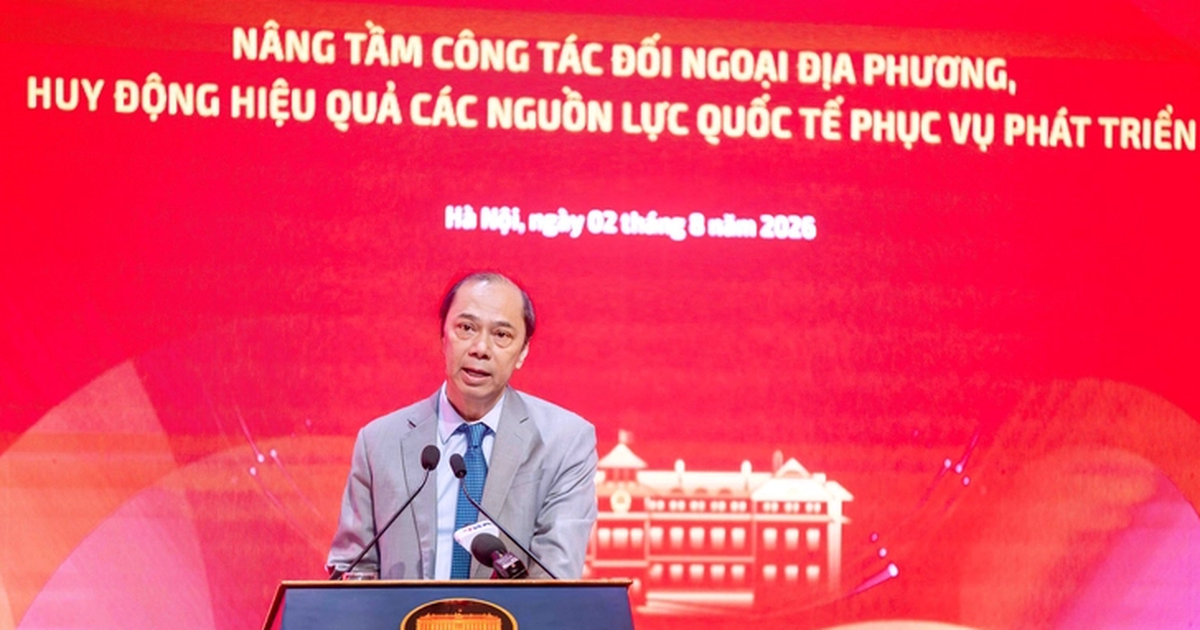
Vietnamese Ambassador to the U.S. Nguyen Quoc Dung delivers a presentation on realizing the Vietnam-U.S. comprehensive strategic partnership and recommendations for Vietnamese localities to attract high-quality FDI at the 22nd National Conference on External Affairs in Hanoi, August 2, 2026. Photo: Danh Khang / Tuoi Tre
He offered the recommendations at the 22nd National Conference on External Affairs in Hanoi on Sunday.
The Vietnam-U.S. relationship is at its most promising stage since the two countries established diplomatic ties in 1995, with the elevation of bilateral ties to a comprehensive strategic partnership in 2023 opening up new opportunities for economic, investment, and technological cooperation, the ambassador said.
However, the partnership will only deliver tangible results if it translates into investment projects, new supply chains, and innovation centers in Vietnamese localities.
Vietnam remains an important partner of the United States in the Indo-Pacific region, despite adjustments to U.S. trade policies aimed at protecting domestic manufacturing, he said.
“For U.S. businesses, Vietnam is no longer simply a destination offering competitive costs,” he said, noting that an increasing number of U.S. companies are seeking to establish manufacturing facilities, R&D, design and data centers, as well as high-tech supply chains, in Vietnam.
Such projects can generate high-value-added investment, create quality jobs, and promote technology transfer.
Vietnam’s ongoing reform drive is also creating favorable conditions for attracting a new generation of foreign direct investment, according to the ambassador.
The two-tiered local administration model and efforts to streamline the government apparatus are helping shorten decision-making processes and improve transparency.
At the same time, the country’s growth targets, driven by science and technology, innovation, digital transformation and the private sector, align with the investment priorities of many U.S. businesses.
However, even with these advantages and tax incentives, U.S. investors are looking at a broader range of factors when deciding where to invest, the ambassador cautioned.
They are increasingly focused on workforce quality, policy stability, reliable electricity supplies, logistics, digital infrastructure, the speed of administrative procedures, and the ability of local administrations to support projects throughout their life cycles.
Localities should therefore take a more proactive approach instead of simply waiting for business delegations to visit and conduct surveys.
They also need to target potential investors, identify priority sectors, prepare investment-ready projects, and establish specialized teams to support them, Ambassador Dung said.
A Ho Chi Minh City delegation poses for a photo during a working visit to Marvell, one of the world’s leading semiconductor companies specializing in chip design for data infrastructure, AI and cloud computing, in Santa Clara, California, the U.S., July 17, 2026. Photo: Ho Chi Minh City Department of Foreign Affairs
Priority should be given to sectors where the United States has strengths and Vietnam has significant demand, including digital technology, semiconductors, artificial intelligence, data centers, clean energy, logistics, supporting industries, biomedicine, and high-quality workforce training.
Those places that have prepared land, digital infrastructure, and appropriate investment mechanisms will have an edge in attracting U.S. projects, he said.
They should also identify potential U.S. corporate investors and proactively connect with them through Vietnamese diplomatic missions abroad and American business associations.
The diplomat also urged them to develop portfolios of investment-ready projects detailing locations, land areas, infrastructure, electricity and water supply capacity, logistics, and licensing timelines.
“This is how localities can demonstrate that they do not merely want to attract FDI, but are actually capable of receiving high-quality FDI,” he emphasized.
Local administrations should also establish or strengthen dedicated teams to support strategic investors, he said.
Provinces and cities that can shorten the time needed to prepare cleared land, issue licenses, and provide post-licensing support will be better positioned to attract U.S. capital.
Workforce quality is another decisive factor for U.S. businesses when choosing investment locations.
Vietnamese provinces and cities should therefore link FDI promotion with vocational training, university-business partnerships, and innovation centers, particularly in high-tech fields, the ambassador said.
Meeting international standards should also be viewed as a competitive advantage, as U.S. investors are increasingly concerned about data security, supply chain standards, and traceability.
Vietnamese Party General Secretary and State President To Lam (R) shakes hands with U.S. Ambassador to Vietnam Jennifer Wicks in Hanoi, July 6, 2026. Photo: Vietnam News Agency
Localities that offer a transparent and predictable investment environment and comply with global standards will be better positioned to attract high-quality capital, he said.
The ambassador also urged Vietnamese localities to proactively build ties with U.S. states whose strengths align with their development needs.
Oregon, for example, is strong in green technology and agriculture; Texas in energy; California in innovation, AI and semiconductors; Washington in aerospace, logistics and technology; and Maryland in biotechnology.
“In the competition to attract high-quality FDI, Vietnamese localities need to stay one step ahead by preparing infrastructure, institutions, human resources, and projects,” the ambassador said.
“If we can do that, we will attract not only U.S. capital, but also technology, management expertise, and new value chains, thereby improving the quality of growth at the local and national levels.”