It marked a 28% drop from Thursday and the second sharp sell-off over the past month. The decline came admittedly amid a broader weakness across the cryptocurrency market.
Bitcoin slipped below the $70,000 mark on Thursday evening before continuing its slide on Friday, briefly dropping to $60,000, its lowest level in nearly 18 months.
According to Hoang Anh, an administrator of a Pi Network Facebook group with more than 200,000 members, Pi’s price decline was also driven by a sharp increase in supply after the project unlocked hundreds of millions of tokens in a short period.
Pi’s circulating supply has now reached 8.82 billion tokens, up from just over 8.3 billion last month. “In the near term Pi is unlikely to recover as more tokens enter the market while the project shows limited progress.”
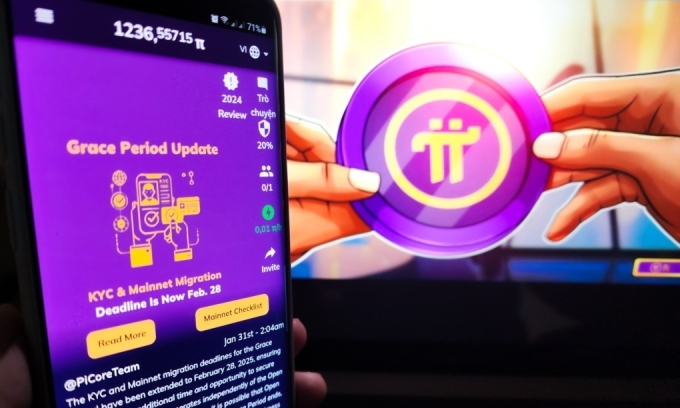
Pi Network’s smartphone app next to Pi Network logo. Photo by VnExpress/Bao Lam
Previously, crypto news site Market Periodical reported that Pi’s decline had been anticipated, as rising supply from the project’s daily release of large token volumes weighed on prices.
Data from cryptocurrency exchange OKX show Pi’s daily trading volume has fallen to just a few million dollars, a small firgue for a token with a market capitalization exceeding $1.4 billion and far below the tens of millions recorded each day last year.
Pi Network has also drawn criticism for its high level of centralization. Unlike networks such as Solana and Ethereum, Pi holders have limited influence over governance decisions.
The Pi Foundation, established last year, reportedly controls billions of tokens across hundreds of wallets, raising concerns about concentration risk. Pi Network has also struggled to build market credibility, as a growing number of early participants have sold off their holdings, adding further downward pressure on prices.
Launched in 2019 Pi Network promoted itself as a way for users to mine the crypto for free by tapping a button in its mobile app daily. Vietnam is among the countries with the most miners. The project has been controversial, taking nearly six years to launch its mainnet before finally allowing users to transfer Pi to exchanges for trading on Feb. 20 2025.
But the project is still viewed as an incomplete blockchain initiative, lacking smart contract functionality and open-source transparency. To date the development team has only introduced limited updates, including a domain name auction feature, the PiFest shopping campaign and a few small-scale applications.