Phuoc Khanh Bridge is due to have its main span joined in mid-July and be completed in September 2026, closing the last gap on the long-delayed Ben Luc-Long Thanh Expressway that will link the Mekong Delta to Dong Nai and the area around the upcoming Long Thanh airport.
On June 16, Phan Van Quan, deputy director of Bac Trung Nam Infrastructure Construction JSC and a representative of the contractor consortium, said the bridge’s main structure was largely complete, with about 200 engineers and workers running three shifts a day to reach the mid-July closure.
The pylons, stay cables and most of the main structure are essentially done. Crews are now building the last girder segments that will tie the main span to the approaches at both ends.
Getting to this point took more than a decade.
The bridge, originally tendered as package J3, broke ground in 2015 under a consortium led by Japan’s Sumitomo Mitsui Construction with Vietnam’s Cienco 4. Work ground to a halt amid funding and procedural problems, the builders stopped on site, and the contract was formally terminated in 2022 with the bridge about 80% built.
An international tender to finish the rest then drew no Japanese bidders at all.
The remaining work, repackaged as J3-1 and worth about VND600 billion (US$23 million), eventually went to a new consortium of Bac Trung Nam Infrastructure Construction and Freyssinet Vietnam, which restarted construction in 2025 on a 450-day contract. The bridge’s total cost is around VND3.5 trillion ($133 million).
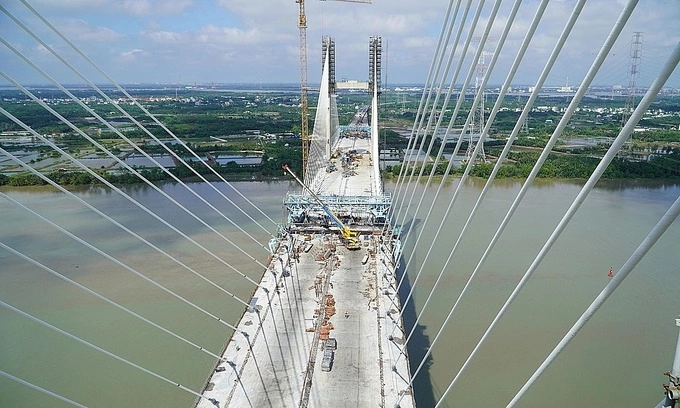
Workers build the remaining sections of the main span girder of Phuoc Khanh Bridge ahead of the closure, June 16, 2026. Photo by VnExpress/Giang Anh
The engineering is built around one demanding constraint: ships.
Phuoc Khanh crosses the Long Tau River, the main deep-water shipping channel to Ho Chi Minh City’s ports, so it has to clear ocean-going cargo vessels passing underneath.
Its deck sits 55 meters above the water, roughly the height of an 18-story building and among the highest navigational clearances of any bridge in Vietnam, matched only by the nearby Binh Khanh Bridge on the same expressway.
The bridge runs about 3.2 km, carries four lanes on a deck nearly 22 meters wide, and hangs its 300-meter main span from two 155-meter towers.
It is the final piece of a 58-km expressway that has been stranded without it. Binh Khanh, the route’s other big cable-stayed bridge, was inaugurated in December 2025 but cannot be put into full service until Phuoc Khanh is done.
Once the whole road opens, vehicles from the Mekong Delta will be able to drive straight to Dong Nai instead of threading through central Ho Chi Minh City. That would ease the load on National Highway 1, Nguyen Van Linh Boulevard and the Phu My Bridge, and shorten the freight route toward the city’s eastern industrial zones and the airport going up at Long Thanh.
The Ben Luc-Long Thanh Expressway broke ground in 2014 with an initial budget of more than VND31.3 trillion ($1.19 billion), later trimmed to more than VND29.5 trillion.
Designed for four lanes plus two emergency lanes and a top speed of 100 kph, it has been held up for years by investment-policy hurdles and funding shortages.
About 55 km of the route is now built, of which nearly 30 km is already carrying traffic at the western and Dong Nai ends. The expressway runs through Tay Ninh Province, which absorbed the former Long An in the 2025 administrative merger, Ho Chi Minh City and Dong Nai.