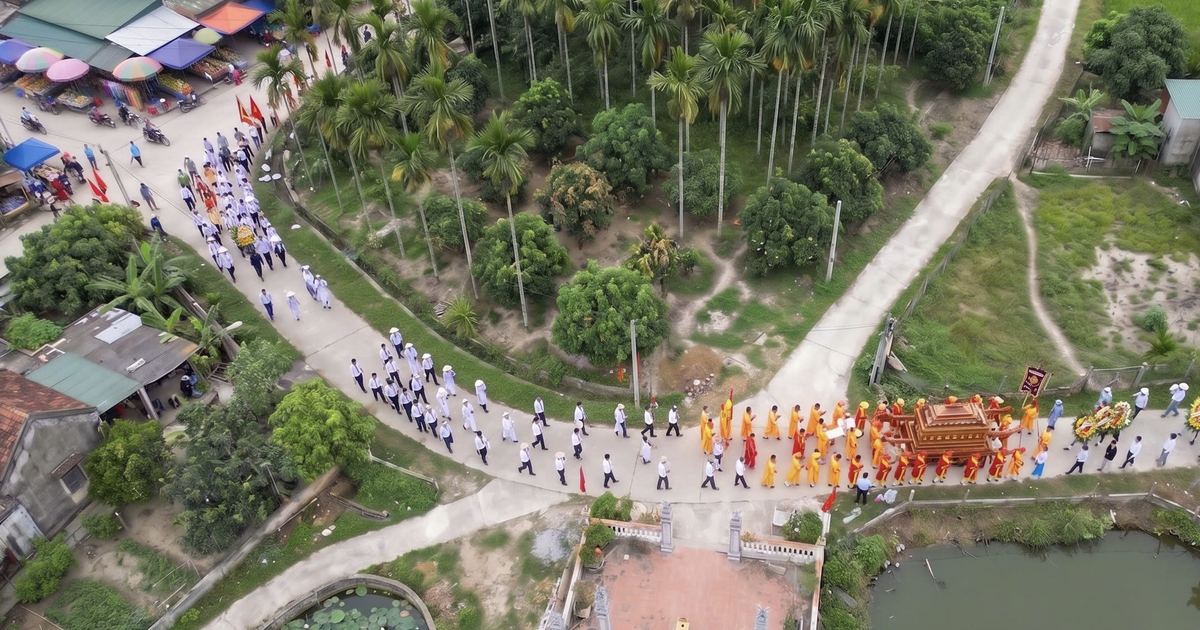
Hue City in central Vietnam has ruled that funerals cannot run longer than 72 hours from the time of death to burial. Photo: Tuoi Tre
The rule is meant to push the city toward a more modern, civilized way of life.
But in a place where funeral rites are deeply tied to spiritual belief and social duty, will three days be enough?
The new rule
The regulation, part of a broader push for civilized funeral practices in Hue, states that funerals cannot run longer than 72 hours from the moment of death to burial.
Exceptions to the cap will be handled case by case, subject to approval from the chairperson of the relevant commune or ward, and families remain responsible for registering the death in accordance with the law.
That is a significant shift from before, when funerals in the city commonly stretched to seven days, sometimes longer.
Alongside the time limit, the city is banning the scattering of currency, votive paper money, or other offerings along funeral procession routes, cracking down on loud sound systems that disturb the surrounding community, and prohibiting superstitious rituals during funerals.
Processions must comply with traffic and environmental rules, and funerals overall are expected to stay simple and manageable for families and communities alike.
The city is also encouraging reusable memorial wreaths, less alcohol and tobacco, no lavish feasting, and a shift toward cremation and other modern burial methods, an incentive made easier by free cremation services for residents through 2030.
City officials say they consulted widely with residents and organizations before issuing the rule, and found broad support.
For now, compliance is being led by example: officials, Party members, and public employees are expected to follow the rule first, with ward and commune authorities handling monitoring and enforcement.
But turning that rule into everyday practice is another matter.
Why is Hue still hesitant?
In an interview with Tuoi Tre (Youth) online newspaper, Dr. Le Vu Truong Giang, a history lecturer at Hue University’s College of Sciences, called the new limit a “quiet and gradual shift.”
Funerals in Hue just work differently, he says.
Elsewhere in Vietnam, families typically wrap things up within 24-48 hours. In Hue, rich or poor, the tendency has always been to draw the farewell out longer.
Rush a loved one to the cemetery too quickly, and locals may read it as careless, even disrespectful to the parents being mourned.
The habit did not come from nowhere, Giang says. Its roots lie in layers of history stacked on top of one another.
This traces first to the deep influence of Confucianism, Buddhism, Taoism, and folk beliefs, which shape funerals through meticulous rites, astrology, feng shui, and consultation with elders and ritual masters.
Hue was once the seat of Vietnam’s last dynasty, and the practice of keeping a coffin in state for days on end trickled down from palace custom into everyday life, eventually becoming an unspoken mark of honor, something people upheld so as not to be seen as skimping on their own.
And there is what Dr. Giang calls mutual funeral support culture. A death in Hue was never just one family’s private affair, it became something the whole extended clan and neighborhood took part in.
The long timeline gave that support system room to work: neighbors showing up, condolence money changing hands, everyone pitching in.
In practice, it doubled as an informal safety net, helping grieving families cover funeral costs and even tomb-building.
“There is a real duality here,” he said. “This custom keeps cultural heritage alive, it honors filial piety, it binds communities together, but it also takes a serious toll on people’s finances and their health.”
Giang is clear that he backs the 72-hour cap. But he also warns that without proper groundwork, real surveys, real enforcement, the rule risks staying on paper.
There is still a real gap between how modern administrators think and how deep the old habits of the former imperial capital run.
Dr. Le Vu Truong Giang. Photo: P.T.
Tackling it at the root
Dr. Giang laid out three ways to work through the problem from the ground up.
First: shift the mindset. Filial piety and dignity, he argues, were never really about how many days a coffin stays in the house, they are about sincerity and doing the rites properly.
Second: give feng shui masters more room to adapt. These are the people who decide the lucky hours, good days for a funeral, and right now that is often what stretches things out. If they can offer ways to work around unfavorable timing within the 72-hour window instead of just pushing the date back, a lot of the pressure disappears.
Third: keep the essential rites, but tighten them up, run the ceremonies closer together instead of spread them out, so nothing feels rushed but nothing drags on either.
Zooming out, Dr. Giang also points to the timing of all this. Hue only became a centrally-governed city in 2025, and that status comes with an expectation of a more modern, rational way of urban living.
He sees the 72-hour rule as a nudge in that direction, pushing Hue toward the leaner funeral customs already common elsewhere in Vietnam, and along the way, loosening two things that have long held the city back: its dependence on spiritually ‘correct’ timing, and the financial pressure baked into condolence-giving.
For the shift to land well, he suggests officials lean on three guiding ideas: balance the needs of the living with respect for the dead; keep the heart of the ritual intact even as its form adapts to the times; and start the conversation where it actually matters, with clan elders and the ritual-timing masters themselves at the community level.
“Hue does not lose its identity just because its funerals take less time,” Dr. Giang concluded. “Not if people here can hold onto what matters in the ritual itself, and find the balance between tradition and the way we live now.”