A total of 585 institutions responded between May 5 and June 11. Together they host roughly half of all international students in the U.S., ICEF Monitor reported.
While 14% recorded an increase, about a fifth said volumes held flat, according to the survey released July 9.
Among respondents, 43% described the drop in graduate applications as substantial, against 31% for undergraduate applications, Inside Higher Ed reported.
Only 39% of institutions reported stable or increased applications from India, the most pronounced decrease among the 21 leading places of origin surveyed.
Indian students made up nearly a third of all international students in the U.S. in 2024-25.
China was the only one of the top 15 source markets to improve. The share of universities reporting stable or rising Chinese applications climbed from 58% a year earlier to 65% this spring, The PIE News reported.
Vietnam became the fifth-largest source of international students in the U.S. in 2024-25, up from sixth, on a 26% increase and its highest total on record, ICEF Monitor reported from IIE’s Open Doors data.
IIE’s Fall 2025 Snapshot found Vietnam was the most targeted market for U.S. undergraduate recruitment, named by 55% of institutions, ahead of India.
Looking ahead, 63% of institutions expect international enrollment to fall in 2026-27. Roughly one in four anticipates a substantial decline.
Among those expecting a drop, 92% cited visa application barriers, 80% pointed to U.S. travel restrictions and 77% said students were choosing other destinations.
“Students are not rejecting the U.S.; they are pricing in its volatility,” Sanjay Laul, founder of the recruitment platform MSM Unify, told The PIE News, adding that the math increasingly favors other destinations.
An Indian family committing 5 million to 6 million rupees, up to about $70,000 and often loan-financed, cannot rationalize a coin-flip visa outcome, he said.
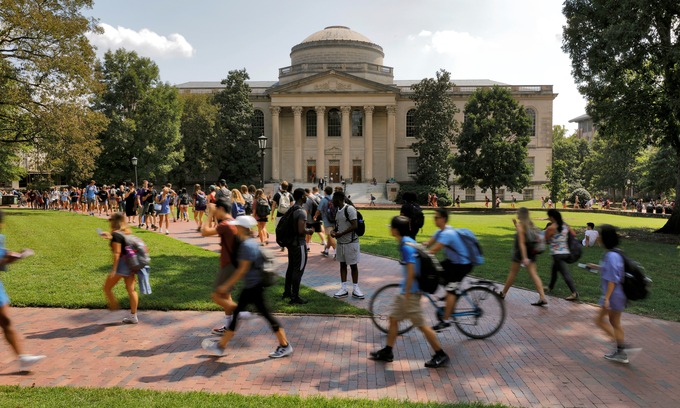
Students walk past Wilson Library on the campus of the University of North Carolina at Chapel Hill, North Carolina, U.S., Sept. 20, 2018. Photo by Reuters
The global F-1 refusal rate reached 35% in 2025, up from 31% in 2024 and 23% in 2015, Newsweek reported. That is the highest in the decade examined by the international education company Shorelight.
Shorelight built the analysis on U.S. State Department data obtained through a public records request.
African applicants were refused at 64%, against 43% in 2015. Rates reached 91% in Somalia and 90% in Sierra Leone.
India’s rate rose to 61% from 53%, and Nepal’s to 81%. Bangladesh and Pakistan recorded 73% and 71%, ICEF Monitor reported.
A proclamation signed Dec. 16, 2025 expanded U.S. entry restrictions from 19 countries to 39, according to the Congressional Research Service. The suspension took effect Jan. 1, 2026 and covers F and M student visas.
70% of surveyed institutions said they have stopped recruiting in countries covered by the ban, IIE reported.
U.S. authorities canceled student records in the Student and Exchange Visitor Information System through 2025, paused F-1 visa interviews, expanded social media screening and detained students over their political views, Inside Higher Ed reported.
U.S. colleges hosted 1,177,766 international students in 2024-25, a 5% increase and the highest total since IIE began tracking in 1948.
Optional Practical Training participation rose 21%. Undergraduate enrollment grew 4% and graduate enrollment slipped 3%.
IIE’s Fall 2025 Snapshot of more than 825 institutions recorded total enrollment down 1%, undergraduate up 2% and graduate down 12%.
New enrollment fell 17%, the steepest non-pandemic drop in more than a decade. Non-degree enrollment fell 16%, the National Association of Foreign Student Advisers reported.
NAFSA estimated the fall 2025 decline cost the U.S. more than $1.1 billion in lost revenue and nearly 23,000 jobs.
Every three international students create or support one U.S. job across higher education, accommodation, dining, retail, transportation, telecommunications and health insurance, the association calculates.