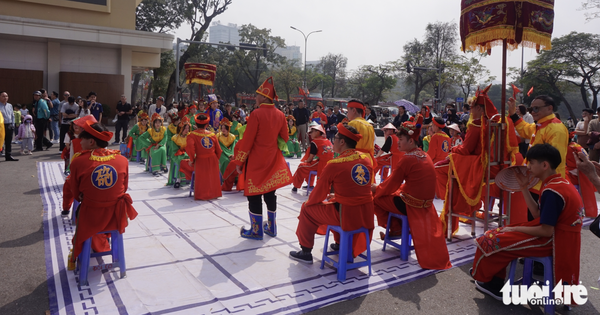
A unique human chessboard at Dong Kinh Nghia Thuc Square in Hanoi draws the attention of visitors during Lunar New Year (Tet) celebrations, February 21, 2026. Photo: Thien Dieu / Tuoi Tre
The event took place on Saturday, the fifth day of the first lunar month of the Year of the Horse, during the eighth day of the nine-day 2026 Tet break.
Titled ‘Human Chinese Chess – The Beauty of Vietnamese Traditional Culture,’ the spectacle unfolded along the shore of Hoan Kiem Lake and was organized by the Hoan Kiem Ward administration.
A giant chessboard was laid out across the square, with each piece portrayed by a live performer in traditional costume.
Their movements mirrored those of two masters competing simultaneously on a standard chessboard nearby, turning every strategic decision into a carefully choreographed visual display.
Two masters compete on a standard Chinese chess board, with every move mirrored simultaneously by performers on the giant human chessboard at Dong Kinh Nghia Thuc Square in Hanoi, February 21, 2026. Photo: Thien Dieu / Tuoi Tre
The match featured two competitors: Luu Duc Hai, deputy chairman of the Vietnam Xiangqi Federation, and Cao Dac Thanh of the Ho Guom Chess Club.
Advances, retreats, attacks, and defenses were expressed through gesture and posture, transforming the contest into a dramatic public spectacle in the heart of Hanoi’s Old Quarter.
Large crowds, including international tourists, gathered around the lake to watch performers portraying mandarins and soldiers from Vietnam’s feudal era move across the oversized board.
After two closely contested games, Hai emerged as the overall winner.
Tran Thi Thuy Lan, director of the ward’s Culture, Information and Sports Center, said the event formed part of Tet celebrations and also looked ahead to the 80th anniversary of Vietnam Sports Day on March 27.
She described human chess as a distinctive folk cultural and sporting tradition that blends strategic thinking, theatrical performance, and martial spirit.
Over generations, it has become closely associated with spring festivals, offering communities both entertainment and opportunities to celebrate intellectual competition and healthy sporting values.
Lan said local authorities hope to make the human Chinese chess tournament an annual cultural highlight starting this year.
Visitors, including foreign tourists, watch the players’ moves replicated in real time on a large human chessboard at Dong Kinh Nghia Thuc Square in Hanoi, February 21, 2026. Photo: T. Dieu / Tuoi Tre
Speaking to Tuoi Tre (Youth) newspaper, Hai said Chinese chess has been played in Vietnam for more than a thousand years and has long been deeply embedded in village cultural life.
He noted that human chess is believed to have emerged in northern Vietnam centuries ago, recreating battlefield formations through performers dressed as feudal-era officials and soldiers.
Hai added that the federation plans to work with the culture ministry and related agencies to seek recognition of human chess as national intangible cultural heritage.
Numerous human chess clubs are now active in communities around the capital, reflecting the tradition’s enduring popularity.
Local and international visitors photograph and film a standard Chinese chess match between two players at Dong Kinh Nghia Thuc Square in Hanoi, February 21, 2026. Photo: T. Dieu / Tuoi Tre
Organizers present awards to the human Chinese chess contest’s champion, Luu Duc Hai (L, 3rd), and runner-up Cao Dac Thanh (L, 4th) during the event’s closing ceremony at Dong Kinh Nghia Thuc Square in Hanoi, February 21, 2026. Photo: T. Dieu / Tuoi Tre
Vinh Tho – T. Dieu / Tuoi Tre News