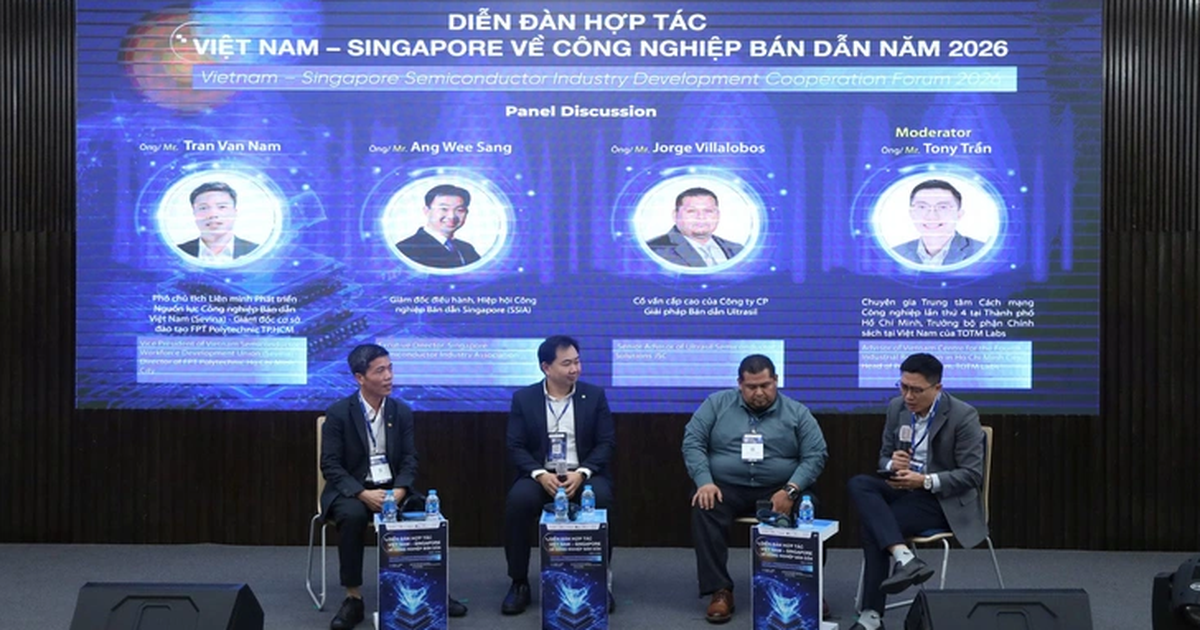
Experts discuss potential cooperation in developing the semiconductor industry between Vietnam and Singapore. Photo: Ngoc Duy
For 2026 alone, the targets are expected to include 3,000 engineers, 300 master’s degree holders, and 40 doctoral degree holders.
To achieve the target, the city is mulling over the establishment of a chip design workforce development fund with an expected size of about $5 million.
The fund is expected to provide scholarships, support postgraduate students, and organize advanced professional training programs.
In addition, experts working at the Saigon Hi-Tech Park and semiconductor start-ups could receive a five-year personal income tax exemption, according to the Department of Science and Technology.
The city is also studying special salary and bonus mechanisms for leading experts.
The city currently leads Vietnam in attracting foreign direct investment in the semiconductor sector, Ly Minh Tuan from the Ho Chi Minh City Department of Science and Technology said at the Vietnam-Singapore Semiconductor Industry Development Cooperation Forum 2026, held on Tuesday at Quang Trung Software City.
The southern metropolis has 54 semiconductor projects with a total registered capital of more than $5.1 billion.
Its semiconductor ecosystem spans multiple stages, from research and chip design to component manufacturing, chip packaging, and testing.
Companies including Marvell, Renesas, and Ampere are active in research and design, while Intel and BESI operate in packaging and testing.
Mtex and Kamet Vietnam are involved in manufacturing components and equipment for the industry.
Ly Minh Tuan, head of the digital economy and digital society division under the Ho Chi Minh City Department of Science and Technology, speaks at the Vietnam-Singapore Semiconductor Industry Development Cooperation Forum 2026, held in Ho Chi Minh City on July 21, 2026. Photo: Ngoc Duy
Several new projects are expanding the city’s semiconductor sector.
U.S. company Ultrasil has launched a semiconductor wafer manufacturing project at Quang Trung Software City.
In the Binh Duong area, Vietnamese semiconductor company CT Semiconductor has begun the second phase of its chip packaging and testing plant, targeting an annual capacity of 100 million chips by 2027.
VNChip, another local semiconductor firm, has put into operation Vietnam’s first Cadence-certified laboratory, while Vietnamese tech firm CMC Group is developing a $250 million data center project at the Saigon Hi-Tech Park.
According to Tuan, Ho Chi Minh City is currently the largest technology training hub in southern Vietnam, with nearly 20 universities capable of providing training in digital technology, information technology, electronics, and telecommunications.
The city is considering providing financial support for training and scholarships from the local budget for students studying fields related to semiconductor technology.
Singapore seeks partners in design, packaging, training
Cao Xuan Thang, Vietnamese trade counselor in Singapore, said many Singaporean companies are seeking capable partners in Vietnam to develop long-term projects.
Areas of interest include chip design, chip packaging and testing, research and development, workforce training, and supply chain development for regional and global markets.
Cao Xuan Thang, Vietnamese trade counselor in Singapore, speaks at the Vietnam-Singapore Semiconductor Industry Development Cooperation Forum 2026. Photo: Ngoc Duy
According to Thang, direct exchanges between businesses from the two countries about their needs and capabilities could pave the way for specific cooperation projects in the future.
At the forum, Quang Trung Software City and the Singapore Semiconductor Industry Association signed a memorandum of understanding to cooperate in business networking, investment promotion, research and development, technology transfer, workforce training, and international cooperation.
The agreement is expected to help Vietnamese companies gain access to Singapore’s partner networks, management expertise, and supply chains.
Singaporean companies will also have a point of contact for exploring the Vietnamese market and connect with management agencies, universities, and research institutes in Ho Chi Minh City.
Tran Huu Dung, director of Quang Trung Software City, said the organization is building an ecosystem for training, hands-on experience, and the development of highly skilled workers, leveraging its proximity to universities, research institutes, and technology training facilities.
Under the plan, businesses can participate in developing training programs, organizing internships, recruiting workers, and providing retraining and upskilling programs.
Quang Trung Software City aims to become a hub connecting international semiconductor companies with Ho Chi Minh City while incorporating businesses’ actual needs into local workforce training and development.