On December 17, 1935, 90 years ago, General Juan Vicente Gómez died in power after 27 years of absolute control over Venezuela. His figure, shrouded in mystery, fascination, and fear, represents the culmination of the authoritarian tradition and the myth of order. So many years later, and once again immersed in an authoritarian situation like the current one, it is worth asking: What remains, and how do our times differ from those of the man that historian Manuel Caballero called the “liberal tyrant”?
Studying the Gómez era is more relevant today than ever. There are points of comparison that help us understand the broader process in which we are currently immersed. After more than half a century of revolts and civil wars, Gómez overthrew his ailing ally Cipriano Castro in 1909, and established a dictatorship that gradually deepened until he concentrated all power in his hands.
His detractors have emphasized the regime’s cruelty, the high number of political prisoners and exiles, and the networks of internal and external repression through which he persecuted and fragmented the opposition. His defenders, on the other hand, stress that during his rule the Venezuelan state consolidated itself as a defined structure. They also highlight the payment of the entire external debt the country had at the moment, freeing Venezuela from numerous international impasses, and maintain that, thanks to the professionalization of the Armed Forces, the construction of highways, and the development of aviation, the country gained cohesion and sovereignty for the first time.
In present-day Venezuela, repression, censorship, political prisoners, and exile have once again become commonplace. And if 50 years ago the country projected itself onto the intoxicating promise of development and a burgeoning Latin American power, the economic contraction, a product of decisions made throughout this 21st century, has led us to a country without aspirations and diminished in its material and symbolic expression. Maduro has attempted to “normalize” business in a way that, in certain aspects, recalls the Gómez regime. Business not only remains in the hands of close families and allies, but the possibility has also been opened to sectors of the more traditional bourgeoisie who want a modus vivendi in which adherence is not to the law, but to personal logic and loyalty, even allowing them to prosper if they are apologists for the system. In the meantime, social inequalities deepen and the existence of a middle class becomes an almost prehistoric memory.
Gómez surrounded himself with the positivist intellectuals of his time, granting them positions and the power to draft laws; today, that role has disappeared. Instead, the emphasis has been on recruiting and funding influencers and social media propaganda: a communications facade that, while demonizing the democratic period, is sustained by the promise of a return to the country’s golden age—precisely the years that chavismo has always denied.
Both figures serve as a warning that, when it comes to abuses of power and national subjugation, history does not advance linearly nor does it guarantee an irreversible transition to democracy.
In the oil sector, if Gómez was loyal to his own interests and docile to the dictates of foreign companies, the Venezuelan case under Maduro has been one of a near-total loss of sovereignty. What had been nationalized in 1976 was diluted by corruption and a lack of strategic vision. As never before, the Venezuelan economy has depended on a single foreign company, as is the case today with Chevron.
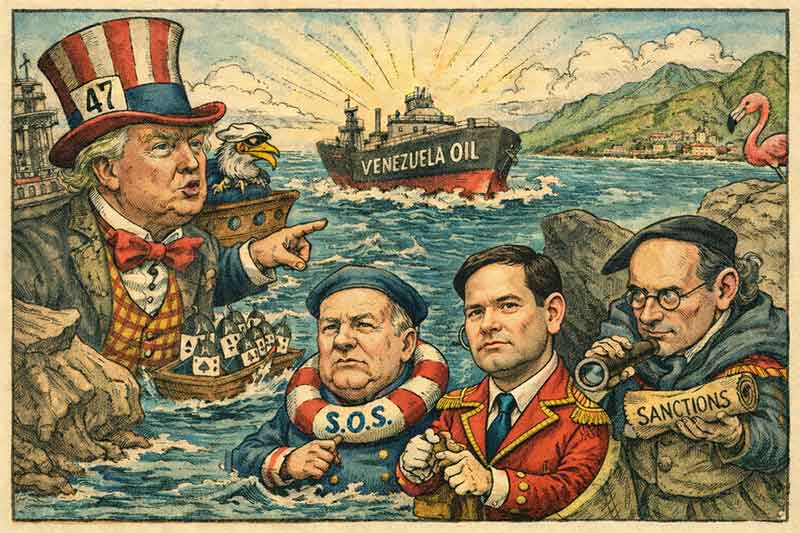
Added to this is the geopolitical context. While Gómez maintained neutrality during World War I, albeit in a clearly subordinate relationship with the United States, under Chávez the country entered fully into the arena of the power struggle, adrift and progressively losing autonomy. Since Gómez, no other ruler has shown such a willingness to curry favor with the US government, to the point of offering full access to national resources. That Maduro has failed to convince Trump of his capacity to surrender everything to remain in power points to other factors, but the offers have been on the table.
Neither Gómez nor Maduro have had genuine national development plans in areas such as education, culture, health, or sports. In this sense, the country seems to have regressed to the period before the February Program, when, after the dictator’s death, Eleazar López Contreras announced a project to reorganize national life. Today, educational, cultural, and healthcare institutions are adrift or have disappeared; and although public-private partnerships are tolerated, there is no overall coordination to link these initiatives around common goals or the construction of a shared future.
Therefore, the comparisons, always odious, go beyond a robust mustache, the fact that both figures were underestimated for a long time while they held power, or that both replaced, through illness, a charismatic leader with a nationalist discourse who had previously paved their way to power. Both figures serve as a warning that, when it comes to abuses of power and national subjugation, history does not advance linearly nor does it guarantee an irreversible transition to democracy.
However, just weeks after the death of Gómez in his Maracay home, the year of 1936 exploded as the one in which the popular masses entered the public debate; the process of organizing modern political parties, unions, and associations began; and the government had to start opening up and proposing real solutions to the country’s social problems. Is a new 1936 looming for Venezuela?