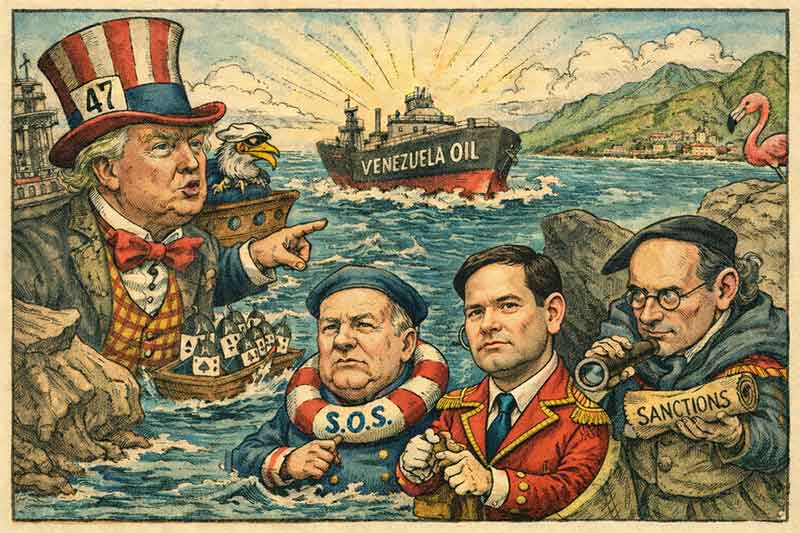
Van Pagee explains that the Netherlands is not just facilitating the US in its agenda against Caracas, but “the Dutch has its own (oil) interests in Venezuela. too.” (oilandgas360)
Last week, Dutch outgoing Prime Minister Dick Schoof visited the Antilles. The old Lago refinery on Aruba will be permanently closed, and the Netherlands will help to dismantle it.[1] On this location, until 1985, the American oil company Exxon refined Venezuelan oil. The Dutch Shell company did the same on Curaçao. Schoof emphasized that the Netherlands is not involved in the current US intimidation of neighboring Venezuela. Dutch media also give the impression that the recent show of force in the Caribbean is an initiative of Trump.[2] This is misleading. The Hague also wants President Nicolás Maduro to be replaced. The Dutch claim of neutrality is a farce. Both now and in the past, the Antilles were an important stepping stone for the Netherlands to Venezuelan oil. At the end of the nineteenth century, when the black gold was first discovered, Shell was one of the first Western oil companies to invest in it. The Dutch government provided the necessary support at all times. Venezuelan leaders who refused to accept unfair oil deals were thwarted and intimidated. In 1908, not very different from Trump’s actions now, The Hague also sent warships to intimidate Venezuela.
In our time, oil does not have a very positive image anymore. Nowadays, the Netherlands wants to look ‘green’ and ‘sustainable’. On his visit to Aruba, Prime Minister Dick Schoof said that the dismantling of the old Lago refinery was an important step towards “a sustainable economy”.[3] Subsequently, on November 9 and 10, he attended the fourth CELAC-EU summit in Colombia where the word ‘sustainability’ was frequently mentioned as well. The participating countries pledged their allegiance to the UN’s ‘2030 Agenda’.[4] One of the zeventeen Sustainable Development Goals (SDGs) reads that the use of fossil fuels needs to be reduced.[5]
How do these noble promises relate to the current aggression against Venezuela, which is about oil?
In fact, Trump’s unlawful attacks on fishing boats were discussed during the summit. Colombian President Gustavo Petro had previously expressed the hope that the meeting would produce a joint statement that would condemn the US actions in the Caribbean. Unfortunately, the final statement only included some vague remarks about the right to self-defense within the margins of international law. It did not explicitly mention the unlawful acts carried out by the Trump administration. Not surprisingly, important parts of the declaration were not signed by Venezuela and Nicaragua.[6]
‘Good cop’ and ‘bad cop’ both want oil
Although EU countries, including the Netherlands, are generally more diplomatic than Washington under Trump, the EU is equally responsible for both the economic sanctions against Venezuela as well as the demonization of Maduro’s government. It seems that the EU is playing ‘good cop’, maintaining contacts in the region, while the Trump administration plays ‘bad cop’, threatening with open war.
How noble the UN’s sustainable development goals may sound, if the US war fleet in the Caribbean demonstrates anything, it is the importance of Venezuelan oil to imperialist interests. The US war fleet now includes: 8 destroyers, 2 missile cruisers, 1 amphibious transport ship, a coastal combat ship, a nuclear submarine, B-1 bombers, several fighter jets, helicopters and drones, and the largest US aircraft carrier the USS Gerald R. Ford.[7]
Regional Support
At the end of October, one of the first ships arrived at the port of Trinidad, about ten kilometers off the northeast coast of Venezuela[8], for a so-called ‘military training’.[9] Regional support centers like Trinidad are essential for the success of imperialist wars and regime changes.[10] The American colony of Puerto Rico[11] is another strategic port where US warships can always rely on.[12]
US and Dutch bases in the Antilles
Less known is that the US has military bases at the airports of the Antillean islands of Curaçao and Aruba as well, just dozens of kilometers from the Venezuelan coast. On April 12, 1999, the Dutch government signed an agreement with the US for the establishment of what they called a ‘Forward Operating Location’ (FOL).[13] Officially, it was presented as a counter-drug operation, yet in 2019, the location was used for an infiltration attempt when the North Americans attempted to invade Venezuela under the guise of providing ‘humanitarian aid’.[14] In the Antilles, the US Southern Command works closely with NATO partner the Netherlands. The latter has a permanent force of thousand defense personnel stationed on the islands.[15] Last spring, together with their North American counterparts, the Royal Dutch Navy conducted an operation near the Venezuelan port of Puerto Cabello.[16]
The Antillean people bear the risks
Of course, the population of the Antilles was never asked about the desirability of Dutch and American military bases on their territory, while they bear the risks of the provocative actions that the imperialist countries together undertake. Even though Curaçao formally has an independent status within the Kingdom of the Netherlands since 2010, in effect it is still a Dutch colony.[17] The Hague decides on all foreign policy or defense matters.[18] Because of their direct link to the Netherlands, the Caribbean islands are also associated with the European Union and the EU-sanctions.[19]
Last August, when the US announced that their warships were planning to refuel in Willemstad, the population reacted with concern. In the Dutch parliament, the D66 party submitted parliamentary questions about the matter.[20] But then-Minister of Defense Ruben Brekelmans (VVD) emphasized that the American deployment was nationally driven and that the Netherlands had nothing to do with it. As if insignificant, he added that the Dutch Defence and Foreign Affairs Ministries were in close contact with the US.[21]
The fact that the brand new Dutch supply ship HNLMS Den Helder arrived in Willemstad on October 20, was also totally disconnected from the situation in Venezuela, according to Dutch Captain Stefjan Veenstra.[22] But was it really a complete coincidence that a large Dutch naval vessel docked in the Caribbean for ‘warm water exercises’ just as Trump was increasing the pressure on Venezuela?[23] After all, also a ‘military exercise’ is not neutral in a context of war. It is unlikely that the Dutch would not assist their American friends if they needed help. Captain Veenstra: “The HNLMS Den Helder has arrived at the right time. The [Dutch] navy has gained a warship.”[24]
Curaçaoan Prime Minister Gilmar Pisas expressed the hope that the treaty between the Netherlands and the US will be extended next year. According to him, there had been intensive discussions about the risks: “That is why an additional Dutch military ship has arrived here. There are no tensions with us as a country, but we could become involved.”[25] He emphasized that the logistical visit of American warships to Willemstad was “no reason to panic.”[26]
Yet, the Dutch intelligence service AIVD thinks otherwise. In a 2024 report, they warn that the situation in Venezuela could potentially have major consequences for “the economy, politics, and security of Aruba, Curaçao, and Bonaire.” Of course, the authors do not see any link with the provocative actions of Western countries themselves. The Antillean population are only at risk because Venezuela is building up its armed forces with the help of Russia, Iran, and China.[27] Not surprisingly, the AIVD fails to mention that Venezuela is forced to build up its defenses because of Western intimidation.
On their part, Caracas equally distrusts the Dutch-European presence in the Antilles. In January 2018, the Maduro government imposed a trade embargo on the Antilles, after which food prices skyrocketed. Naturally, the relationship between the Caribbean islands and the Venezuelan mainland would be much better without Dutch colonialism and threats. After 2015, when the US and the EU increased their pressure on Venezuela, the Venezuelan-Antillean trade has only deteriorated.[28] In a way, the Antillean islanders, like the Venezuelans, are victims of the US and European sanctions too.
Dutch neutrality claim is a farce
Given the close historical ties with the US, the Dutch claim of neutrality is not very convincing, even if The Hague currently does not play an active role in the escalation right now. In the war of aggression against Venezuela, Dutch politicians and media follow the line set by Washington and Brussels, which continuously accuses Venezuelan President Nicolás Maduro of undemocratic and authoritarian actions, human rights violations, and recently even of involvement in illegal drug trafficking. Last August, the Dutch embassy in Caracas provided shelter to pro-Western opposition leader Edmundo González who claimed that he, instead of Maduro, had won the election.[29] According to the human rights report of 2023, Venezuela is also one of the twenty countries that the Dutch government labeled a priority.[30]
In fact, The Netherlands is not just facilitating the US. The Dutch has its own (oil) interests in Venezuela too. History shows how central the Antilles are to the close collaboration between the two imperialist powers in the colonial exploitation of Venezuelan resources. For over a century and a half, the Dutch occupation of the islands caused reoccurring troubles in the bilateral relation with Venezuela.
The Antilles: A Stepping Stone to Venezuela
A 1971 article, published in the magazine of the Communist Party of the Netherlands (CPN) refers to the Netherlands Antilles as a “stepping stone to South America.”[31] In practice, the islands were primarily a stepping stone to Venezuela, which had attracted European attention long before the discovery of the black gold.
The Spanish colonization of Venezuela began in 1522 and lasted until 1811. After independence, under the leadership of Simón Bolívar (the present-day Venezuelan Republic is named after him) the country became part of Gran Colombia. This new nation, which united Venezuela, Colombia, Ecuador, and Peru, collapsed in 1830 with Bolívar’s death.
Subsequentely, the Venezuelan cocoa and coffee industries, which had been established by the Spanish before, were further intensified and expanded. This was done by Dutch, British, German, and Italian entrepreneurs and the large profits flowed primarily to Europe. Money creates money and the capital generated was obviously not intended to develop Venezuela.
The Dutch financed the exploitation of Latin-America
Uruguayan Eduardo Galeano writes in his book The Open Veins of Latin-America (1971) that Venezuela remained an agricultural country “condemned to the cyclical rise and fall of coffee and cacao prices; the two products created the capital that enabled landlords, merchants, and moneylenders to live as wasteful parasites.”[32] The profits also created a local oligarchy in Caracas, who served as intermediaries and accomplices of the Western imperialists.
Interestingly, in Galeano’s book, the Dutch appear not only as (slave) traders or colonists, but especially as bankers and moneylenders who controlled no less than one third of the Spanish trade at the end of the seventeenth century.[33] Besides the physical occupation of land (colonization) and the appropriation of bodies for unpaid labor (slave trade), the true goal of Western imperialists was to control the vast flows of money. Raw materials, whether petroleum, coffee, or cocoa, were the means by which this end could be achieved.
Even though the financial center shifted from Amsterdam to London and New York respectively, this did not mean the end for the Netherlands as an important player on the capitalist market.
Historically Bad Relations with Venezuela
The relationship between independent Venezuela and the colonial Dutch in the Antilles was never smooth. One moment there was a disagreement over import duties, the next, frustrations arose after Willemstad granted asylum to a Venezuelan opposition leader who was planning a coup. There were also recurring conflicts over islands over which both countries claimed jurisdiction. But everything changed when oil was discovered in Venezuela.
The enormous oil reserves, which are now being protected by Maduro’s socialist government against the bargain prices that the imperialists demand, are therefore a major reason why the Netherlands will not leave the Caribbean islands. Although the Dutch government publicly claims neutrality regarding Trump’s military actions, The Hague would love to see Maduro replaced too. If the “Eldorado” of Venezuelan oil could flow back to the Netherlands via the Antilles, this would be very beneficial for Dutch businesses as well. At least, this is what Shell did between 1918 and 1985, until Venezuelan leaders began demanding higher oil prices, something Shell’s top brass found unacceptable, prompting them to quit and leave the island.
Debts are not meant to be repaid
Venezuelan oil reserves, now known to be among the largest in the world, were discovered in the late nineteenth century. Sometimes, the local oligarchy in Caracas was willing to accommodate the imperialists, sometimes not. Venezuelan General Cipriano Castro – who came to power in a coup in 1899 – proved to be someone unwilling to do the bidding of the West. Like the current Venezuelan government, he was inspired by Simón Bolívar’s struggle for independence. After Castro took office, soon disagreements arose over Venezuela’s government debts to the Netherlands, Britain, Germany, and Italy. In 1902, a number of British, German, and Italian gunboats blockaded Venezuelan ports. This form of military intimidation was intended to force Castro to resign, in the hope that his successor would accept the debts. [34]
Like in our time, politicians in The Hague initially claimed neutrality, even though they were heavily involved and wanted Castro to pay back as well. On December 16, 1902, the governor of Curaçao received the instruction that, should war break out, he had to issue a statement of neutrality. Dutch historian Hans van der Jagt, in his book Engelen uit Europa (Angels from Europe, 2022), concludes that remaining neutral proved very difficult with “German, British, and Italian warships around and in the Curaçaoan port of Schottegat.”[35]
This time, the US played the role of ‘good cop’ and took a more diplomatic approach as mediator. Naturally, this was not because they wanted peace. The goal was to force Caracas to resume debt repayments at all costs.[36] Endless negotiations resulted in the Washington Agreement. On May 7, 1903, the Netherlands and Venezuela also agreed on a payment arrangement.[37] It was decided that the countries would join the Court of Arbitration in The Hague, the predecessor of the international court that settles disputes between states.
In his book The Debt System (2019), Belgian author Eric Toussaint explains that the creation of foreign debt was a way to subjugate the Spanish-colonized countries in Latin America all over again. Freedom fighter Bolívar already understood why Britan was willing to finance the independence struggles against Spain. In a sense, the debts were not even expected to be repaid entirely. The unfair conditions created a relationship of dependency that, above all, had to continue indefinitely.[38] Extremely high debt levels make a country tied to their creditors forever. As a consequence, a country has no leverage when the imperialists demand unrestricted access to valuable raw materials.[39] It seems that Castro understood this mechanism very well.
Castro a bone in the imperialists’ wheel
Dutch colonizers in the Caribbean were also very much annoyed by Venezuela’s 30 percent import tariff, which was levied on all European and American products imported through the Dutch Antilles. The Venezuelan coast guard regularly checked on Dutch ships in an attempt to control the smuggling trade. This was unacceptable according to the Dutch, and in some cases they went so far as to fire at the Venezuelan coast guard.[40]
Historically, 2024 was not the first time that the Netherlands gave shelter to a Venezuelan opposition leader. In 1902, rebel general Manuel Antonio Matos was also granted political asylum in Curaçao after losing a battle against Castro, after which he fled the country. This decision further increased bilateral tensions.[41]
Dutch and other European businesses who continued to do business with Caracas were considered suspicious and threatened with sanctions. In 1904, a Dutch diplomat bluffed that if Venezuela would continue its border controls at sea, the Netherlands would seize Venezuelan coast guard ships. At the end of that year, the cabinet meeting in The Hague discussed the possibility of sending warships. However, as the Russo-Japanese War reached its peak in 1905, there were no ships available to put their words into action.[42]
The conflict dragged on and finally reached a conclusion in December 1908. Three Dutch warships left for the Caribbean. Once again, the US played ‘the good cop’, and advised the Netherlands against military intervention. Eventually no shot was fired: just before Christmas, Castro fell ill and left for Europe for treatment.[43] The imperialist countries were relieved.
1914: Shell Claims Venezuelan Oil
The bilateral relationship improved under Castro’s successor, Juan Vicente Gómez, who granted several oil concessions in the following years. Around 1913, the Caribbean Petroleum Company commissioned a team of geographers to investigate the quality of the oil. The results were so promising that Shell paid $1 million for a majority stake in the company.[44] In his book De Aprilmoorden (The April Murders, 2012), Surinamese author Nizaar Makdoembaks writes about the reason why Curaçao was chosen as the location for the oil refinery:
The connection between Lake Maracaibo and the open sea made it obvious to transport the oil by tanker, yet the depth of the water was insufficient for large vessels. This is why they had to use the smallest ships possible. However, with such small ships, sailing across the ocean was both economically and nautically irresponsible. Consequently, they began searching for locations where the oil from these small ships could be transferred to larger tankers. Curaçao, located 216 nautical miles from Maracaibo, was their destination. Its natural, deep, and developed port made it a perfect location for transshipment.[45]
Besides practical reasons, there was also a political reason why the Dutch oil company did not establish itself in the country where the oil had been discovered. After all, Curaçao was considered ‘property’ of the Netherlands and the Dutch did not plan to leave there for a long time to come. The political climate in independent Venezuela was too unpredictable for costly investments. There was always the possibility that another independent leader would stand up, who, like Castro, would defend Venezuelan self-interests. This is why Shell built the Isla oil refinery in Willemstad between 1914 and 1918, just a few dozen kilometers from the Venezuelan mainland.
The Hague enthusiastically offered the Shell Group several tax advantages. Whenever a new regulation led to a more serious tax assessment, the oilmen, through their political connections, managed to secure exemptions. The money shuffling through subsidiaries began here and would later result in Curaçao becoming a tax haven.[46]
Shell refuses Venezuela more profit and leaves
The highly polluting Isla refinery still gives Willemstad quite an industrial look. In the early years, Shell also processed Mexican oil, but from 1938, after Mexico nationalized its oil industry, Isla only processed Venezuelan oil. Business was booming. By 1929, the refinery was employing more than ten thousand people.[47]
Meanwhile, Venezuelans saw how their oil was made into a very profitable product, only 70 kilometers away. It was the same old model: the impoverished colony could supply raw materials at rock-bottom prices, and the colonizers changed it into gold. After Castro’s successor, Goméz, died in 1935, Venezuelans began lobbying for a refinery on their own soil. In 1943, a new law was passed prohibiting the Isla refinery from processing oil from new concessions. Belgian author Michel Collon writes in his book De 7 zonden van Chavez (The Seven Sins of Chavez, 2013):
In 1943, the Venezuelan government of Isaias Medina proposed a progressive ‘Petroleum Control Law.’ He subsequently implemented land reform to save small farmers. He was immediately deposed. The US would not tolerate such reforms. For the same reasons, President Gallegos was also deposed in 1948. The same was true for General Perez Jimenez in 1958, when he too began to show signs of independence.[48]
According to Collon, the Venezuelans did actually attempt to pursue a policy that served their own interests rather than foreign interests: “But the US refused to accept it and forced them to remain dependent on their market, to the benefit of the large American corporations.”
Nevertheless, the new law was adopted. Shell was forced to invest in a new refinery in Venezuela itself. But the Dutch multinational was unwilling to do so. The oil from the old concession continued to be processed in Curaçao until the late 1960s. Not long after which Shell left the Caribbean.[49]
In 1976, Venezuela nationalized the oil industry. Oil prices went up. Shell’s attempts to negotiate a lower price failed. This led to Shell selling the Isla-refinery in 1985. The government of Curaçao became the new owner, and from then on, day-to-day operations were managed by the Venezuelan company Petróleos de Venezuela S.A. (PdVSA). To this day, the PdVSA logo can be seen at the oil tanks in Willemstad. [50]
The Hague continues to interfere
Yet, this did not mean the end of Dutch interest in Venezuelan oil. It is unthinkable in the current situation, but in 2013 the Dutch royal couple paid an official state visit to Venezuela, where Maduro had just taken over the presidency from Hugo Chávez. Despite the fact that the refinery had not been owned by a Dutch company since 1985, the NOS stated that the South American country was still very important to the Netherlands as an oil supplier.[51]
The lease contract with the Venezuelan company PdVSA expired in 2019. Due to the American and European (economic) war against Venezuela, it was no surprise that the contract was not renewed. Since then, the production process has been almost completely halted, affecting 3,000 to 4,000 families.[52] Since then, the government in Willemstad has been actively searching for candidates who want to takeover the refinery.[53] The Hague is intensively involved in the takeover issue. A bid by the Chinese state-owned company Guangdong Zhenrong was rejected for “geopolitical reasons.”[54]
In June 2022, the NOS reported that a new consortium had registered in the Curaçao trade register under the name Caribbean Petroleum Refinery. Almost all directors involved were Venezuelan opposition members who had fled to the US.[55] Were they anticipating to the possible success of an American regime change attempt?
The Netherlands is not neutral
In summary, there is considerable overlap between the past and the present. The Netherlands feigns naive innocence, but is in reality deeply involved. Not only politicians but also the media are buying into the narrative that Trump is acting completely independent and that the Netherlands has nothing to do with it. For example, the Dutch radio program Bureau Buitenland (VPRO) asked what Trump’s true goal might be. “Oil,” said one of the guests, journalist Edwin Koopman. He argued that Maduro obstructs the US because he is a dictator: “an ideological opponent.” The fact that the Netherlands itself is an imperialist country with its own (oil) interests was not discussed. EU sanctions were also not mentioned.[56]
This denial of Dutch involvement supports the false image of the Netherlands as a democratic and freedom-loving nation. It also reduces imperialism to an act of Trump. Yet, not he, but Democrat Joe Biden was president when the Dutch embassy sheltered Venezuelan opposition leader González in 2024. Also in 1902, the Netherlands was not neutral at all when Castro’s opponent Matos received political asylum on Curaçao. The claim of neutrality was equally implausible when British, German, and Italian gunboats sailed from Willemstad to Venezuela in that same year. The situation is no different now. While all eyes are on the USS Gerald R. Ford, the newest Dutch naval vessel, HNLMS Den Helder, is also in Caribbean water, less than seventy kilometers from Venezuela.
Eventually, truth will out, as in 1908 when the Dutch government decided to send warships. It is just a matter of time before the Netherlands is going to reveal its actual interest in Venezuelan oil. Outgoing Prime Minister Dick Schoof may announce the closure of an old (unused) refinery in Aruba under the guise of sustainability, but this doesn’t mean the end of the Antilles as a strategic location for Dutch imperialists.
Marjolein van Pagee is a Dutch historian founder of the Media-Mondo outlet and History Bersama, an online platform focusing on colonial history.
The views expressed in this article are the authors’ own and do not necessarily reflect those of the Venezuelanalysis editorial staff.
Source: Media Mondo
Footnotes: