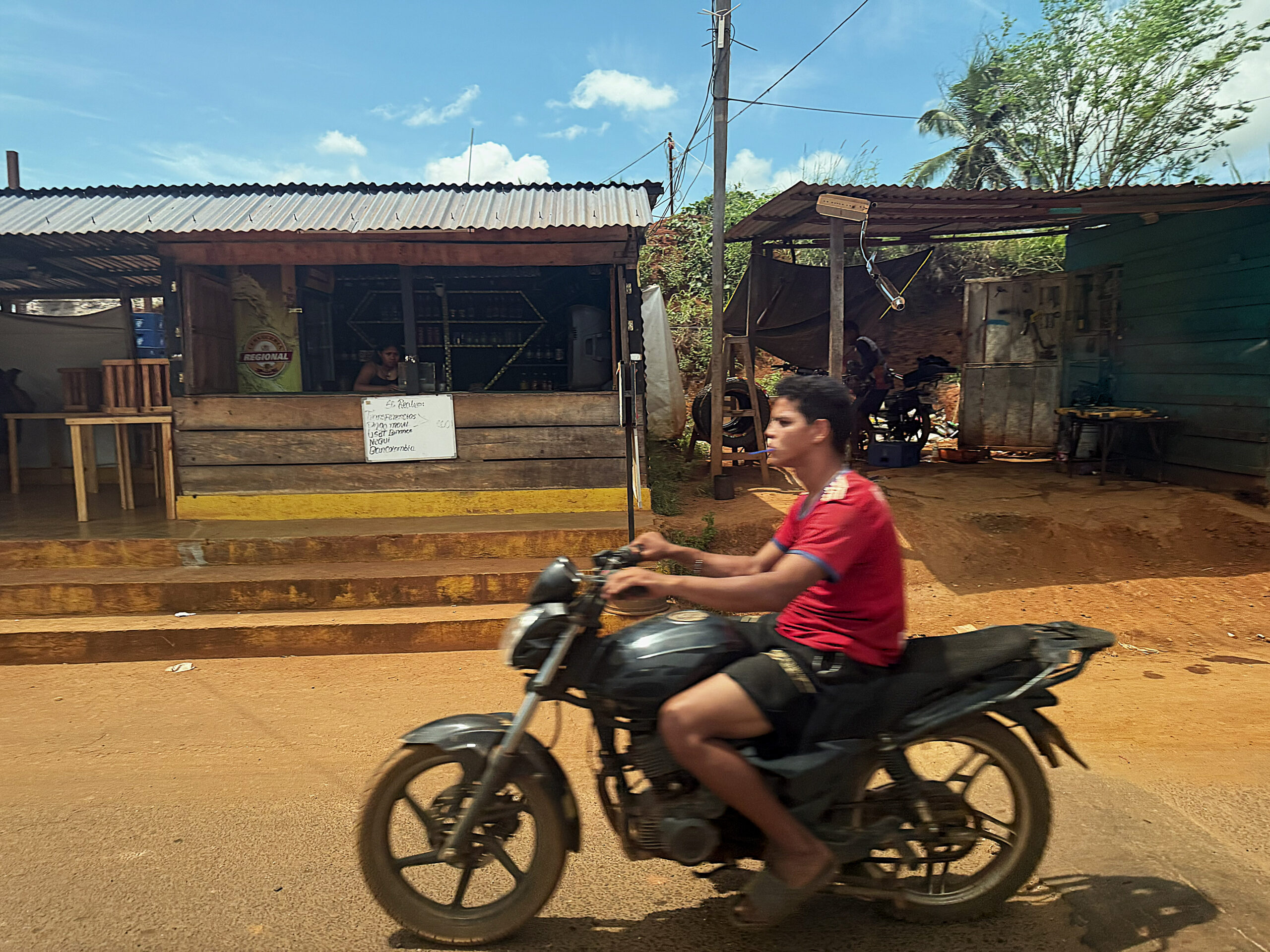
A view of the Kilómetro 27 mining settlement from the road, along the stretch between El Dorado and Kilómetro 88 (Las Claritas). The road continues all the way to Santa Elena de Uairén. All photographs in this article were taken by the author.
This journey begins at 5:30 in the morning, with a small cup of guayoyo coffee to prepare for more than twelve hours of driving from Puerto Ordaz to Santa Elena de Uairén. After strapping two large fuel containers to the truck’s roof, we set off to cross Bolívar state, almost as large as Wyoming. Soon, we’ll see long lines of cars waiting around gas stations down the road, not because of scarcity, but because they would resell the fuel in the mines.
The Troncal 10 highway, which once welcomed tourists and adventurers heading south to the Gran Sabana, cuts through Venezuela’s most important gold-mining region. Since the Maduro years, however, travelling there means entering towns entirely reshaped by the involvement of organized crime.
Road hazards
At a roadside stall in Upata, Coca-Cola bottles filled with gasoline sit under the blazing sun while the owner fries empanadas. Some miners have paid her in gold, she tells me, showing me a small folded piece of paper containing a few “points” of gold that she keeps in her handbag. Others carry their tiny golden stones in small containers, an additional layer of weirdness in a national economy where different exchange rates make every payment a challenge.
Beer and gasoline for sale along the road to the mining settlements: 10 beers or four liters of gasoline for 0.1 grams of gold (one punto).
The journey is exhausting with so many craters in the asphalt. Some were caused by big trucks and low maintenance. Other craters occupy the spots where policías acostados—speed bumps—and military checkpoints stood just months ago. After the government ordered their removal, they were carved away, leaving behind a road riddled with potholes. Soldiers remain active at the entrance of each town, searching bags, extorting drivers or demanding their cut from those trafficking in gasoline.
As we make our way along the track, the presence of the Orinoco Mining Arc Protection Group (GPAMO) becomes increasingly visible. Created by the Maduro regime in 2022, GPAMO is a military force tasked with “protecting” mineral deposits. Or, at least, overseeing their custody, whether by state forces or non-state groups.
A GPAMO military checkpoint along the stretch of road between Upata and Guasipati.
They have increased its deployment in the first towns on the way to El Callao. Especially after June 9, when a military operation to retake the territory, apparently led by the United States, killed Héctor Rusthenford Guerrero, alias “El Niño Guerrero,” the head of the Tren de Aragua mega-gang that is part of El Sistema, the criminal network operating in the gold mines.
As we pass through Guasipati, gold-testing and trading shops begin to appear, although most of them are empty. A local gold buyer complains that the power goes out “all the time”, even though everyone knows that just a few kilometres away the mines have generators and Wi-Fi 24/7.
“Let them come!” the old man exclaims, referring to rumours of gold companies arriving in the area. “If everyone is emigrating to the United States, there must be a reason, right?” he concludes.
More than ten years ago, you could still see plenty of gringos in these towns like in El Cintillo.
“This business was one of the first in the settlement” recalls an owner of a taguara, a traditional roadside restaurant, who has lived in the village for more than 35 years. She used to serve Americans and all kinds of foreigners drawn to the natural wonders of the Gran Sabana, rather than its gold.
“Last week the power went out for three days. We had to take to the streets and protest.” While the lack of basic public services is a nationwide problem, it is particularly severe in the small towns and settlements along Troncal 10. “The government pays no attention to us around here. The gas never comes, and when it does, it costs a fortune.”
The bad boys in town
In El Cintillo village, it is the residents themselves who keep control of the streets. Unlike in other towns, El Sistema has not managed to take control.
“They tried to come in once, years ago. But we protested, and they left us alone,” the shopkeeper says.
As we continue along the highway, we begin to see trucks loaded with what locals call el material: a mixture of earth and stones containing tiny golden particles. They drive without protective sheets, allowing dust to spread across the streets. Among the vegetation, but close to the road, open-pit mines and processing mills reveal the environmental damage repeated across several municipalities: muddy, sludge-filled pools clouded by hoses that blast water at high pressure to erode the earth before sucking it up for processing the gold.
A miner searching for gold in a small stream near the road to Las Claritas. He will extract the gold before processing it with mercury.
Some of these mills have no name or signage. Others display signs with the logo of the CVM, the State-owned Venezuelan Mining Corporation, with the word “ally” in the corner.
Further along, in El Callao, gold shops and motorbikes line the streets around the statue of a miner holding a pickaxe. There’s an unusual sense of calm, but even with AKA Niño Guerrero gone, the residents of the town where Guayana’s calypso music was born have little to celebrate. “They’re there, but it’s as if they weren’t”, a shopkeeper tells me. The gold mafia has not disappeared; it now operates more low-profile.
The situation is different in the next settlement, Tumeremo, where El Sistema is intertwined with daily life. Here, any baker or shopkeeper could be related to the gang. Few dare to break the silence. Since Guerrero’s killing, little has changed, according to Natalí, a clinical lab analyst. She says El Sistema keeps working as a kind of parallel government. “As far as I’m concerned, I’m not afraid. Here there is something alternative to the law.”
“I call them the bad boys”, Natalí says. They have their own ‘complaints’ office, known as El Cacho (The Horn), where residents can report thefts and other crimes, leaving their everyday problems in the hands of the criminals. El Cacho is also the name of a nearby mine where El Sistema operates.
The “Artisanal Miner” statue in El Callao, erected by the Venezuelan Mining Corporation at the “request” of the ruling party. Alexis Rodríguez Cabello, Diosdado Cabello’s cousin and the current head of SEBIN, inaugurated it in 2023.
“They impose order in their own way, but it works. Going to the authorities, not so much.” It is a sentiment shared by many people in Tumeremo, who would rather see the military keep its distance from the town.
Between mercury, hope and nostalgia
“When I first came here, the streets were in perfect condition, properly paved. There was order and discipline,” recalls a former mining contractor from Tumeremo.
“When Greenwich, Monarch and the other international companies were here, there was a future. Young people were training to become professional miners, technicians and university graduates, and they had jobs.”
After years of expropriations and fleeing companies, he keeps a workshop where anyone with enough gold can come and melt it down into small lingots, in a “do-it-yourself” style. He eagerly awaits the arrival of the Americans, as long as they come to improve the town’s basic services.
“What I can tell you is that this town is safe. Here, if someone owes you money, they pay you back. Get it?” he says, alluding to the criminal organization that runs the town.
Natalí, for her part, is grateful that she has never had to use El Sistema’s “services” or had any problems with its members. Nevertheless, the consequences of illegal and criminal mining regularly steps into her laboratory. In between the power cuts, she has examined miners suffering from malaria and tuberculosis, as well as women with sexually transmitted infections linked to prostitution in the mines. The mining economy also affects underage girls, who are often the subject of abuse, sexual exploitation and slavery, according to a 2020 UN Fact-Finding Mission report.
In what locals call the “kilómetros,” the other villages south of Tumeremo, mining is even more embedded in everyday life. Prices are quoted directly in gold points: from the lunch we sit down to eat at Kilómetro 27 to the products in local shops, where you can even buy inflatable swimming pools for children. This is not a place for tourists. These towns are home to artisanal miners and their families, who live alongside the armed groups controlling the area. Parents pay for their children’s school supplies with small gold nuggets. They can take their little ones to a gigantic circus set up near the town centre or, sometimes, take them to the mines and spend their afternoons there.
Fruit for sale by the punto in the Kilómetro 27 mining settlement.
As we eat, a few tables away, near the street, several people set up a scale and take out metal bowls to make a payment in gold in plain daylight. When I approach to get a closer look, a heavily tattooed young man warns me not to film. He looks like other men I saw moving through the motorbike traffic and clouds of dust, wearing gold chains with slogans such as real hasta la muerte, “real until death.”
“The guy who told you not to film with your phone was part of El Sistema,” my driver explains.
In Las Claritas, you can find gold even in rainwater puddles. Beside the main road, a man and a woman are working in a stream. “You run the earth through here, over the carpet,” the man explains to me, pointing to a patch of artificial grass. He is doing what miners call sampleo: a test to see whether any golden specks are trapped among the green plastic fibres of the carpet and check if there is any gold in the area. “Then you put it in the pan and wash it with mercury,” the miner continues, without the slightest hesitation.
Like many artisanal miners, including those working in mines controlled by El Sistema, he uses azogue—mercury—to separate gold from other minerals. “You burn it, and what’s left is yellow,” he explains. That mercury is then released into the atmosphere, eventually contaminating rivers and the fish swimming in them.
As we reach our final destination, the beauty of the Gran Sabana finally embraces us. It is deeply dark. It is almost 9 pm when we arrive at my grandfather’s posada (a lodge for visitors) at Santa Elena de Uairén. Over the next few days, we explore the town and see prices change. They are now quoted in Brazilian reais and gold trading shops are now disguised as jewelry shops or phone repair shops, where transactions happen at the back of the store.
Pure gold used for everyday transactions in Tumeremo.
We cross into Brazil’s border, La Línea, to fill up the tank, rather than spend days waiting in line at the local gas station. The border has become a gateway to everything the local town lacks, even education. Each morning, buses crowded with Venezuelan children cross La Línea to go to school at Pacaraima, where they receive their education in Portuguese. Behind every window is the sacrifice of parents sending them away in the hope of giving their children the benefits and opportunities they can no longer find at home.
Back in the hotel, the only people staying are a miner and a few Brazilian women. One morning, during breakfast, I show one of them some pictures on my phone of places we plan to visit next, like Salto Kama and Quebrada del Jaspe, assuming she is a tourist. “I’ll go maybe next time,” the woman replies. She is staying at the lodge for different reasons: to recover from the plastic surgery she just had a few days earlier in the clinic next door. They come for cheap plastic surgery. Venezuelans cross for better opportunities and to fill their tanks.