Mountain Views Supervisory Union is desperate to replace its new middle and high school. The existing one, located in Woodstock, was built 70 years ago. Its pipes are crumbling. One of its boilers recently failed. And its ventilation system is in poor shape.
In March, voters approved a $112 million bond to build a new school, a project that has been in the works for a decade. But school officials say there is just one thing holding them back: the Vermont Agency of Education.
School board chair Keri Bristow and superintendent Sherry Sousa say they can’t move forward with the project until they get preliminary approval from the state. But Agency of Education officials say they can’t sign off on the project until they complete a two-year process to craft new rules for school construction aid — and to do so before then would be “unlawful and irresponsible.” The disagreement has created a tense standoff between the two sides.
The current situation was set in motion on Town Meeting Day of this year, when Mountain Views voters — who come from the towns of Woodstock, Barnard, Bridgewater, Killington, Pittsfield, Plymouth , Pomfret and Reading — approved the $112 million bond for a new school, which the district plans to build on a football field next to the existing structure. According to a 2023 school facilities assessment, the current building’s condition is among the worst in the state.
But the bond contained a contingency: private donations and state or federal aid would need to cover 25 percent of the project cost. The school board decided to include that provision in the proposal, Bristow said, after hearing from residents following a failed bond vote in 2024 that they believed local communities shouldn’t have to bear the hefty burden of building a new school on their own.
State aid for school construction has been on pause in Vermont since 2008, but Act 73, the education reform bill passed in 2025, calls for it to resume. That gave Mountain Views’ officials confidence that their project would eventually be eligible for financial help.
Furthermore, school officials said, the district had already received preliminary approval for their project from the Agency of Education in 2024 and again in 2025. They were also heartened by the passage this year of another ed reform law, Act 170. It states that school construction projects approved by the education agency would be eligible for state aid covering at least 30 percent of the costs, with more support for small districts that choose to merge voluntarily. But it also directs the agency to develop rules governing school construction. And the bill does not specify a source for state funding of the construction projects.
In recent weeks, Mountain Views officials reached out to the Agency of Education to get the go-ahead to move forward with the initial stages of their construction project, including permitting and signing contracts. But school officials say the agency has rebuffed their requests to meet and has told them that the pre-approval they gave in prior years is no longer valid.
The agency’s prior pre-approval of the Mountain Views project “was never intended to represent approval for future state construction aid and should not be represented as such,” education agency spokesperson Toren Ballard wrote in an email. Ballard said the agency “has provided this clarification to the district and school board on multiple occasions, both in writing and through direct conversations over the past several years.”
Under Act 170, Ballard continued, the Agency of Education is required to adopt new rules for scoring districts’ applications for construction aid by March 1, 2028. Until then, he wrote, “the Agency is not authorized to approve an application for construction aid.”
In a letter sent last week to Mountain Views officials, Education Secretary Zoe Saunders characterized the district’s frustration with the agency as “misplaced and unproductive.”
“It was [Mountain Views’] decision to make your bond contingent upon state funding for a program that had not yet been funded by the General Assembly and for which implementing rules had not yet been established,” Saunders wrote.
The education secretary noted that other districts, such as Colchester and Winooski, “have leveraged creative means to secure construction funding, while many districts have not been able to cobble together sufficient funds. This variability creates an equity challenge, which is precisely why the Agency remains committed to a fair rule making process.”
Mountain Views officials aren’t satisfied with the state’s response. They understand that new rules are in the works for applying for state aid, and they will comply with them once created, Bristow said. But they do not have time to wait.
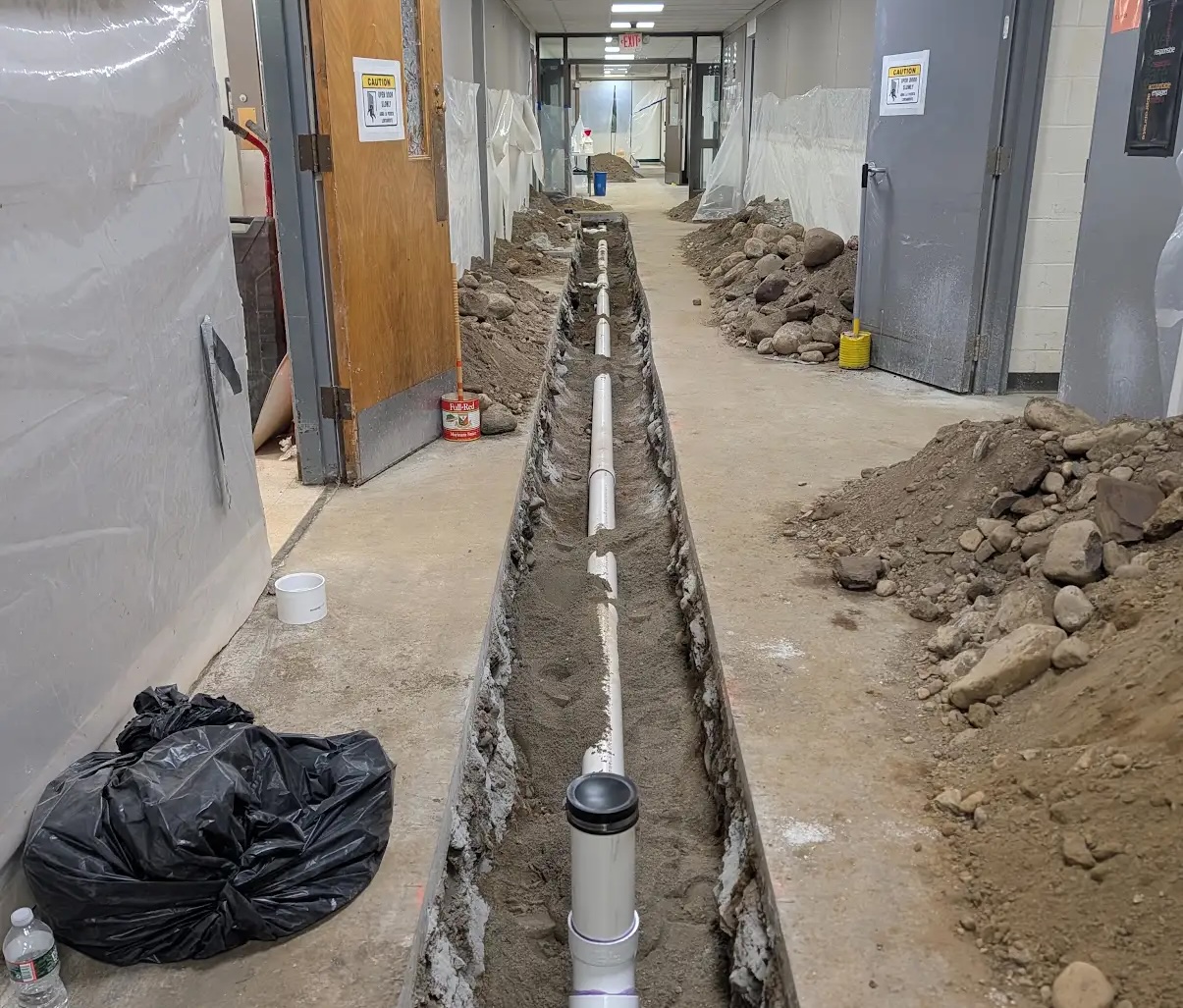
In recent months alone, they’ve had to dig up a hallway to replace failed cast-iron pipes coming from the cafeteria, and a 1958 boiler has stopped working, according to Mountain Views facilities director Joe Rigoli. The gym’s ceiling is at risk of collapse and only one shower works in the boys’ locker room. Rigoli said that fixing these issues in a 70-year-old building feels like throwing money away.
The agency’s “approval of the rebuild would not obligate the State financially, predetermine future rulemaking, or guarantee future funding,” board chair Bristow wrote in an email. “It would simply recognize that the project satisfies the statutory requirements, preserve the Legislature’s authority over appropriations, and allow the district to continue advancing one of Vermont’s most thoroughly planned regional school projects while the State completes implementation of the new program.”
If the district moves forward without the education agency’s go-ahead, school officials worry that they might be penalized from receiving aid in the future. The district has already secured more than $5 million for the new school through private donations.
“The holes are in the dike. The water’s oozing through and we’re told to just hold our breath while they figure it out,” Sousa said in an interview earlier this month. “It’s an emergency situation.” She said the agency’s actions amounted to them turning “a deaf ear” to Mountain Views.
But Ballard, the agency spokesperson, disputed that framing.
Since 2021, the Agency of Education “has relentlessly pursued the creation of a school construction aid program to address longstanding facilities concerns, modernize our infrastructure, and build the schools of the future,” Ballard wrote. “After years of effort, it would be unfortunate for the legitimacy of a new state aid for school construction program, meant to benefit all districts, to be undermined by one district seeking to work outside a legislatively established process for their sole benefit.”