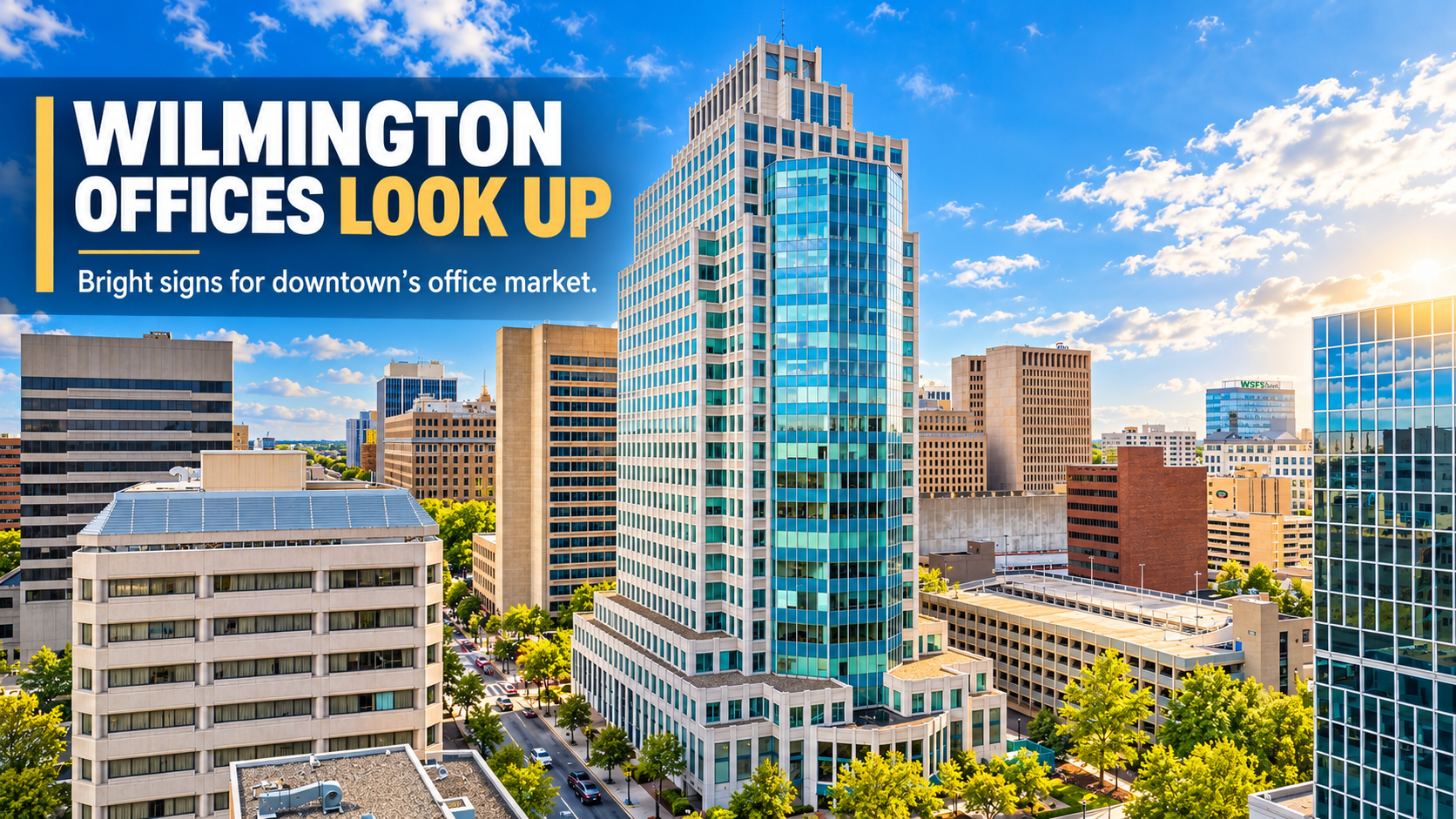
Caption: A new report from commercial real estate firm Newmark shows the Wilmington area’s office vacancy rate fell to 15.9% during the third quarter of 2026, its lowest level in two decades. Image created on 10/23 using AI.
Newmark report shows stronger leasing, business expansion, and renewed investor confidence, signaling a potential turning point after years of uncertainty.
WILMINGTON — After six difficult years for Delaware’s office market, commercial real estate professionals are seeing something they have been waiting for: measurable signs of recovery.
A new report from commercial real estate firm Newmark shows the Wilmington area’s office vacancy rate fell to 15.9% during the third quarter of 2026, its lowest level in two decades.
The improvement reflects businesses occupying more office space, stronger leasing activity and growing demand from expanding companies. Investors are also beginning to return to a market that has struggled since the COVID-19 pandemic.
“For six years, when someone asked, ‘How is the office market in Delaware?’ I said ‘challenging,’” said Wills Elliman, senior managing director at Newmark. “I meant terrible but didn’t want to say it out loud. That’s changing, and we saw it this quarter.”
Businesses are keeping and expanding their space
According to Newmark’s third-quarter Delaware Office Market Overview, businesses occupied a net additional 139,842 square feet during the quarter.
That brought net absorption for the first nine months of 2026 to 208,458 square feet, already exceeding the full-year totals recorded in every year since 2012.
Net absorption measures the change in occupied office space. Positive absorption means businesses are collectively occupying more space than they are vacating.
Wilmington’s overall vacancy rate declined from 16.8% in the second quarter to 15.9% in the third quarter, well below the market’s 20-year average of 18%.
Leasing activity also improved, with nearly 195,000 square feet leased during the quarter.
Elliman said the improvement reflects an important shift in how businesses are making decisions about their offices.
“Tenants took less space when they moved or renewed. Now, more are keeping their space or expanding. We’re seeing that especially with law firms.”
Among the largest transactions was Morris, Nichols, Arsht & Tunnell’s renewal of an 82,549-square-foot lease at 1201 N. Market St.
Financial technology company Fiserv also signed a lease at 800 Delaware Ave., while Gordon, Fournaris & Mammarella leased 9,540 square feet along Lancaster Pike.
Those transactions demonstrate the continuing importance of Delaware’s legal, financial and professional services industries to Wilmington’s commercial real estate market.
Growing businesses offer reason for optimism
Perhaps the most encouraging finding involves companies currently searching for office space.
Newmark identified approximately 603,000 square feet of active tenant demand in the Wilmington market.
Nearly 370,000 square feet of that demand comes from businesses seeking to expand or enter the market.
That distinction is important. Companies renewing existing leases help maintain occupancy, but expanding businesses and new employers can create opportunities for additional jobs and economic activity.
The broader regional economy is also supporting demand.
Unemployment across the Philadelphia-Camden-Wilmington metropolitan area stood at 3.8% in August, compared with the national rate of 4.1%.
Employment in office-oriented industries remains approximately 4% above pre-pandemic levels.
Investors are returning to the office market
Beyond improving occupancy, Elliman sees another encouraging development: Investors are purchasing office properties again.
“Investors are buying office buildings again. Good buildings in good locations are trading at prices that make sense,” Elliman said. “Add renewed confidence in Wilmington’s business climate, and there’s reason to feel better about the office market than we have in years.”
The return of buyers is significant because office buildings have faced uncertainty over tenant demand, operating expenses and property values since the pandemic.
Elliman said Newmark is involved in another transaction that could further demonstrate improving investor confidence.
“We just put a large office building under contract, and we’ll have more to say about it in our Q4 2026 review,” he said. “It’s the kind of building tenants will love, at a price that makes sense for the buyer. That deal is one more reason to have confidence in this market.”
The property and terms of the pending transaction have not been disclosed.
While Elliman’s observations suggest renewed investment activity, Newmark’s quarterly report focuses primarily on leasing, occupancy and asking rents rather than broader commercial property sales trends.
Downtown is improving, but challenges remain
The recovery is not occurring evenly across Wilmington’s office market.
Downtown Wilmington recorded particularly strong activity during the third quarter, with positive net absorption of 148,681 square feet.
However, downtown’s vacancy rate remains at 18.2%, higher than the overall market average.
Other Wilmington-area office markets present a mixed picture.
Office market
Vacancy rate
Wilmington North
11.3%
Wilmington West
13.5%
Wilmington South
16.2%
Downtown Wilmington
18.2%
Overall market
15.9%
Wilmington South experienced negative absorption during the quarter, meaning more space was vacated than occupied.
Older buildings also face competition from newer properties offering modern layouts, amenities and updated technology.
Office buildings constructed since 2000 have a vacancy rate of 14.4%, compared with 15.9% across the overall market.
Still, Newmark reports that the gap between newer buildings and older properties has narrowed, suggesting demand is improving beyond just the newest office towers.
Limited construction is helping the market
One significant factor behind Wilmington’s improving vacancy rate is the absence of new office construction.
Newmark reports that no office buildings are currently under construction in the Wilmington market.
The most recent major delivery was the 100,000-square-foot Avenue North office building completed in 2024, which is now 88% leased.
With few new buildings entering the market, businesses looking for office space are increasingly choosing from existing properties.
Another factor is the conversion of older commercial properties to residential or other uses.
Such conversions can reduce excess office inventory while bringing additional residents into business districts, potentially supporting restaurants, retail businesses and other downtown services.
However, declining vacancy does not automatically mean every building is becoming more financially successful. Removing vacant buildings from the office inventory can improve marketwide statistics even without equivalent growth in occupied space.
In Wilmington’s case, the report identifies both positive net absorption and constrained supply as contributors to the improvement.
Office rents remain relatively stable
Despite stronger demand, office rents have not increased dramatically.
Average asking rents reached $26.14 per square foot during the third quarter, up 1% from the previous quarter but down 3.3% compared with a year earlier.
Newmark attributes much of the annual decline to Wilmington University’s purchase of a large vacant building at 3 Beaver Valley Road in 2025, which removed higher-priced space from the available inventory.
That change affected the marketwide average rather than necessarily reflecting widespread rent reductions.
For businesses considering expansion or relocation, relatively stable rents and a substantial selection of available properties could present opportunities.
For property owners, the challenge remains attracting tenants while managing operating costs, property improvements and financing.
A potential turning point for Wilmington
The latest report offers reasons for optimism after several years in which remote work and changing workplace habits raised questions about the future of traditional office districts.
Vacancy is declining, office employment has stabilized and businesses are actively searching for additional space.
Perhaps more importantly, according to Elliman, tenants and investors appear increasingly willing to make longer-term commitments to Wilmington office properties.
Still, the market has nearly 3 million square feet listed as available, including space occupied by existing tenants but being marketed for lease.
That leaves significant room for improvement.
The long-term question is whether Wilmington can build on its advantages as a center for banking, law, financial services and other professional industries while continuing to attract new businesses.
The next phase of recovery may depend not only on filling traditional office buildings but also on creating an environment where employers, residents, restaurants and retail businesses can grow together.
For now, Newmark’s findings and Elliman’s observations point in the same direction: After years of difficult conditions, Wilmington’s office market is showing renewed momentum.
Whether that momentum becomes sustained growth will depend on continued tenant expansion, successful property investments and the strength of Delaware’s business climate
TO GO: Wilmington office market at a glance
Third quarter 2026
- 15.9%: Overall office vacancy, the lowest in 20 years.
- 208,458 square feet: Net office space absorbed during the first nine months of 2026.
- 603,000 square feet: Office space being sought by prospective tenants.
- 370,000 square feet: Demand from expanding businesses or companies new to the market.
- $26.14: Average annual asking rent per square foot.
- Zero: New office projects currently under construction.
- 18.2%: Downtown Wilmington office vacancy rate.
Source: Newmark, Delaware Office Market Overview, Third Quarter 2026.
Delaware LIVE collaborates with a network of professional journalists to cover a diverse range of stories across various fields. Staff Writers include experienced journalists and young professionals. If you have questions, please feel free to contact [email protected] or our publisher, George D. Rotsch, at [email protected]