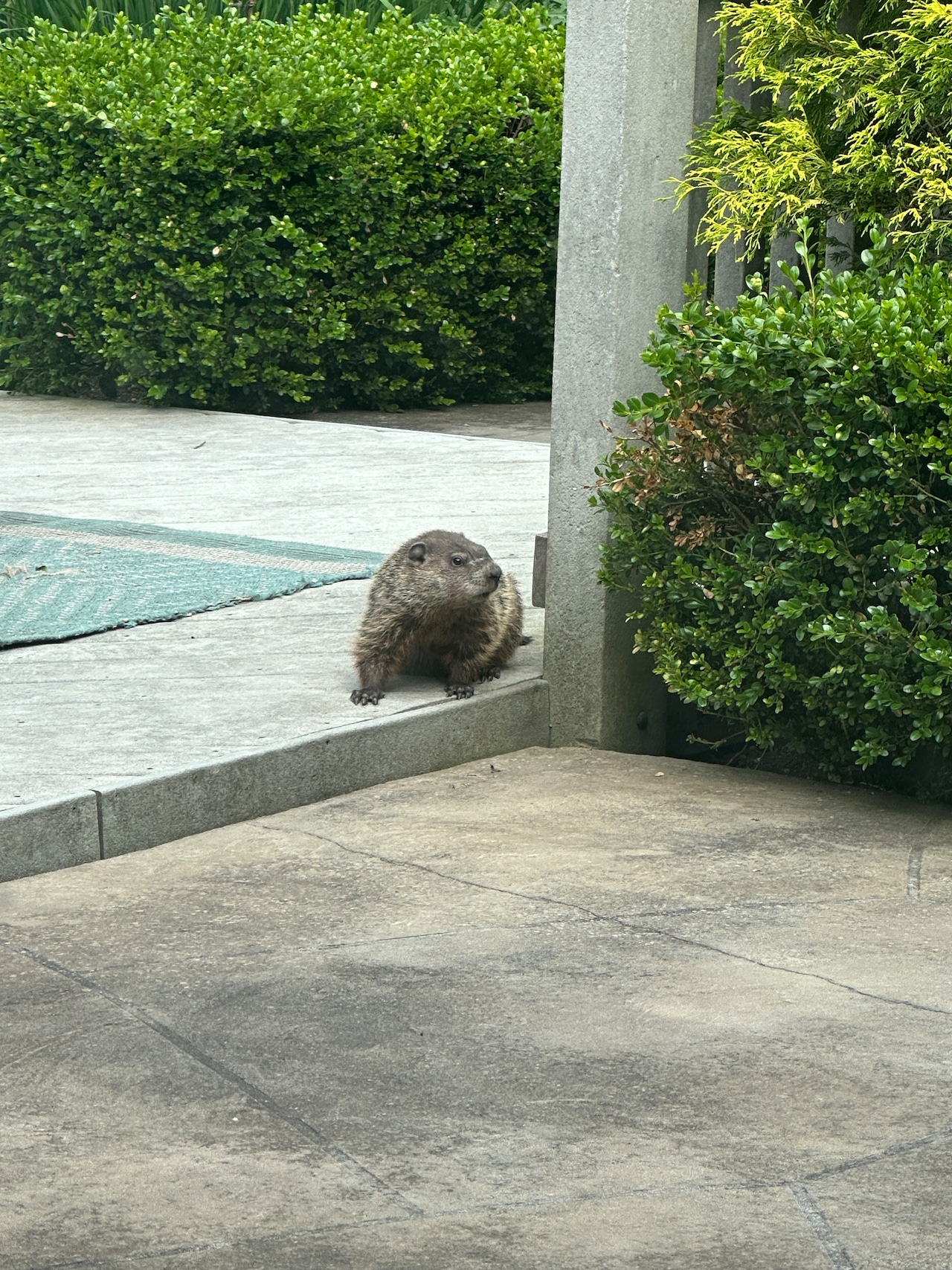
My neighbor Carrie shared an image in our neighborhood group chat last week from her outdoor security camera with the comment, “Um, new animal sighting.”
It was a stocky, low-to-the-ground creature with short legs, a blunt snout, and a furry gray body. Coincidentally, Master Gardener Carolyn Hufford had just sent me a presentation from OSU Extension titled, “Managing Groundhog Damage in the Landscape,” so the identification was a quick but unwelcome conclusion.
Like many Northeast Ohio communities, Groundhog Day is now every day in our neighborhood.
Although initially met with amusement, a groundhog sighting like ours is a sign of trouble to come. Deer may be the top nuisance wildlife complaint among gardeners in our region, browsing hostas and rosebuds at twilight and dawn and rubbing trees to death, but groundhogs (also called woodchucks) bring a different kind of destruction, which true to their name, usually begins underground.
Groundhogs (Marmota monax) are native to Ohio and much of the eastern U.S., and the most famous groundhog is, of course, Punxsutawney Phil in western Pennsylvania. They belong to the squirrel family and are technically a type of marmot. Once mainly woodland edge dwellers, they’ve adapted to suburban and even urban environments. Lawns, garden beds and the open areas we create around our homes provide easy digging and plentiful food.
Unlike deer, which are highly mobile and tend to pass through properties in search of food, groundhogs are territorial. They establish elaborate burrow systems on a single property and stay for years unless removed. Their tunnels can be over 25 feet long, with multiple chambers and exits.
Gardeners hate them because a groundhog can consume up to a pound of vegetation per day. Their favorite snacks include tender vegetables like lettuce, broccoli, and beans, but they’re not picky. You may notice broad, low gnaw marks on stems, or entire plants cut cleanly down. Flattened pathways through grass and large, round burrow openings (typically 10 to 12 inches wide) near sheds, patios, or under decks are strong indicators of groundhog activity.
In fact, the structural damage caused by groundhogs is far more serious than their garden devastation. Their burrows can extend beneath garages and home foundations. Over time, the repeated digging and shifting soil can lead to sagging floors, cracked foundations, or even collapsed structures, especially if multiple groundhogs share or expand a tunnel system. The burrow system can also cause flooding issues after heavy rains because it creates underground paths for water to pool or seep under buildings. So, while deer may chow down your tulips, groundhogs can destabilize your property.
According to the OSU Extension, options for managing groundhogs include:
- Habitat removal: Clear away brush, tall grass, and debris that may offer cover.
- Physical barriers: Fencing is most effective when buried 12 inches underground and angled outward. A 3- to 4-foot-high fence of chicken wire is usually sufficient; the hard part is burying it deep enough.
- Repellents: Home remedies abound and may provide short-term deterrence, but OSU Extension says that no repellant has been proven effective, noting that groundhogs will “push through an unpleasant experience.” But if you have some rotten eggs lying around, it can’t hurt to try.
- Trapping: Traps can be used on your own property, and OSU Extension has information on both live and kill traps. Some gardeners with gentle hearts prefer the thought of live traps; however, you need permission of the property owner where you release the animal, and if you don’t want it in your yard, why would somebody else want it? Another option is to contact a licensed nuisance wildlife control operator to set the traps and take care of removal. In the city of Cleveland, you can request removal of a nuisance animal, including groundhogs, by calling Animal Controls Services at 216.664.3069. Leave your name, address, zip code, phone number, and type of nuisance animal.
Unlike deer, which are protected game animals and require special permits for control measures, groundhogs have far fewer restrictions when they pose a nuisance. That said, prevention is almost always easier than eviction.
We encouraged Carrie to take action, not just to protect her garden, but to safeguard her home and perhaps prevent a neighborhood infestation. With groundhogs, the nuisance isn’t only what they eat in the garden, but where they dig in the yard.
Thanks to Carrie for the question (and for being a fantastic neighbor), and thanks as always to Master Gardener Carolyn Hufford for her wisdom.