He was out there somewhere, forsaken in the city where he had sought sanctuary. His damaged eyes blurring the foreign world around him, he was lost in the snow-caked Buffalo sprawl, underfed, underdressed, speaking a language few understood.
Where was Nurul Amin Shah Alam?
Six days had passed since Border Patrol agents intercepted the Rohingya refugee upon his release from a downtown jail, where he had spent a year for a police incident rooted in confusion. With no reason to detain him, the agents addressed the mistake by leaving the disabled man, still wearing jail-issue orange canvas shoes, in a darkened parking lot without informing anyone, even his family.
Six days, then, since Nurul Amin, a 56-year-old grandfather despondent over broken American promises, had last been seen, and only then as a specter trudging past a security camera and into the pewter grayness of a Rust Belt winter.
Where did he go?
The question hung like black crepe in his family’s small apartment on Buffalo’s distressed east side. Adorning the yellow walls were Islamic decorations and a framed certificate awarded by a local school to his 11-year-old son, Yassin. Beyond the front window loomed a 19th-century Roman Catholic basilica named after a Polish saint, a rarely used remnant of an earlier immigrant wave.
The missing man’s wife, Fatimah, and another son, 22-year-old Faisal, were meeting with two people from the agency that had resettled the family in Buffalo a year earlier. With the help of an English-speaking friend, they conferred on what else could be done, now that “missing” posters had been circulated, the police alerted, the shelters scoured.
The friend paused the somber discussion to tell someone calling his cellphone that he was in an important meeting and couldn’t talk. The caller said this was more important: A body had been found.
Soon a photograph of a dead man was being beamed across the city to a sparse apartment brimming with dread. How could the government just snatch the family’s patriarch and then leave him to a winter night’s mercy? Why hadn’t they called the family? Didn’t they notice his damaged eyes? His inability to speak English?
What kind of country was this?
Then, with the family’s future balanced in the moment, Faisal Nurul Amin, the worry-wearied son of the missing man, opened the image.
His father.
In the weeks to come, the story of Nurul Amin Shah Alam would attract international attention, his case seen by many as emblematic of a dehumanizing cruelty coursing through the Trump administration’s immigration crackdown. But for six days the refugee was simply lost in the strangeness of Buffalo.
Abandoned in the dark, rutted parking lot of a run-down strip mall, Nurul Amin would have sensed the shadowy unwelcome of closed and vacant storefronts. He would have discerned the deceiving glow of a Tim Hortons doughnut shop, its doors locked but its drive-thru window still open. He began walking south toward Niagara Street, which ends downtown five miles away, near the Art Deco colossus of a city hall.
Buffalonians are proud of their city’s sports teams, majestic architecture and reputation for welcome — all reflected along Niagara Street as it weaves past old and new, snaking under a train trestle with a paint-peeled mural that spells Buffalo. Here, the ghostly remnants of a grain mill; there, the campus of a global food company. Here, weathered two-story homes; there, luxury loft apartments. A Buffalo Bills sign. A shuttered tavern. A former Prohibition-era bootlegging warehouse transformed into a small-business bazaar featuring Egyptian food, Afghan food, Thai, Korean, Congolese.
Along the route Nurul Amin may have taken.
Wandering south like the blind protagonist of a Greek tragedy, Nurul Amin might have hewed to Niagara Street. To the right hummed Interstate 190; beyond the highway, the Niagara River; beyond the river, Canada. Wherever he was, signs and passersby were of no use; he spoke no English, and was illiterate.
“Imagine if he had been able to say, ‘Help me, I’m lost,’” said the family friend, who is known as Prince Arakan.
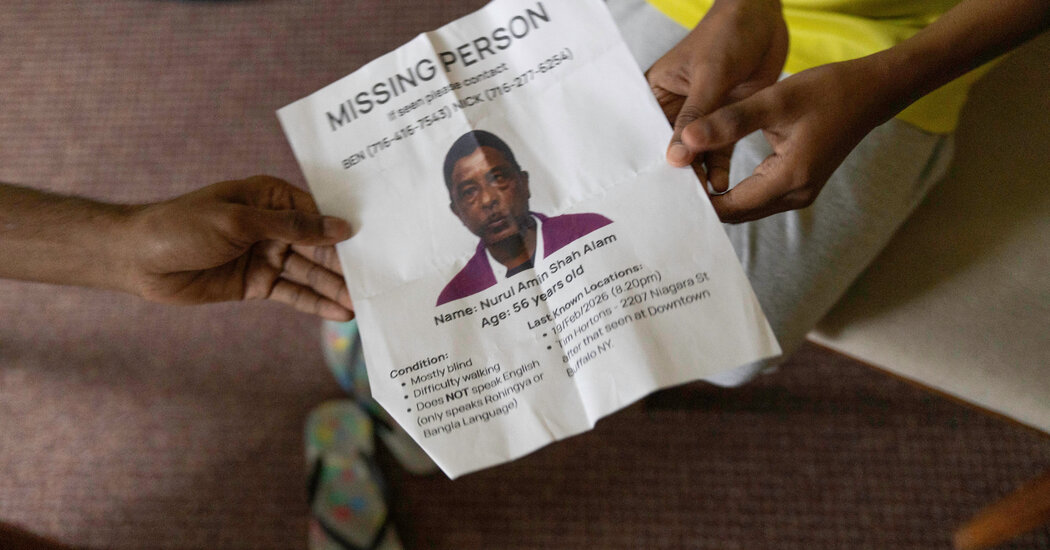
Prince Arakan had joined the missing man’s son Faisal and several young men from the city’s small Rohingya community in a Buffalo-wide search. On lampposts and storefront windows, they taped posters of the dark-skinned Southeast Asian man with an impaired left eye.
“Nurul Amin is mostly blind and unable to communicate in English,” the posters said. “He only speaks Rohingya. He is 56 and has back problems, difficulty walking and is in poor health. He is not able to use a phone and does not know phone numbers or addresses.”
“Thank you for being the City of Good Neighbors, Buffalo!”
The earnest words met wintry silence. Was he eating? Was he sleeping? Where was Nurul Amin?
On the misty Thursday night that he faded from view, the temperature lingered around 40 degrees. The next day, a gusty Friday, light rain turned to light snow. The snow gave way on Saturday to a freezing drizzle, but returned on Sunday and fell through the night.
On Monday, the February weather of western New York asserted itself. The temperature dropped below 20 degrees by midnight and plummeted into early Tuesday. At breakfast, it was 12 degrees.
Around dinnertime, at 5:30, a woman was walking in the downtown area dominated by the KeyBank Center, home of the Buffalo Sabres. With the hockey team out of town, this stretch of Perry Street was quiet, the vast parking lot empty, the soaring bank building across from the arena long vacant. The area’s security cameras, recently vandalized, were offline.
The woman noticed a man on the ground. He wore a dark parka, khaki pants and one prison-orange canvas shoe. Detecting movement, she walked on.
Three hours later she walked past the closed bank building again, saw the same man, body still, hands gray, and called 911. Fourteen months to the day after his arrival in the United States, Nurul Amin Shah Alam lay dead on the Buffalo pavement.
The Erie County medical examiner later determined that a stress-induced ulcer had allowed gastric acid to leak into his belly, causing excruciating pain. The official cause of death: complications of a perforated ulcer, precipitated by hypothermia and dehydration.
The official manner: homicide, meaning that the death resulted “from the volitional acts of another, which may include negligent acts or omissions” — a medical determination that leaves the question of criminality to the judicial system. Law enforcement officials say the death remains under investigation.
In terms of geography, Nurul Amin came from the town of Maungdaw, in Rakhine State, on the western coast of Myanmar, formerly known as Burma. But in truth, he came from a state of internal displacement: As a Rohingya, he was part of a Muslim minority essentially stripped of Myanmar citizenship decades ago and subjected ever since to an increasing repression of rights, the burning of mosques, the destruction of villages, even what the United States has called genocide.
Uneducated and poor, Nurul Amin navigated life with a left eye damaged in infancy by the poke of a stick. He worked in the rice fields and at a fishery, raising chickens and a few crops on the side, happiest when a rich harvest meant a family feast.
After an arranged marriage, he and his wife, Fatimah, started a family, but the repression became too much, with the Myanmar military forcing Rohingya men like Nurul Amin into unpaid manual labor, cutting down trees, clearing roads. In 2003, he made his way alone to a refugee camp in Bangladesh, and then to Malaysia, where Rohingya are often exploited, but where he could work off the books as a laborer and send money home.
Fearing that his four sons would also be forced into servitude, Nurul Amin arranged for them to join him, one by one. By 2013, the entire family was in Malaysia, with a fifth son, Yassin, soon to be born.
Nurul Amin then began the rigorous, yearslong process of resettlement. “Refugees are vetted more intensively than any other group seeking to enter the U.S.,” according to the International Rescue Committee, a global humanitarian aid organization. “In fact, the hardest way to come to the country is as a refugee.”
After the United Nations High Commissioner for Refugees identified him as being in need of resettlement, his case was forwarded to the U.S. refugee admissions program for a screening process that included biometric collection, medical examinations, document verification, in-person interviews and a security assessment by a fleet of federal agencies. In 2015, Nurul Amin was approved.
But when told that only his wife and two youngest sons, both minors, could join him, he declined the offer, refusing to break up the family, his son Faisal said. His case was deferred until 2024, when it appeared that the Biden administration would also allow Nurul Amin’s three older sons and their families to resettle.
“‘Once we process their paperwork, they will join you in America,’” Faisal said the family was told. “They said within six months.”
After traveling more than 8,000 miles, Nurul Amin and part of his family arrived in the United States on Christmas Eve. Faisal bent down to touch the snow that symbolized their new reality: Buffalo.
“Very exciting,” he recalled.
Buffalo has benefited from the presence of families like Nurul Amin’s. Immigrants, including a Bangladeshi wave moving up from New York City, and refugees, including people from Myanmar, have revived dying neighborhoods, diversified the culture and spurred the city’s first growth since 1950, when it had more than double the current population of 278,000.
“You can’t have economic growth without population growth,” the mayor, Sean M. Ryan, said in an interview. “And the new Americans have been Buffalo’s economic lifeblood.”
A stretch of Niagara Street.
Caseworkers for one of the city’s resettlement agencies, Jewish Family Services, moved the family to the ever-changing Black Rock neighborhood, where they settled into the top floor of a gray, Depression-era house. A caseworker helped them to adjust. What to wear in the cold. Where to buy provisions. How to enroll in school. How to find employment.
“This is cost-positive programming,” said Molly Carr, the chief executive of Jewish Family Services of Western New York. “We invest up front in somebody, knowing that, overwhelmingly, the individuals we invest in will become contributing members of the community.”
Yassin received a “Heart of a Dragon Award” certificate from his elementary school. Faisal began assembling the documentation he needed to get a job. Fatimah cooked the rice, curries and other familiar food found at immigrant-owned markets. And on Jan. 20, 2025, as the patriarch waited for the rest of his family to arrive, Donald Trump took the presidential oath.
That same day, the new president issued an executive order to suspend the country’s refugee admissions program.
Resettlement agencies across the country were blindsided by what they saw as a bait and switch. The federal government had recently admitted refugees like the family of Nurul Amin, but now it was reneging on its commitment to help cover the costs of food, housing and other basic needs for the first 90 days.
Forced to lay off a third of its work force, Jewish Family Services of Western New York notified newly arrived refugees that it could not provide the full set of traditional resettlement services. The family of Nurul Amin interpreted this to mean they were on their own.
Even worse, the president’s executive order also meant that Nurul Amin’s three older sons and their families in Malaysia would not be coming to the United States. According to statistics cited in a recent federal appeals court ruling, more than 128,000 individuals had been conditionally approved for refugee status when the resettlement program was halted.
The patriarch’s decision to resettle in the United States had been predicated on the promise that his family would be together. That promise had been broken, and now so was he.
NO ONE KNOWS how Nurul Amin wound up in a stranger’s backyard. In the United States for less than two months, the refugee might have been lost, or disoriented. But there he was, with two police officers aiming Tasers at his chest.
The weeks had passed in a sad, snowy blur. When the weather allowed, the family would take walks to the Buffalo Fresh halal supermarket, with Faisal keeping a hand on his sad, disabled father, whose life of hard labor had taken its toll. They got to know the owners of a tax-preparation business who welcomed visitors with tea, and a woman who ran the market where they sometimes bought sacks of rice.
On a gray February morning, Nurul Amin ventured out, alone. Wearing a black coat and knit cap, he walked to Buffalo Fresh and bought curtain rods to use as walking sticks. He then rested at the tax-preparation office, where he complained about his aching knees before heading back out into the cold.
Instead of turning right toward his apartment on Grace Street, the newcomer kept walking south on Tonawanda Street, past a storefront featuring the triangular Alcoholics Anonymous symbol, past a yard where a murder victim was buried a few years ago, to a tan house with a metallic heart sculpture near the front door. He later told his family that the house looked similar to theirs.
He opened the wooden gate, and chaos followed. A small black dog barked furiously before escaping through the open gate. The owner saw a stranger with two poles and a “milky white” eye, and called 911.
The two police officers who responded found a short, stocky man in the backyard and an aluminum shed with its door yanked off. They repeatedly ordered him to drop the poles, their voices rising with each new command, but he did not seem to understand. Where he came from, people in paramilitary uniforms represented oppression.
Buffalo Police Department
He raised his right hand as if to ask for calm.
“Drop it!” one of the officers ordered.
“I’m going to tell you one more time! Drop that shit!”
“You’re gonna get Tased.”
“I’m gonna shoot you, dude! Put it down!”
Nurul Amin became agitated. He began walking toward the officers, swinging the curtain rods and saying words they didn’t understand. Within 45 seconds of the officers’ arrival, there came the electrified crackle of Tasers.
The three were suddenly rolling on the ground, the officers trying to pry Nurul Amin’s grip from the curtain rods. They punched him and he bit them, breaking skin, while two languages crisscrossed in the brisk morning air.
More officers arrived. Soon the refugee was shackled in the snow, hand bleeding, face bruised. The police later said he smelled of alcohol; the devout Muslim didn’t drink, but the betel leaves he sometimes chewed have a pungent aroma. He had $13.65 in cash, an employment authorization card and a few items in a fanny pack.
One of the arresting officers looked down at Nurul Amin and asked, “The fuck’s wrong with you?”
He didn’t understand them any more than they understood him, as he recited, over and over, a prayer for help.
NURUL AMIN WAS charged with assault and criminal possession of a weapon (the curtain rods), among other crimes. The Buffalo police contacted the U.S. Border Patrol to confirm the identification on his employment authorization card, after which the Border Patrol promptly issued an “immigrant detainer,” providing for the agency to be notified before the refugee was released from custody.
He was booked into the Erie County Holding Center, a maximum-security complex once notorious for inadequate medical and mental health care. Conditions have improved in recent years, but the detention center remains an ominous, seven-story presence in downtown Buffalo, processing more than 20,000 people a year.
The average stay is 33 days. Nurul Amin would remain for more than a year.
After discussing the case with a Legal Aid lawyer, the family chose not to post bail. Aware that the Trump administration was intensifying its immigration enforcement efforts, they feared that Nurul Amin might be snatched up and sent to the crowded detention center in nearby Batavia, perhaps even deported.
“At least we know his whereabouts,” Faisal later said.
The seasons passed with Nurul Amin in lockup, isolated by disability and differences in language and culture. With his hair and beard growing long and white, he looked like a shipwreck survivor, a Robinson Crusoe in prison orange.
In November, three dozen members of the city’s Rohingya community packed one of his court hearings. Imran Fazal, the founder of the recently formed Rohingya Empowerment Committee, said in a letter to the court that Nurul Amin’s case was rooted in misunderstanding; that he had had “no opportunity to participate in a cultural orientation program to learn the laws, customs and expectations of life in the United States.”
During visiting hours twice a week, family members would see, through a plexiglass partition, their loved one in physical and mental deterioration, becoming thinner, more listless. It is unclear if he knew how to use the commissary, or had access to halal food.
Faisal tried to pick up his father when he was released from jail.
“Information about special diets is provided to each incarcerated individual via the inmate handbook,” a spokesman for the Erie County Sheriff’s Office said in an email.
But Nurul Amin could not read.
Fixated on the memory of the curried dishes he had known all his life, he would repeatedly ask about the meals being cooked at home. But his family would avoid the questions, fearing the answers would only deepen his sadness.
Another Buffalo February set in. Nurul Amin had spent 12 of his 14 months in America behind bars.
His son Faisal was working part-time as a housekeeper at a downtown hotel. His son Yassin was in the fifth grade. They and their mother were living now in a cramped apartment across from the old Polish Catholic church, on Buffalo’s east side, where many of the city’s 2,000 Rohingya residents had settled.
Finally, the Erie County district attorney, Mike Keane, offered to end the case if Nurul Amin pleaded guilty to two misdemeanors. “My decision was the result of a comprehensive evaluation of his conduct, criminal history, acceptance of responsibility, medical condition, time served in pre-trial custody, and the proposed resolution,” Mr. Keane later said. “I also considered the significant collateral consequences that would result from a felony conviction — including mandatory deportation.”
ON THE OVERCAST late morning of Feb. 19, a dull-silver compact car pulled up to the Holding Center in downtown Buffalo. Its driver, Faisal, could not wait to see his father emerge a free man from this tan-colored fortress.
Nurul Amin had pleaded guilty to criminal trespass and criminal possession of a weapon. His $5,000 bail had been posted. His sentencing had been scheduled for late March. Everything now centered on his homecoming, when the family would celebrate by breaking the dawn-to-dusk fast of Ramadan with a feast.
His wife, Fatimah, had prepared stir-fried vegetables and chickpea side dishes, lentils in a savory tomato sauce and his favorite, korma, a mild, creamy curry with chicken. She had also ironed his clothes, as if to steam away the past year. Yassin, the youngest, was so excited that he kept pestering his older brother with texts. Is he out yet? Do you see him? Is he out?
Nurul Amin’s youngest son, Yassin, with Fatimah.
Faisal and an English-speaking friend waited through the leaden afternoon, inquiring at the front desk every half-hour, monitoring a website that indicates when inmates are released. At times they nodded off.
At 5:30, they inquired again at the front desk, only to be told to come back in an hour; it appeared to them that a pizza party was taking place. The two Muslim men continued their wait in the car, breaking fast with chewing gum and water.
After an hour, and with the website indicating that Nurul Amin had been released, the men once again approached the front desk, only to be told:
They took him.
WHO TOOK HIM? When? Why?
It would take days for Nurul Amin’s family to create a rough timeline of all the mistakes, misunderstandings and moments of indifference. By then, it would also be too late.
Before releasing Nurul Amin, the Erie County Sheriff’s Office honored the year-old immigration detainer and notified the Border Patrol. While his son and his friend continued their daylong wait for him just outside, the refugee was freed, only to be detained and taken to a Homeland Security facility.
And while the refugee’s panicked family and lawyer scrambled to locate Nurul Amin, the Border Patrol determined that the “noncitizen” taken into custody was “not amenable to removal.” Meaning: He was in the country legally, his felony charges had been reduced to misdemeanors, and it had no reason to detain him.
Siana McLean, an immigration lawyer who joined the effort to find Nurul Amin, said that “a very simple assessment” by the Border Patrol could have determined that the refugee was “not removable” before taking such drastic action.
In the Border Patrol’s telling, the agents offered Nurul Amin “a courtesy ride” back to Buffalo. In its telling, the refugee who did not speak English agreed to be dropped off near his last known address, though a call to his family or lawyer would have revealed that the family now lived on the other side of the city. In its telling, the agreed-upon drop-off point was a coffee shop “determined to be a warm, safe location.”
Security footage obtained by The Washington Post and The Investigative Post, a nonprofit news outlet, captured some of what unfolded.
At 8:19, a white van pulled into a darkened parking lot on Niagara Street, near the Tim Hortons with only its drive-thru open. A short man got out. He had no cellphone, no identification, no English skills, no reading skills and no true understanding of where he was.
“A dereliction of duty,” Mayor Ryan would later call this moment. “Unprofessional and inhumane.” And the family’s lawyer, Terrence M. Connors, would describe the Border Patrol’s actions as “the definition of negligence.”
The Department of Homeland Security would answer such criticism, in part, this way: “Another hoax being peddled by the media and sanctuary politicians to demonize our law enforcement. This death had NOTHING to do with Border Patrol. Mr. Shah Alam passed almost A WEEK AFTER he was released by Border Patrol.”
The white van pulled away, and the short man began walking. He had a slight limp.
Out there somewhere was the family he had been unable to reunite. In the days to come, with the first three sons still continents away, the fourth son would reluctantly assume the role of patriarch. The fifth son, still a boy, would endure in silence. An ever-present veil would fail to conceal the wife’s all-consuming grief.
The refugee moved past the inaccessible Tim Hortons. Past the drifts and piles of shoveled snow. He raised his black hood and disappeared into the Buffalo mist.
Produced by Eve Edelheit, Gabriel Gianordoli and Rumsey Taylor.