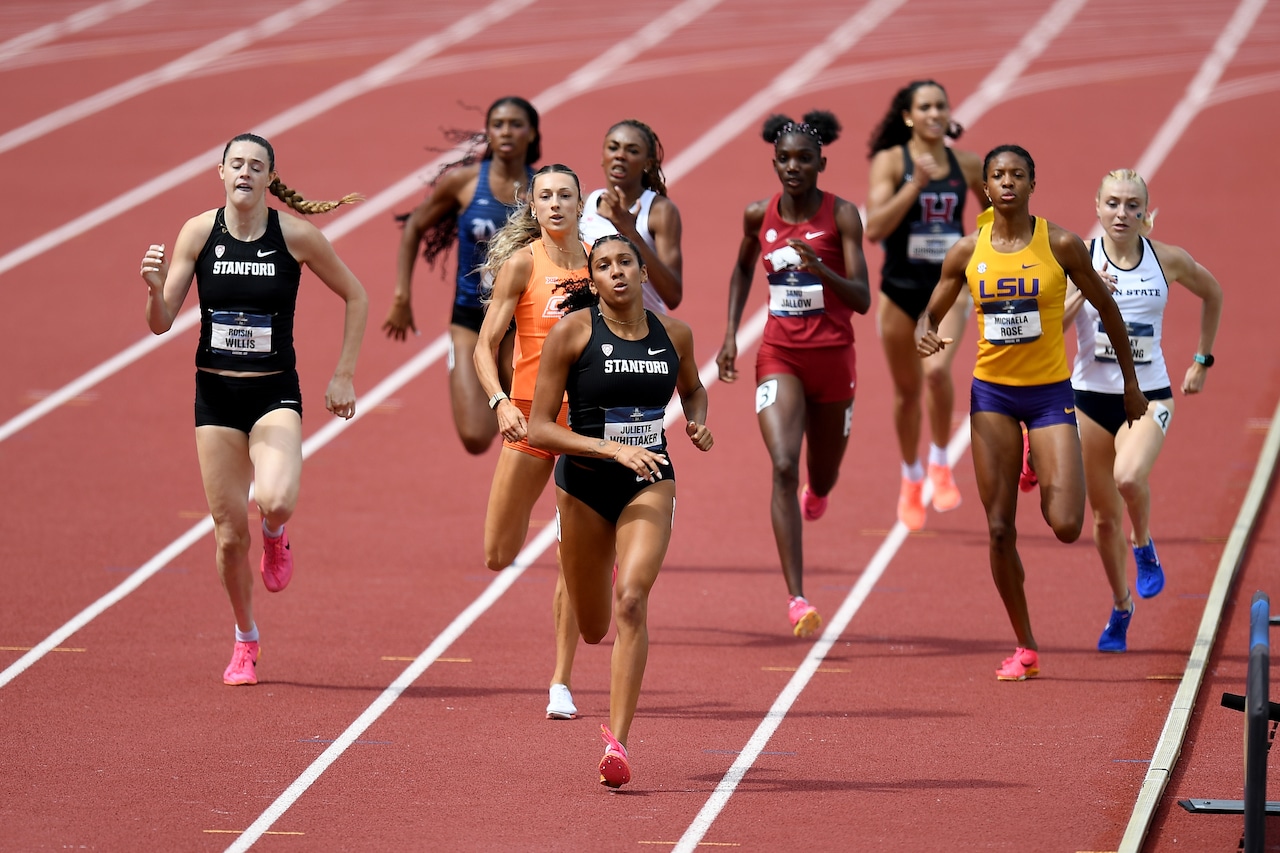
The final day of the NCAA Division I Track & Field Championships is Saturday, June 14. Several women’s championship events will air on ESPN2 from 9 to 11:30 p.m. ET.
How to watch: Fans can watch the event on ESPN2, or stream it free via a trial of DirecTV. The event can also be streamed via free trial on fuboTV.
Here’s what you need to know:
What: NCAA Division I Track & Field Championships
When: Saturday, June 14, 2025
Where: Hayward Field, Eugene, Oregon
Time: 9 p.m. ET
TV: ESPN2
Channel Finder: DirecTV, Verizon Fios, Cox, Xfinity, Spectrum, Optimum
Live stream: DirecTV (free trial), fuboTV (free trial), Sling (half off first month), Hulu + Live TV, ESPN+
Saturday’s women’s Track & Field Championship events
Track
- National Collegiate Wheelchair 100 meter
- 4×100 Relay
- 1500 meter
- 3000 Steeplechase
- 100 Hurdle
- 100 meter
- 400 meter
- 800 meter
- 400 Hurdle
- 200 meter
- 5000 meter
- 4×400 Relay
Field
- Discus
- High Jump
- Triple Jump
Here’s a recent NCAA story from the Associated Press:
Sydney Moore and Sabrina Ootsburg were surrounded by hundreds of college athletes at a convention in Charlotte when news broke that the $2.8 billion NCAA settlement had been approved by a federal judge. In a room full of college athletes, they felt like the only two people who understood the gravity of the situation.
“I’m about to get paid,” Moore said a Division I football player told her.
“Yes, you are about to get paid, and a lot of your women athlete friends are about to get cut,” she responded.
Moore acknowledged that her response might be a stretch, but while the sprawling House settlement clears the way for college athletes to get a share of revenue directly from their schools and provides a lucky few a shot at long-term financial stability, it raises genuine concerns for others.
Schools that opt in will be able to share up to $20.5 million with their athletes over the next year starting July 1. The majority is expected to be spent on high-revenue generating sports, with most projections estimating 75% of funds will go toward football.
So what happens to the non-revenue-generating sports which, outside of football and basketball, is pretty much all of them?
It’s a query that’s top of mind for Ootsburg as she enters her senior year at Belmont, where she competes on the track and field team.
“My initial thought was, is this good or bad? What does this mean for me? How does this affect me? But more importantly, in the bigger picture, how does it affect athletes as a whole?” Ootsburg said.
“You look at the numbers where it says most of the revenue, up to 75% to 85%, will go toward football players. You understand it’s coming from the TV deals, but then it’s like, how does that affect you on the back end?” Ootsburg asked. “Let’s say $800K goes toward other athletes. Will they be able to afford other things like care, facilities, resources or even just snacks?”
Moore has similar concerns. She just completed her fifth and final year of eligibility at Syracuse University, where she was a key member of the volleyball team. Like Ootsburg, she’s become a pioneer in the NIL space and an advocate for college athletes, even though her on-court ventures are behind her.
Moore says most female athletes aren’t worried about how much – if any – money they’ll receive. They fear how changes could impact the student-athlete experience.
“A lot of us would much rather know that our resources and our experience as a student-athlete is going to stay the same, or possibly get better, rather than be given $3,000, but now I have to cover my meals, I have to pay for my insurance, I have to buy ankle braces because we don’t have any, and the athletic training room isn’t stocked,” Moore said over the weekend as news of Friday night’s settlement approval spread.
One of the biggest problems, Ootsburg and Moore said, is that athletes aren’t familiar with the changes. At AthleteCon in Charlotte, North Carolina, they said, perhaps the biggest change in college sports history was a push notification generally shrugged off by those directly impacted.
“Athletes do not know what’s happening,” Ootsburg said. “Talking to my teammates, it’s so new, and they see the headlines and they’re like, ‘OK, cool, but is someone going to explain this?’ because they can read it, but then there’s so many underlying factors that go into this. This is a complex problem that you have to understand the nuances behind, and not every athlete truly does.”
Some coaches, too, are still trying to understand what’s coming.
Mike White, coach of the national champion Texas softball team, called it “the great unknown right now.”
“My athletic director, Chris Del Conte, said it’s like sailing out on a flat world and coming off the edge; we just don’t know what’s going to be out there yet, especially the way the landscape is changing,” he said at the Women’s College World Series in Oklahoma City. “Who knows what it’s going to be?”
What about the walk-ons?
Jake Rimmel got a crash course on the settlement in the fall of 2024, when he said he was cut from the Virginia Tech cross-country team alongside several other walk-ons. The topic held up the House case for weeks as the judge basically forced schools to give athletes cut in anticipation of approval a chance to play — they have to earn the spot, no guarantees — without counting against roster limits.
Rimmel packed up and moved back to his parents’ house in Purcellville, Virginia. For the past six months, he’s held on to a glimmer of hope that maybe he could return.
“The past six months have been very tough,” he said. “I’ve felt so alone through this, even though I wasn’t. I just felt like the whole world was out there – I would see teammates of mine and other people I knew just doing all of these things and still being part of a team. I felt like I was sidelined and on pause, while they’re continuing to do all these things.”
News that the settlement had been approved sent Rimmel looking for details.
“I didn’t see much about roster limits,” he said. “Everyone wants to talk about NIL and the revenue-sharing and I mean, that’s definitely a big piece of it, but I just didn’t see anything about the roster limits, and that’s obviously my biggest concern.”
The answer only presents more questions for Rimmel.
“We were hoping for more of a forced decision with the grandfathering, which now it’s only voluntary, so I’m a little skeptical of things because I have zero clue how schools are going to react to that,” Rimmel told The Associated Press.
Rimmel is still deciding what’s best for him, but echoed Moore and Ootsburg in saying that answers are not obvious: “I’m just hoping the schools can make the right decisions with things and have the best interest of the people who were cut.”
What is DirecTV?
DirecTV is a comprehensive internet TV service that offers your favorite entertainment, news and sports channels, as well as local TV stations and regional sports networks. It’s the only choice for fans who want full access to local, televised sports. DirecTV Choice includes 125+ channels, unlimited DVR storage and thousands of on-demand titles.