Gina Gilbert knows what it’s like when gaming stops being fun and starts to add strain to a person’s life.
For years, she and her husband used World of Warcraft as a way to spend time together.
“A lot of our date nights were spent raiding with friends, and for a long time it was something we genuinely enjoyed doing together,” she said.
Over time, the structure of the game started to feel less like something they were doing for fun and more like a chore.
“If you weren’t logging in regularly to complete things like world quests, daily tasks or mythic dungeons, you could quickly fall behind in gear progression,” Gilbert said. “Even then, the rewards weren’t guaranteed to actually be useful for your character.”
It wasn’t that real-life responsibilities were being neglected so much as that the game “stopped feeling relaxing and started feeling like an obligation,” she said. “Instead of logging in because I wanted to play, it felt like logging in because I needed to keep up with the content cycle and other players.”
She stepped away from the game about four months into 2021. She said that between the stress of the covid-19 pandemic and some personal mental health challenges, she realized gaming was starting to feel more like work than a hobby.
Gilbert, now captain of Northwest Arkansas Community College’s esports Marvel Rivals team, said once she stopped playing the game, things got better.
WHAT THE RESEARCH SHOWS
From allowing gaming to create real-world strain to overuse of social media, it’s all about nuance and individual effects, according to Morgan Ellithorpe, associate professor at the University of Delaware College of Communications.
An increasing amount of research shows there’s an important distinction between heavy use and problematic use of such things, Ellithorpe said.
People tend to assume that those who are heavy users of a medium must also be problematic or addicted, but a social media addiction isn’t actually a clinical diagnosis that can be given. Only about a third of people who would be classified as heavy users for social media and video games are actually problematic users, she added.
It becomes problematic when a person’s behaviors start to resemble a behavioral addiction. In that instance, a person can experience withdrawal, mood modifications and potential conflict with other important things in life causing work, school or an in-person social life to suffer, Ellithorpe said.
“Yes, the social media companies are pushing content that’s probably not ideal for most people,” Ellithorpe said. “But users have agency too in terms of what they seek out and the kinds of content they avoid. There’s lots of different ways that we can take ownership over our media use and try to give ourselves the best outcomes without feeling guilty about media use and without saying the responsibility is all on the user.”
Gilbert understands the concerns from a social media side as well. She is also a streamer and content creator. Like any other job, it has its positives and negatives.
People who work on social media platforms, or other online spaces, have to learn how to deal with things such as negative or inappropriate comments said in chat systems so things don’t pile up and eventually impact their mental health.
Having a job in social media means she has to be her own human resources and do things like block comments or not read them because there are people who are out there just to make people mad, she added.
“It’s about knowing who to interact with and knowing how to build community,” Gilbert said. “And if you build it well enough to protect yourself and your community, you’re going to have a lot better of an experience than if you let everything online get to you.”
From a workaholic to an alcoholic, there’s always a chance people can become addicted to something out there. But knowing they still have a real life outside their gaming or social media experiences is key to having a healthy balance, Gilbert said.
VARIED EXPERIENCES
Ryley Morris, a member of the Northwest Arkansas Community College esports team, said the effects of online gaming vary based on a few factors.
Morris said when someone gets into an online space and they’re dealing with other people, it can be either very positive or negative, depending on the type of circle they’re in. Popular games like Call of Duty, Battlefield, Fortnite, Madden and NBA 2K can have a large mix of people from all over the world of different ages, and their experience can depend on the exact game and community they’re interacting with.
A positive of online gaming is meeting great people, especially if they’re in a more competitive or team-based environment, which can be rewarding, Morris said. Going through adversity, practicing, playing and eventually achieving their goals can be a positive experience.
Morris said some game developers have put in safeguards to protect certain people, such as kids and teens who may be playing the game, from disruptive or toxic behavior.
Safeguards include settings that censor bad language or specific words, according to Carlos Merino, head coach of the college’s esports team.
Morris said he is in his first semester at the college, and though he hasn’t been on the esports team long, it’s been a great experience.
Gaming can be a positive experience as gamers get to meet people from different backgrounds and walks of life, he said. Players learn life skills by planning, communicating with teammates and working together to compete.
Some gamers can be a bit more toxic online because of how easy it can be to let emotions get to them online, especially when there’s the element of anonymity, and players can convince themselves they’re not talking to a real person, Merino said.
Merino grew up playing football and soccer and has been trying to carry over what he learned from those sports to esports. There are general rules team members are asked to follow online as far as behavior. Team captains are asked to create positivity when they’re playing and practicing because the online gaming world can be toxic, and the coach doesn’t want them to think that’s how they have to behave.
Allen Clark, the esports team’s Fortnite captain, said online gaming has been a helpful and positive experience since he started playing in eighth or ninth grade.
Clark struggled with depression in high school but said gaming with friends and others made him happy — distracting him from reality outside the games, he said.
POSITIVE SIGNS
Researchers from the University of Arkansas recently released findings from two studies suggesting possible mental health protections for online gamers and social media users.
In one, researchers studied the anxiety levels, personality and the amount of emotional support received on social media platforms of more than 2,403 adults ages 18-30. They found young adults who receive emotional support online were more likely to report reduced anxiety.
This is significant because anxiety is the second-leading cause of disability and mortality worldwide, and a third of adults in the U.S. will experience an anxiety disorder in their lifetime, according to a news release from the university.
“The findings from this research have important social implications, given the increased prevalence of anxiety among young adults,” the researchers noted in the study. “We currently know that anxiety also increases the risk of stress-induced inflammation, sleep disruption, migraine headaches, negative workplace culture, maladaptive perfectionism, low self-esteem and negatively impacting academic performance.”
The findings closely mirror Ellithorpe’s research, which has found that social support online is critical for some individuals.
For example, LGBTQIA+ adolescents who live in rural areas don’t tend to have in-person support for working through their identity, Ellithorpe said. She also mentioned international students who have yet to build a support system in their new country tend to benefit a lot from social support online from those back home.
In the second UA study, researchers found religion and spirituality helped protect against depression in young adult online gamers.
Lindsay A. Lundeen, a researcher in the UA College of Education and Health Professions; and John R. McCall, an assistant professor in the Auburn University College of Education surveyed 340 gamers ages 18-24.
“We found that gamers who struggled to limit, cut back or control their internet use were 35% more likely to experience symptoms of major depressive disorder (MDD) compared to gamers who did not struggle to control internet activity,” Lundeen said in a news release from the American Counselor Association. “At the same time, gamers in the study who identified as religious or spiritual were 62% less likely to experience MDD symptoms, even if they experienced difficulties moderating internet use.”
Ellithorpe said other studies suggest religion and spirituality tend to be protective with any risk factor for negative mental health — like poverty or negative home environments. Researchers, however, are still trying to figure out the correlation between the two, she added. It seems to be some combination of optimism coming from a sense that there’s something greater than themselves and the connectivity that comes from being part of a religious community, Ellithorpe said.
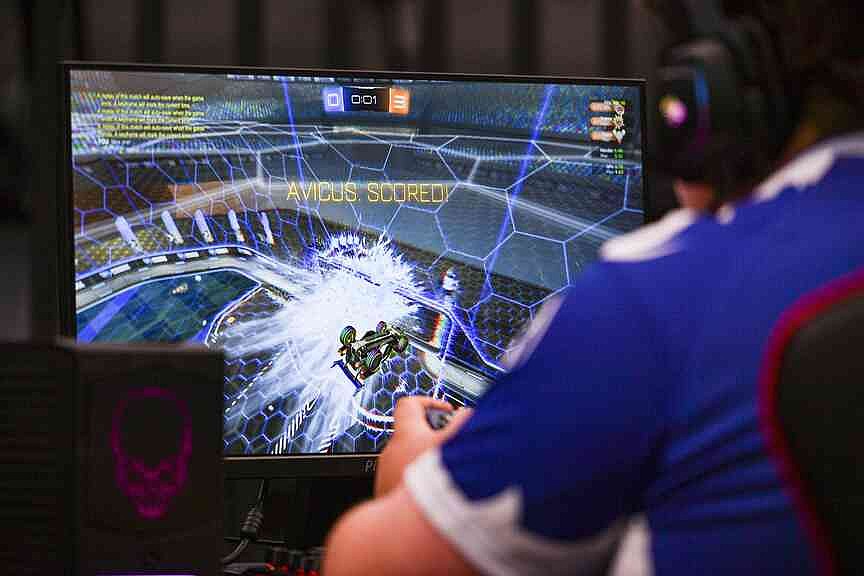
Students play Rocket League in April 2024 during the 2024 Arkansas Activities Association State eSports Championship inside Fort Smith Southside Arena in Fort Smith. A recent University of Arkansas study found religion and spirituality helped protect against depression in young adult online gamers.
(File Photo/River Valley Democrat-Gazette/Hank Layton)