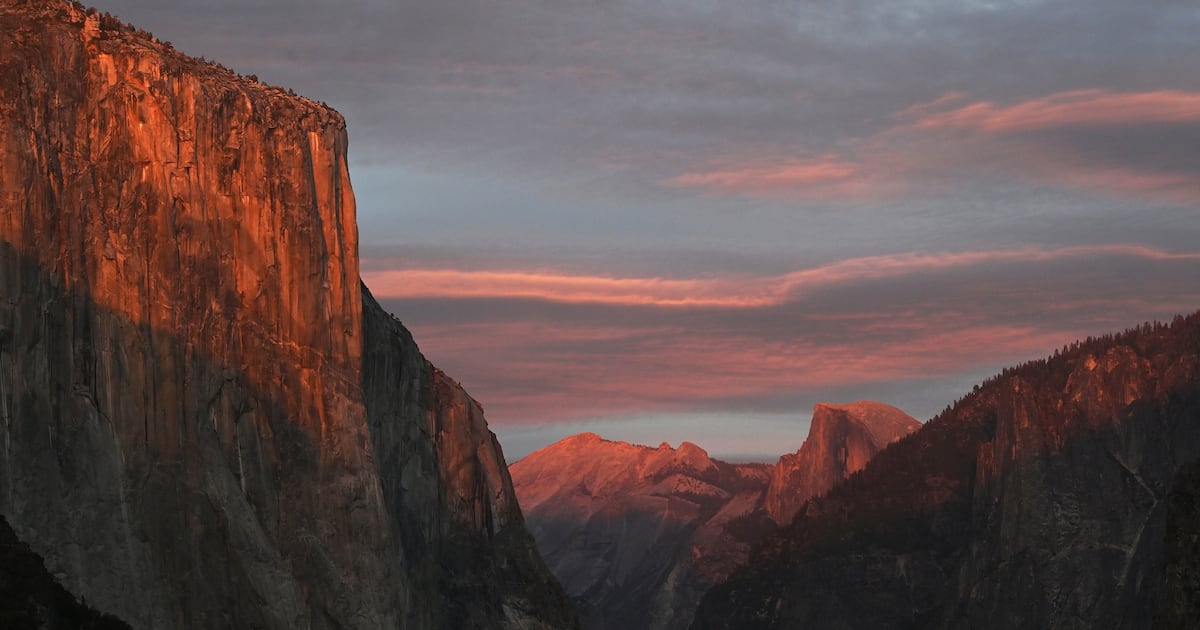
Sunset at Yosemite National Park. (Matt McClain/The Washington Post)
In his first interview on the topic, Jeff Pori said he aims to connect a new resort to a national park road by exchanging an acre of federal land for another parcel.
A potential deal to enable a land swap in Yosemite National Park would allow for a driveway that would connect a lodge and rental cabins to the iconic park, the project’s developer said in an interview with The Washington Post.
Jeff Pori, chief executive of Nevada-based Kingsbarn Realty Capital, shared new details about the company’s goals Monday in his first press interview on the topic.
Under the proposal, Pori said, the federal government would exchange land that is part of Yosemite for property purchased by Kingsbarn so the company can connect its development to a highway lying inside the park, 700 feet away.
On its 83-acre property, the company aims to build short-term rental accommodations for tourists coming to the country’s fifth-most-visited national park. Pori said it would not be a private “compound for rich guys” to live in, as some are trying to characterize it.
A lawyer representing Kingsbarn initially described plans for upscale residences, before clarifying that the plans were for rentals and not individually owned houses.
Pori said the project has yet to be designed, but the company’s proposal will be similar to one made by a previous private owner from whom Kingsbarn bought the property. That plan included more than 80 cabins and a 150-room hotel, as well as parking and other amenities, according to the previous design plans.
Land advocates criticized the plan as granting access to the public park for private gain.
“It’s for a massive commercial development,” said Neal Desai, senior director for the Pacific region for the National Parks Conservation Association, which is opposed to the swap. “This is to help a real estate developer make a massive windfall off of property that never had direct private access to a national park, full stop.”
Kingsbarn’s property sits on Yosemite’s western border, with the Stanislaus National Forest along its other three sides.
Currently, the property can be accessed only by an 11-mile dirt road through the national forest, and Pori said that could be a safety issue in winter conditions.
Kingsbarn is instead seeking to build a driveway to connect the property to the park highway, Pori said. It would cross land currently owned by the Interior Department, which would give Kingsbarn 1.1 acres in exchange for property of equal value, if the deal moves forward.
Even once connected to the highway, the development would be a 45-minute-plus drive to Yosemite’s valley floor or any of the other major attractions of the park, he said. The development would be hidden by a berm and not visible from the highway.
Pori said the potential new lodging area would pull some visitors away from the congested valley floor inside the park where other accommodations are located.
“It’s about safety, convenience and adding something to the park so that it would be a nice place for people to come to. And the fact that it’s a long way away from where the other lodging is, which is congested,” Pori said.
Desai of the National Parks Conservation Association said the Kingsbarn project would do the opposite and add congestion to the already overloaded park.
“They are bringing more people to the park. They are bringing more cars to the park,” Desai said.
He said congestion became far worse after the Trump administration eliminated a daily reservation system at the park that previously controlled the flow of visitors.
“We have people already waiting for hours just to get inside the park, and then they get inside the park and they spend another hour circling around looking for for parking. Yosemite right now is in complete chaos.”
Desai said he visited early on a Thursday in June, when there was a 30-minute wait at the park’s entrance and already hundreds of cars competing for too few parking spots near the trailheads in the valley.
In the company’s efforts to gain access to the main park highway, Pori said, he had one in-person meeting last year at the Interior Department, which referred him to National Park Service staff.
A series of Zoom calls followed, in which park staff established that a land swap would be the best way to move forward.
Kingsbarn is now in the process of having the land appraised to ensure that the swap is of equal value, Pori said. Only after the park land is appraised would Kingsbarn and the Park Service be able to identify a suitable parcel to exchange for it, Pori said.
He said the Park Service indicated that the parcel would need to be in California.
Last week, the Interior Department, which oversees the Park Service, said no final decision had been made on the matter. In a statement Tuesday, Elizabeth Peace, an Interior Department spokesperson, said that “if a more concrete proposal is submitted for consideration,” it will be subject to federal law and the established review process, including opening it for public comments and completing an environmental review.
The Park Service generally transfers land only with congressional approval, with possible limited exceptions for minor adjustments to park boundaries, so long as the ultimate goal is conservation.
“A land exchange does not necessarily require a congressional appropriation if the proponent agrees to cover all associated costs,” Peace said. “Depending on the appraised values of the properties involved, congressional notification or approval may be required before an exchange could be completed.”
Congress established the Land and Water Conservation Fund (LWCF) in 1964 for acquiring land and water for conservation purposes, and it currently has permanent annual funding of $900 million a year.
The administration earlier this year included the Yosemite land swap on a list sent to congressional appropriators for potential inclusion in the 2026 fiscal year’s LWCF transactions, documents show. Congress has not advanced the project.
Sens. Jeff Merkley (D-Oregon) and Lisa Murkowski (R-Alaska), the top-ranking lawmakers on the Senate Appropriations subcommittee for interior, provided the department with a list of projects they agreed to advance, according to Merkley spokesperson Maggie Sunstrum.
“That didn’t include the Yosemite project, which Senator Merkley objected to,” she said.
Murkowski’s office did not respond to request for comment.
The office of Sen. Alex Padilla (D-California) is aware of the administration’s attempt to transfer part of Yosemite to a private developer, spokesperson Danny Rodriguez said in a statement.
“Our office is working with staff on the Senate Appropriations Committee to try to block the Interior Department from moving this project forward,” Rodriguez said.
The Park Service property in question is in Tuolumne and Mariposa counties, but the land acquired in exchange “may be in a different county,” the submission to Congress said, without elaborating on the possible location.
Desai said that if the land exchange is allowed for reasons that are commercial rather than conservation-related, it would set a dangerous precedent.