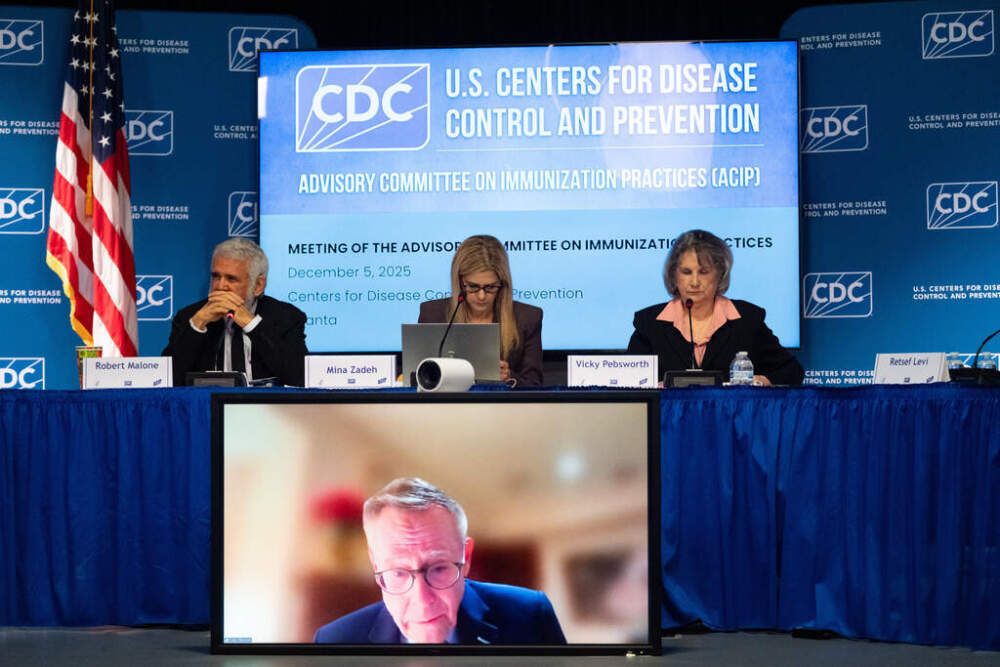
The head of the CDC’s vaccine advisory panel recently said he thinks vaccines for polio and measles should be optional. A fact-check of the Trump administration’s latest moves against mass vaccination.
Guests
Dr. Peter Hotez, physician scientist and professor of pediatrics and molecular virology at Baylor College of Medicine, where he also co-directs the Texas Children’s Hospital Center for Vaccine Development
Also Featured
Bob Oakes, former senior correspondent and Morning Edition host at WBUR. He was diagnosed with polio as a baby.
The version of our broadcast available at the top of this page and via podcast apps is a condensed version of the full show. You can listen to the full, unedited broadcast here:
Transcript
Part I
MEGHNA CHAKRABARTI: We’re going to take a look at how deeply anti-vaccine sentiment has embedded itself at the highest levels of government. Now, that’s not really new, but what is new are some very recent comments made by the head of the CDC’S vaccine advisory panel. But first, let’s start with Bob Oakes.
He happens to be a former colleague of mine for decades. He was WBUR’S Morning Edition host, and that’s my home station. Bob was also one of the most respected political reporters around these parts. Bob was born in December of 1954. That also happens to make him a survivor of what was once the most feared disease in America.
BOB OAKES: In her journal, my mom kept a journal. She repeatedly wrote about how I was an active baby standing in the playpen, in the bathtub, in the crib before I was six months old. But then just a month or so later, she wrote, you became sick.
(Courtesy of Bob Oakes)
She got up one morning and I was in the crib, and instead of bouncing around as a six-month-old, I was not really moving.
She wrote on August 11th; you were taken to the hospital. POLIO! in all caps, followed by two exclamation points. Mom wrote about this, but she never really talked about it much, and I always wondered if she felt guilty about not getting me the polio vaccine as quickly as maybe it was available.
Because it was available for a few months before I got polio. I never really brought it up because I was worried that if I did, I would make her feel bad and I didn’t want to do that.
CHAKRABARTI: Polio was once one of the most feared diseases in the U.S.
In 1952 alone, some 60,000 children were infected, thousands were paralyzed and more than 3,000 died.
(NEWS MONTAGE)
There are a lot of parents who live in fear. I know I do. The fear, my friends, is polio, infantile paralysis.
50,000 polio cases, 103,000 cases. 122,000 cases. Where will it end?
CHAKRABARTI: The polio virus is highly contagious and spreads through person-to-person contact. Even if someone doesn’t have symptoms. In the fifties, some parents wouldn’t let their children play with other kids.
(NEWS BRIEF)
It has closed the gates on normal childhood. It has swept our beaches, stilled our boats, and emptied our pockets.
CHAKRABARTI: A polio infection can look like the flu at first, but in about one in 200 cases, the virus attacks motor neurons in the spinal cord and brainstem. It paralyzes muscles, and in some cases, a child’s chest and throat muscles stop functioning and they can’t breathe without the help of the infamous iron lung.
(NEWS BRIEF)
Mechanical respiratory aids temporarily do the work of the muscles required to breathe.
In two hospitals in Los Angeles County alone, these machines are now furnishing the breath of life to 72 polio victims.
CHAKRABARTI: They were those long cylindrical tubes that looked almost like a submarine. Children would be placed inside the iron lung with their heads sticking out of one end, and the air pressure inside the cylinder would go up and down, forcing air in and out of the child’s lungs.
In Bob’s case, the virus withered the muscle and bones in his left arm and right leg. Both are smaller, weaker, and shorter than his other limbs, and he still walks with a pronounced hitch on his right side.
Bob was just two years old when he first started wearing the leg braces emblematic of kids with polio.
Without them, he couldn’t do what toddlers do. Stand, walk, toddle around.
OAKES: So the braces were these kind of ugly metal and leather things that were attached to a boot-like shoe and went up my leg, either from the midcalf to all the way just below the knee. They were awkward and heavy to wear, and they were painful in that in the upper part of the brace it was metal wrapping around your leg covered in leather.
(Courtesy of Bob Oakes)
So there was friction there all the time. I always had at least a minor sore in those spots. I resented the fact that they were there, because they limited the opportunities I had to play with other kids. I couldn’t run as fast as other kids. Maybe I couldn’t run at all.
CHAKRABARTI: 2-year-old Bob wouldn’t be able to take those leg braces off until he was more than 12 years old.
OAKES: If you’re wondering whether I was self-conscious, the answer is, Oh, definitely. Yes. Kids were not necessarily kind, they’d point and they’d stare and sometimes they’d make fun. I was a pretty thick-skinned kid. One time I must’ve been about 12, some lady with her little kids looked at me and she grabbed her kids and pulled them away, I would infect them or something.
But then she kept staring at me. And I was a little bit of a smart ass kid, so I turned around and I looked at this lady, and I remember saying something like, is there something I can help you with? Or would you like to pay the admission charge for staring at me? And she harrumphed and walked away. When I was a little older and reached school age, the surgeries started.
Every summer or every other summer for years I was in the hospital for orthopedic work. They fused bones to help stabilize bone weakness. They transferred tendons mostly from my good left leg into my right leg, and also, they transferred tendons from the leg into the left arm to help give me movement and mobility and strength in those limbs that I would otherwise not have.
CHAKRABARTI: The surgeries stabilized Bob’s limbs, but could not make up for the muscle mass he’d never get back, or the fact that his right leg and left arm would remain significantly shorter.
OAKES: I had the right arm, and the right arm became the workforce. As a teenager, I had a huge forearm. Through the urging of an older cousin of mine, I started arm wrestling other kids. Because the right arm was so strong and so huge, this little kid with the withered left arm could topple a lot of kids even bigger than me with the right arm in arm wrestling.
Just before entering seventh grade, the surgeries pretty much ended. The braces that were on my legs for the decade came off. When they came off, I was incredibly liberated and I tried almost everything.
What I found that I really loved was hiking and backpacking. So through my teens and into my early ’50s, I was fairly constantly in the woods hiking. I backpacked in different spots all over America, a lot of mountains in New England, Mount Washington in New Hampshire, Mount Katahdin in Maine.
CHAKRABARTI: As I mentioned earlier, Bob went on to have one of the most celebrated radio journalism careers in New England.
He was both a very tough and highly respected political reporter and the warm and energizing Morning Edition host that hundreds of thousands of listeners woke up to every weekday. I’ve learned so much from him. It’s obvious that Bob was never held back by polio, but when he turned about 60 years old, the disease showed it was not done with him.
OAKES: About a decade ago, I realized I was having some trouble climbing stairs, new trouble. And since then, I’ve been diagnosed with what’s called post-polio syndrome. I’ve started losing muscle mass because of old age, which is a problem because I started with a muscle deficit and I’m nowhere near as agile and steady on my feet as I was before.
I have a scooter to help me with long distances. I also have a stair lift in my home to get from the first floor to the second floor.
I’ve been a fly fisherman throughout my entire adult life, and I’ve stood in swift water and countless streams to cast a fly to a rising trout or a rising salmon.
While I can fish from a canoe or a rubber raft now or from the shore, I can’t stand in the rushing water anymore because I cannot trust my legs to slide out from under me.
CHAKRABARTI: The creation of the polio vaccine is one of the great public health triumphs of the 20th century. The disease has almost been completely eradicated except in a handful of countries, and with it, the public’s memory has also faded of how dreadfully polio can ravage the body.
OAKES: When I go see a new doctor and I get some sort of physical exam where I have to lift up my pants leg or sit in a hospital gown or whatever, and they look at me and they say, what was that? And I say, that was polio. And they say, wow, we never see this. And some doctors I’ve seen have never seen it, and they’ve never seen the impact on the body.
Some doctors I’ve seen have never seen [polio], and they’ve never seen the impact on the body.
Bob Oakes
CHAKRABARTI: It is this lost memory that may be contributing to declining vaccination rates in America. Overall, polio vaccination rates in kindergartners dropped to about 92%. In some states that rate drops below 90%, and in Washington, D.C. just 80% of kids had been vaccinated against polio before they started school, according to a 2024 dataset from the CDC. And then, there is the extreme political polarization of public health now at the highest levels of the nation’s government. Dr. Kirk Milhoan is the current head of the CDC’s Vaccine Advisory Panel, and just last month he appeared on a podcast and said this about the polio vaccine.
I think also as you look at polio, we need to not be afraid to consider that we are in a different time now than we were then. Our sanitation is different. Our risk of disease is different. And so those all play into the evaluation of whether this is worthwhile of taking a risk for a vaccine or not. But it’s been very important to us members of the committee, is that what we are doing is returning individual autonomy to the first order, not public health, but individual autonomy.
OAKES: If you tell people that polio vaccines are optional, some people are definitely going to read that as, I don’t need to get it for my kids because things must be okay with polio.
CHAKRABARTI: Bob Oakes asks people to consider the bigger picture.
OAKES: What about the family next door that has a little kid and the little kid is too young yet to get any of the polio vaccine, or is too young to have gone through the series of four doses of the vaccine that they get now. How could you possibly put another little kid not in your family at risk of a disease that could leave that little kid debilitated or might kill him or her?
And there will be new cases of little kids who end up with shrunken arms and legs like me. And I ask, why inflict that chance on a little kid? Look at my body and ask yourself if you want to put your little kid through this.
There will be new cases of little kids who end up with shrunken arms and legs like me. And I ask, why inflict that chance on a little kid?
Bob Oakes
CHAKRABARTI: Bob Oakes is a retired senior correspondent and Morning Edition host at WBUR in Boston.
Part II
CHAKRABARTI: Joining us now is Dr. Peter Hotez. He’s a professor of pediatrics and molecular virology at Baylor College of Medicine. He also co-directs the Texas Children’s Hospital Center for Vaccine Development and is author of the Deadly Rise of Anti-Science: A Scientist’s Warning. And he joins us from Houston.
Dr. Hotez, welcome to On Point.
PETER HOTEZ: Oh, thanks Meghna. Thanks for having me.
CHAKRABARTI: I’m delighted to have you because what I’d like to do is for the rest of the program today, I want to go through, in detail, many of the things that Dr. Kirk Milhoan said on a podcast just a couple of weeks ago. By the way, the podcast is called Why Should I Trust You?
Actually, it’s an excellent podcast that’s hosted by doctors and health care journalists who are trying to get to the bottom of the sort of rising distrust in science and medicine. And they talk to people from all different points of view about why they don’t trust science or medicine.
And they spoke with Dr. Milhoan I think just about two or maybe three weeks ago. He’s, of course, now the head of the CDC’s vaccine advisory panel. So that’s the backdrop. Dr. Hotez, let me just start with a simple background question. How would you define exactly what the CDC’s Vaccine Advisory Panel does and why it’s important?
HOTEZ: We have what the Vaccine Advisory Committee did, and now we have the current version of ACIP, which has become a platform for anti-vaccine activism. So in the past, it’s been an advisory committee of experts. And it’s truly an advisory committee. It’s meant to help the director of the Centers for Disease Control look at vaccine policy, to check what their internal thinking is with genuine experts who are picked from people all over the country.
And these are often infectious disease physicians, because so much of it is around specific guidelines for administering the vaccine. The problem, of course, is with this new version of the Department of Health and Human Services under Mr. Kennedy, under Robert F. Kennedy, Jr.
He’s removed all the experts and he’s filled the committee with ideologues, with propagandists and those who pride themselves on their anti-vaccine activism. And as a consequence, the committee has no standing with the scientific community. I can spend as much time as you’d like debunking all of his statements, but I’ll always, I’d like to just preface it by saying, who cares?
In the sense that what these individuals are saying has no substance to it. There’s no, it’s fact free. It has no basis in science. And so that’s why you’re starting to see, for instance, American Academy of Pediatrics create their own set of guidelines. And why you’re seeing groups of coalitions of states in the Northeast and in the West Coast create their own set of guidelines.
Why we have now a new vaccine integrity product. It’s to try to figure out what the heck to do now with this mess we’ve got.
CHAKRABARTI: Okay. Dr. Hotez, you point has taken about people in the scientific establishment don’t take the current version of the panel very seriously, but when you said who cares, I would say the millions, tens or hundreds of millions of Americans who are not in the scientific establishment, they care. Because when they hear these statements from folks who are supposed to be leaders of our public health infrastructure, it’s hard for your everyday person to really understand, as you said, what is fact and what is fact free.
So that’s actually why I am really, really passionate about today’s episode. Because we need you, right? The public needs people like you to help explain what may be obvious to you, but not obvious to the rest of us. So let me also make another side point that Dr. Milhoan is a physician, but he’s a pediatric cardiologist and not a virologist or an infectious disease specialist.
But let’s get to what he really said about polio in this podcast. So here’s the full section of his comments about the polio vaccine.
I think also as you look at polio, we need to not be afraid to consider that we are in a different time now than we were then. Our sanitation is different.
Our risk of disease is different, and so those all play into the evaluation of whether this is worthwhile of taking a risk for a vaccine or not. We have to take into account that are we enjoying herd immunity right now? That it may look like it’s better not to get a vaccine than to get a vaccine, but if we take away all of the herd immunity, does that switch?
CHAKRABARTI: Okay, so Dr. Hotez, there’s four things in there that Dr. Milhoan says that I want to go through quickly but importantly. First of all, he says, we don’t need to worry about the polio vaccine so much because our sanitation is different. Cleaner water, better waste treatment. Does that have an impact on the spread of polio?
HOTEZ: Remember, polio came to this country and caused paralytic polio epidemics starting in the ’40s and ’50s, in part because our sanitation had improved. So it’s a fallacious statement. So as our urban centers got cleaner, improved sanitation, kids, little babies were not being exposed to poliovirus at a younger age anymore.
And so the paralytic polio was mostly striking school age children. So that’s point one. Point two is, remember, our vaccine ecosystem is extremely fragile, and it doesn’t take much for these diseases to return. So we already have active transmission globally in Pakistan and Afghanistan.
But for instance, as vaccination rates went down in in communities in New York and New Jersey in 2021, 2022, guess what? Polio shot back up in the wastewater in New York State, particularly around the confluence of the tri-state area. So it doesn’t take much for these viruses to come back.
And of course, now we have the return of measles and the return of pertussis. So the dominoes are falling and polio is going to be one of the next dominoes.
CHAKRABARTI: Okay he also says, maybe you just answered this, but he says our risk of disease is different. And he couches that against the risk of taking a vaccine or not.
Isn’t our risk of disease different now simply because we have been vaccinating children against polio since 1955.
HOTEZ: Yeah. I think we call that a death wish. As vaccination, if his dark dystopian vision comes to fruition, then, of course, vaccination rates will decline precipitously as they have in many parts of the country already.
This will continue and we’ll simply see the return of polio in the wastewater first, and then we’re going to start seeing paralytic polio cases. Again, just like we have now for measles and pertussis.
CHAKRABARTI: Okay. So this next part of what he said is I know a source of confusion for many Americans.
He says, we’re enjoying herd immunity right now. So for polio specifically, what does the overall vaccination have to be in order to maintain that herd immunity?
HOTEZ: So the way we calculate, fortunately, the genetic variation of the three polio strains is not that great. So if you are vaccinated and you have circulating antibodies and T cells the level of protection is quite high.
But it also means that when a virus is highly transmissible, as is polio, and we use something called a reproductive number two, and the scientists abbreviated … R0 is of polio is quite high. And so as vaccination rates go down, the reproductive number then exceeds the herd level of herd immunity.
So you really need to be up around 90% vaccination rate. For measles it’s even higher. And remember also that when polio appears in the community, it doesn’t necessarily trigger things right away. And this is a very important point. Because when polio was occurring in the summer and fall in urban centers in places like New York or Houston in 1940s and 1950s.
For every 100 kids that had polio, 90%, 90 of them would be without symptoms at all. 10% would have fever, headache. About 1% or 2% would have what’s called aseptic meningitis, and about 0.5% would actually have paralytic polio. So the point is polio can circulate in a community for a while, and if you’re not actively looking for it, either in wastewater or sampling bodily fluids from populations, you’ll miss it.
Polio can circulate in a community for a while, and if you’re not actively looking for it, either in wastewater or sampling bodily fluids from populations, you’ll miss it.
Peter Hotez
And so it’s easy to get caught off guard.
CHAKRABARTI: So it’s interesting because you said it has to, for polio, that vaccination rate needs to be at least 90%. I mentioned some statistics from the CDC from 2024 that said we’re already, we’ve dropped to the low 90s for polio, so we’re skirting that line here. Now, by the way, I should let —
HOTEZ: Yeah, we’re already in fact in a study that I was part of, but it was led by Nathan Lo at Stanford.
We’ve been looking at the declines in vaccination rates over the last few years. Part of the problem is the CDC only collects statewide data or national data. It doesn’t drill down to the counties. And that’s where you really see the horror unfold. So we’ve got counties and places like West Texas and the Southern Great Plains are in northern parts of South Carolina, where vaccination rates by county are very low and well below that 90%.
CDC only collects statewide data or national data. It doesn’t drill down to the counties. And that’s where you really see the horror unfold.
Peter Hotez
Guess what? That’s where we had measles and that’s where we had pertussis. And that’s the danger point. And sometimes what you’ll see is anti-vaccine activists will, quote statewide numbers, which is a pretty blunt instrument, which you really need to do is drill down to the county level or even finer than that.
CHAKRABARTI: Yeah. If I memory serves that outbreak in the tri-state area and some of the counties there, it wasn’t even in the 30s, the percentage of vaccination. But I want to just tell listeners clearly that we did reach out both to the CDC and Dr. Kirk Milhoan directly to get comment or being able to interview Dr. Milhoan for this conversation.
Neither Dr. Milhoan nor the CDC responded to our multiple requests. Now Dr. Hotez you mentioned measles as well. And the issues are similar to polio. So I want to play a part of the podcast where Dr. Milhoan talked about why he’s also less worried about the necessity to get the measles vaccination, and here’s what he said.
MILHOAN: Many of those risks of not, of getting measles without having a vaccine was in the 1960s. We take care of children much differently now. Our ability to have pediatric hospitals, children’s hospitals, pediatric ICUs, are we looking at real today data with our population? Are you traveling? Are people traveling to you?
What I see in Africa is much different. I’ve never seen a case of congenital rubella affecting a child. Now, it may happen, but I haven’t seen it. In Africa, I saw three in a day.
CHAKRABARTI: Okay. So a lot going on there. Let’s take the first half of that.
HOTEZ: I’m just, I just couldn’t help but thinking of Abba Eban’s famous statement in the UN general assembly, which was his ignorance is encyclopedic.
This is just extraordinary.
CHAKRABARTI: So tell us why. Let’s took the take the first half here, because he’s basically asserting that medical care is light years ahead of where it was in the 1950s and asserting that we can just take care of kids better in the hospital when they come down with measles.
HOTEZ: But remember, okay let’s look perfect. So let’s look at that situation that we had in my state of Texas, in West Texas, we had this horrific measles epidemic. Usually on average, about 20% of kids require hospitalizations. And so in our measles epidemic, we had 99 kids in the hospital, which by the way, our Secretary of Health and Human Services, Mr. Kennedy, made false statements about, he said they were there for quarantine or isolation. It wasn’t true.
They were there because of measles pneumonia. Measles neurologic involvement and meningitis, deafness because of measles otitis. Measles is a bad actor, and of course, we had two deaths among those children who were unvaccinated. Perfectly well, school aged kids whose parents made the terrible decision not to vaccinate them, and that’s basically what they want to bring back.
So yes, we have pediatric intensive care units and when I was a resident in Boston where you are, in the 1980s, I took care of kids like that in pediatric ICUs. And it’s horrible to watch these kids with diseases that now we can prevent with, and who wants their child intubated? For measles pneumonia, have you ever seen a child gasping for air because of the bordetella pertussis toxin, the pertussis bacteria that produces a toxin that makes it so you can’t oxygenate and you basically asphyxiate. You want to watch your child do that in an intensive care unit?
That’s what he’s talking about.
CHAKRABARTI: Can I ask a question though? But the treatments overall, while they may look sophisticated, they’re still the same. There was oxygen and ventilation. For measles back in the 1950s and ’60s, they would be able to rehydrate patients, IV fluids.
Has there been anything significantly, those same measures may have better techniques, but are there like any novel new treatments for measles or is it the same thing?
HOTEZ: Not really. Our armamentarium of antiviral drugs is not nearly as strong as antibacterial antibiotics.
And so no, we don’t have specific antiviral medicines that would work for polio or work for measles. And so there’s, it’s all supportive care. And who wants to subject your child to that? Not to mention, it is not just a matter of death. It’s permanent neurologic injury. It’s scarred lungs.
Your colleague Bob was so eloquent, at the beginning of this broadcast, describing the long-term consequences of a single polio infection when he was a young child. That’s not what we want to bring back.
CHAKRABARTI: And I think the risk of mortality for a measles infection also hasn’t changed.
It’s the same as it was before there was the MMR vaccine, meaning we actually, we haven’t gotten much better at treating it once someone gets measles.
HOTEZ: If you’re not vaccinated and you get one of these breakthrough infections, there are some things that we can do and there have been some improvements in supportive care, but it’s modest. And there’s still a high risk of your child having permanent injury or unfortunately losing their lives, as those two kids did in Texas.
CHAKRABARTI: So we have about 30 seconds before our next break, Dr. Hotez. Dr. Milhoan also said basically, an American child’s exposure to measles, mumps, or rubella is just not going to be the same as it is in Africa. So there’s less reason to worry. Your thoughts.
HOTEZ: I don’t know where that comes from. Certainly, for Rubella, I’ve taken care of kids with congenital rubella syndrome, and this happens when mom, who’s not vaccinated, gets exposed to the rubella virus.
It produces pretty severe consequences of birth defects, including cataracts, heart disease, small head, what’s called microcephaly, profound intellectual impairment. And the risk if mom is not vaccinated and gets rubella is just that.
Part III
CHAKRABARTI: I just want to go back in time to the years where the polio vaccine was developed because it’s not just one of the greatest public health triumphs in U.S. history. I think it’s also an example of how fragile the public’s trust can be. You know the story, Dr. Hotez, but for our listeners, let me just say that in the first half of the 20th century, annual polio epidemics were so deadly and so feared they could completely transform daily life.
Here’s a PSA from 1949.
(PSA PLAYS)
It has closed the gates on normal childhood. It has swept our beaches, stilled our boats, and emptied our parks.
CHAKRABARTI: President Franklin Delano Roosevelt decided that the government had to push harder for a vaccine or a cure, but the money just wasn’t there. Roosevelt, of course, had been struck by polio himself.
So in 1938, he created the National Foundation for Infantile Paralysis, later known as the March of Dimes. And it’s an incredible story of the entire nation pulling together literally dime by dime, raising millions of dollars for polio research.
ROOSEVELT: The generous participation of the American people in this fight is a sign of a healthy condition of our nation. It is democracy in action.
CHAKRABARTI: Enter Dr. Jonas Salk, the son of Russian Jewish immigrant parents. Salk was a brilliant young man who would later say that he wasn’t so much interested in science itself, but in how he could use science to, quote, do the greatest amount of good for the greatest number of people.
SALK: And it’s necessary merely to have enough who make positive contributions to overcome and help solve the problems of each age.
CHAKRABARTI: Dr. Salk in 1976. By 1949, the March of Dimes funding was going to several vaccine researchers. Salk gathered his group at the University of Pittsburgh, and their lab, by the way, was in the basement of Pittsburgh Municipal Hospital. The childhood polio ward was just upstairs, a constant and sobering reminder to Salk’s researchers of the urgency of their work.
Now, Salk faced a major early challenge. Because he believed that an inactivated polio vaccine would work best. That’s when people are exposed to small amounts of the dead virus to trigger an immune response. Others, particularly Dr. Albert Sabin, who would also play a towering role in eradicating polio.
He believed that vaccine using a live but severely weakened virus would be stronger protection. Now, Sabin had reason to doubt Salk. Because earlier in the 1930s, two separate attempts to develop an inactivated polio vaccine had ended in tragedy. The virus in the vaccine had not been totally inactivated, and it actually gave kids polio.
Many died. Nevertheless, Salk and his team carried on, and by the early 1950s, they had formulated a polio vaccine that they were willing to try on themselves and their kids. Then in 1954, the first vaccine field trial began right there in Pittsburgh. Here’s John Troan, former editor of the Pittsburgh Press.
JOHN TROAN: Once the words started getting around about some progress being made, there was no lack of volunteers. Parents were willing to turn their kids right over. They were convinced long before Salk, this is going to work.
CHAKRABARTI: In 1954, the researchers scaled up. They launched nationwide placebo-controlled testing on over a million children.
It was the largest vaccine field trial in history. And here’s where I think the past is the present, because disinformation and fear mongering began on the polio vaccine as soon as the trial had been announced.
(NEWS ANNOUNCEMENT)
Time for Walter Winchell, the man who gives America the news. Walter Winchell of the New York Daily Mirror and the Washington Post.
CHAKRABARTI: Winchell was a massive and popular columnist and gossipy radio broadcaster. 50 million Americans regularly tuned in, and he’d kicked off his April 4th, 1954, broadcast saying quote: “Attention everyone. In a few minutes, I will report on a new polio vaccine claim to be a cure. It may be a killer.”
Winchell also said that authorities were stockpiling little white coffins to handle the vaccine’s potential victims.
And that week parents pulled 150,000 children out of the national trial. The Pittsburgh Post-Gazette fired back noting Winchell was, quote: Was distinguished for a long career of washroom gossip, self-glorification, and journalistic vendettas of the basest sort. End quote. That trial though was successfully completed and on April 12th, 1955, the results were announced in a global media event.
The vaccination was 80 to 90% effective against paralytic poliomyelitis.
CHAKRABARTI: 90% effective in protecting people from polio. The world’s first successful polio vaccine, the nation celebrated as if a war had just ended, which in a way, it had. In 1950, the U.S. recorded 33,000 polio cases. In 1955, the number was still high, 14,000.
But just two years later after the vaccine was introduced, the number plummeted to just 2,500 cases. But here again, is where the past is the present, because less than a month after vaccination began nationwide, thousands of children suddenly fell sick with polio, and hundreds were paralyzed. All of these sick children had been injected with one bad vaccine batch made by Cutter Labs.
It was one of the companies contracted to make the vaccine. A huge disaster. There’s no underplaying it, and it risked sparking immediate distrust in the lifesaving vaccine. The government immediately tightened regulation and expanded oversight of vaccine production.
They suspended polio vaccinations for eight days. And though the vaccination did resume, the tragedy proved just how fragile the public’s trust could be. Now, one last thing about Dr. Salk himself. He remains an American hero. So too are the other researchers who we didn’t really mention in depth here, particularly Dr. Albert Sabin, whose oral vaccine went into production in 1961.
Both men saved millions of lives, both men and their colleagues, they could have been billionaires if they’d patented their vaccines, but both men chose not to. In 1955, Salk told famed broadcaster Edward R. Murrow why.
MURROW: Who owns the patent on this vaccine?
SALK: The people I would say, there is no patent. This is, could you patent the sun?
CHAKRABARTI: It’s Dr. Jonas Salk in 1955. Now, Dr. Hotez, I wanted to go through that history because I want to hear from you what can we learn from, let’s say, the government’s response to that temporary failure with that bad batch of vaccine in terms of how to regain the public’s trust.
HOTEZ: Let me just make a couple of points first, which is that Jonas Salk was a hero of mine. I got to know him towards the end of his life in 1995. And he inspired our group at Texas Children’s Hospital also to not patent our vaccine. So our low-cost COVID vaccine reached 100 million people in India and Indonesia.
For $2 to $3 a dose. No patents, no strings attached. And so we provide a proof of concept that you can bypass some of the big pharma companies and still do big things in the vaccine space. And now we’re doing this for our low-cost parasitic disease vaccine. So he has been this incredible role model.
And another point is you mentioned Salk, Sabin. There’s a third individual who’s very important from Boston, who made the fundamental discovery that allowed those two breakthroughs. And that was John Enders. Who was a virus researcher at Harvard Medical School and Boston Children’s Hospital, who developed the cell lines that allowed both Salk and Sabin to grow the virus.
And even though they were competitors with Salk making the formal and inactivated virus and Sabin the oral live attenuated vaccine, they both relied on that discovery. You’re right. I think, you know, as we sometimes say in the vaccine world, it doesn’t take much for a vaccine, even a good vaccine to be voted off the island.
Just because of public perception. That’s what derailed an earlier Lyme disease vaccines, one of the rotavirus vaccines. So it could have things could have gone very badly after that Cutter incident. And I think there was transparency. People were very honest and it was a matter of explaining things to the public.
And this is one of the things that I try to do in my science communication during the COVID pandemic was give underlying assumptions and let the American people understand what you’re thinking. And I think that’s the mistake sometimes people make, is they give summary statements without giving the underlying assumption.
CHAKRABARTI: With Dr. Kirk Milhoan now the head of the CDC Vaccine Advisory Panel, he’s also clear about what he’s thinking and a lot of what he’s thinking is underlined by a well publicly declared disbelief in established science. Here is what he said on that podcast, Why Should I Trust You?
MILHOAN: I wouldn’t use established science. We’ve gotten in trouble with that.
JOHNSON: But that’s interesting. Someone who’s chairing the ACIP committee. You don’t like that? I don’t like established science.
JOHNSON: I’m not criticizing, I’m just, I’m curious, you’re probably gonna be getting a lot of reports and a lot of files and a lot of data that’s been established, things that we’ve looked at and pursued and invested.
MILHOAN: But that’s not science. So that’s not science. That’s not necessarily science. Science is what I observe. And is there a confirmation bias in what is established science?
CHAKRABARTI: Dr. Hotez, how do you respond to that?
HOTEZ: As you pointed out that this is a man who has no track record of accomplishment, either in vaccine development, vaccine clinical science, infectious diseases. And this is straight out propaganda. And this is what the MAHA movement is all about, it’s a system of pseudoscience designed to confuse people.
And remember, you know, what Hannah Arendt taught us a long time ago in the 1950s about propaganda. It’s not meant to convince you of the propaganda; it’s meant to confuse you. It’s meant so you don’t know what to believe anymore and that’s what this is.
CHAKRABARTI: Actually, I also see it as something perhaps even more insidious because he’s talking about that data that is gathered in trials, for example.
He does not see as real science, he distrusts established science because it goes through this systematic process of testing, of widespread observation and then analysis of the data. And instead, what he said in that clip is he essentially, what he only trusts is observable science.
And observable I think he means with his own eyes because a vaccine trial by definition is observable science. Why else would we do it? This is the level of even, he’s a pediatric cardiologist, but he seems to have a fundamental misunderstanding or a deliberate one of how we come to conclusions based on observable science in virology.
HOTEZ: That’s right. And heavily laced with what I’ll call gaslighting. And so you have, for instance, the head of the agencies like NIH or FDA, now say now we’re going to provide gold standard science for the American people. The NIH and the FDA and CDC historically have always provided gold standard science to the American people.
What they really want to do is provide gold standard pseudoscience for their own for this MAHA agenda, which unfortunately is very much linked to the wellness and influencer industry.
CHAKRABARTI: There’s one more clip I want to play because Dr. Kirk Milhoan, he also said there in that podcast that he’s not actually against vaccines.
He’s not anti-vax, but what he did say is he wants to change the focus of how we consider who’s taking on what risks. And he also, of course, believes in individual autonomy over public health. So here in this clip, you’re going to hear podcast host Tom Johnson ask Milhoan how he thinks about balancing freedom of choice with the safety of others.
JOHNSON: Where do you see the line for individual autonomy versus you are infringing on my child’s safety by the choice you are making, it doesn’t just affect you, it affects my child.
MILHOAN: I agree. There are two different things at play here. We don’t take one over the other. Just, let’s just flip that the other way around.
What if the child gets a measles vaccine to protect your immunocompromised child and gets a negative consequence from that? Wasn’t that your child causing that child to be harmed? I think these are hard decisions to make. This is why it’s nuanced. This is why I don’t like these, the different camps that come up with this is really hard.
CHAKRABARTI: This is why Dr. Milhoan advocates for personal autonomy over government mandates on vaccinations. Dr. Hotez, we only have a minute left here for all the people who are listening who may —
HOTEZ: Well, can I just, could I just say, this business of health freedom, it’s another propaganda term.
Look, where’s the health freedom now, if you now have a newborn baby, if you have a five, six month old baby and you now live in an area where there’s a measles epidemic, let’s say you have a six month old baby and you’re in South Carolina where the epidemic is ongoing, you have to be terrified now about bringing your child out to go to Target or Walmart or to go shopping for groceries.
Where’s that parent’s health freedom? And so it’s so disingenuous. It’s so cynical and so dark and it’s, frankly, it’s disgusting.
CHAKRABARTI: Actually Dr. Hotez, you answered the question I was about to ask, so with that, I want to say thank you so very much.
The first draft of this transcript was created by Descript, an AI transcription tool. An On Point producer then thoroughly reviewed, corrected, and reformatted the transcript before publication. The use of this AI tool creates the capacity to provide these transcripts.