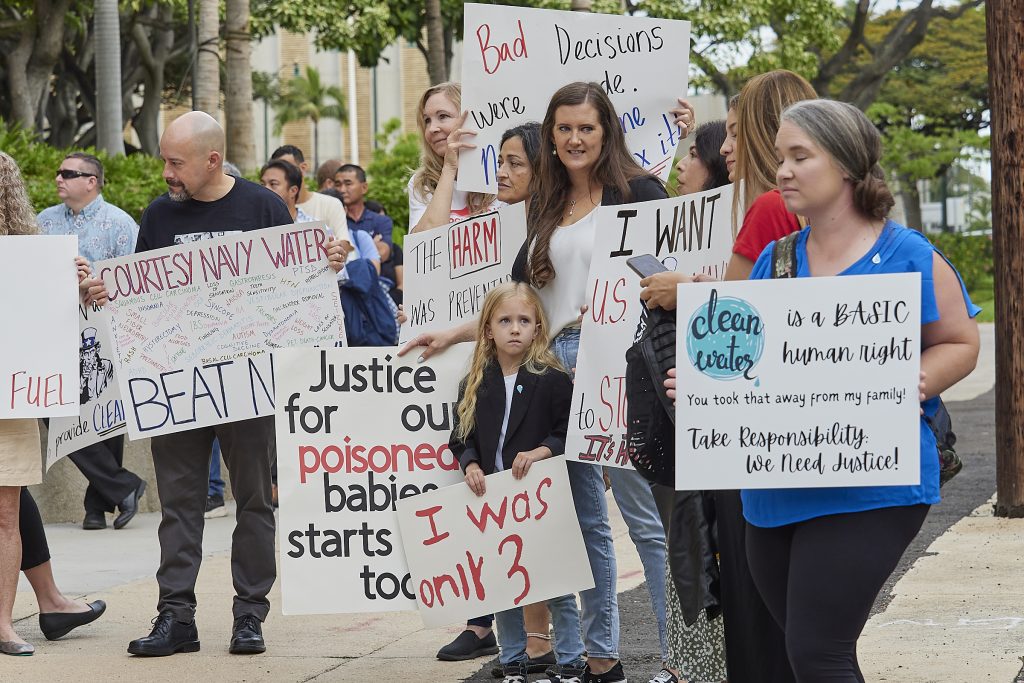
The state wanted the girl and her siblings to have a permanent home. The Kaluas were willing. But were they able?
Today, the trial of Isaac and Lehua Kalua — arrested on charges of murdering their adoptive daughter, Ariel Sellers — still looms.
To better understand how this state-sponsored adoption unfolded, we asked the family court to release case files concerning Ariel and the report of Special Master Steven Lane, who reviewed her case. The Judiciary commendably released Ariel’s records. Without such openness, Hawai`i cannot truly begin the policy discussions needed to better protect our children.
Ariel’s records reflect a child welfare system so heavily focused on the biological parents, it missed warning signs — some subtle, others flashing bright — that Ariel was suffering in the Kalua home.
Civil Beat is focusing on transparency, accountability and ethics in government and other institutions. Help us by sending ideas and anecdotes to sunshine@civilbeat.org.
Ariel was under the supervision of social workers, judges and court-appointed child advocates for over two years. After the adoption, oversight ended, and she disappeared less than a year later.
In the first 20 months, the parental ability of Melanie Joseph and Adam Sellers was the subject of numerous reports to the court, hearings and close examination by a host of professionals before termination of their parental rights. By contrast, in the adoption case — completed in a month — the state Department of Human Services submitted a single glowing report about the Kaluas, and the judge held a 12-minute hearing on the Kalua’s ability and fitness as parents.
But the family court lacked important facts concerning Ariel’s well-being with the Kaluas. The focus, of DHS, on expedient permanency — finding Ariel’s “forever home” — may have overridden their duty to report facts in a complete and impartial manner.
For the adoption, DHS represented that the Kaluas were “financially and otherwise able to provide proper care for the children” and that the adoption was in the children’s “best interests.” It is not clear DHS had sufficient information to make that representation. It certainly did not provide the family court with everything necessary to independently evaluate those claims.
DHS’s assessment of the Kalua’s finances, for example, was plainly insufficient. Isaac filed for bankruptcy six months before the adoption hearing. DHS had no idea. The failure to discover that fact and disclose it to the family court is inexcusable.
Isaac and Lehua Kalua are still awaiting trial for murder in connection with the death of their adoptive daughter, Ariel Sellers. (Honolulu Police Department/2021)
The bankruptcy also casts doubt on the Kaluas’ candor if they failed to notify DHS or the court of such a significant financial event. Lehua was similarly under financial duress — with a collection action filed weeks after the family court approved the adoption and two more filed within the next six months. How can DHS assess financial ability to provide for children when its form adoption petition does not even reference debts?
The Kaluas’ economic strain, Lane observed, “could provide the wrong type of motivation to accept as many children as possible in foster care or adoption proceedings.” Illustrative, the foster payments nearly doubled the Kaluas’ monthly income (Issac received $4,755 as a shipyard specialist, Lehua $3,750 in foster payments).
DHS’s assessment of Ariel’s medical issues under the Kaluas’ care also was deficient. For example, DHS attributed a potential red flag — Ariel’s rapid and “significant” weight loss with the Kaluas — to healthier eating. But when Lehua reported that “Ariel would raid the refrigerator for food” at night, no one stopped to wonder why. DHS also received a report that Ariel was “treated differently” and “not being fed like the other children.” DHS failed to disclose that report to the family court.
After a series of fractures, DHS told the court that Ariel was “prone to fractures” and “does not seem to feel physical pain.” DHS also reported, however, that Ariel was taken to Castle Hospital after she “cried in pain after falling from a trampoline.” When DHS convened a “multidisciplinary team” to assess neglect based on the injuries, it did not invite the social worker who had expressed concerns, but did invite the Kaluas.
DHS also failed to disclose to the family court a critical report from Ariel’s teacher. The teacher raised several concerns, including that Ariel attended school only five days in January 2020 and only 66 days to date — 50% attendance. The teacher reported that “when Ariel is asked about her home environment, Ariel will shut down despite Ariel being the most vocal student throughout the day.”
The case records reflect serious concerns about DHS. DHS represented to the family court that the Kaluas would be better parents than Joseph and Sellers. But its singular focus on the shortcomings of Ariel’s biological parents — combined with the relatively minimal judicial review of DHS-sponsored adoptions as compared to child protective act cases — left the family court with an unduly rosy picture of life with the Kaluas. DHS needs to collect more information about foster placements, assess that information without bias, and share it with the family court.
Guided by the child welfare professionals, family court judges have the final say on matters of child safety. The American Bar Association recommends that judges in such cases ask “probing, detailed questions” so that agency staff, court-appointed guardians and attorneys will make “more thoughtful case decisions.”
“Often after the initial removal, attorneys, caseworkers and judges lose sight of original safety concerns,” the ABA says.
If Ariel’s case is representative, family court judges may need to ask more detailed and probing questions to compensate for DHS’s lack of neutrality and transparency in court reports. Questions yield information, and information drives safety.
Review the records here.
Sign up for our FREE morning newsletter and face each day more informed.
Sign Up
Sorry. That’s an invalid e-mail.
Thanks! We’ll send you a confirmation e-mail shortly.