EVERETT — Election officials in Washington state expressed relief after the Supreme Court upheld an injunction on Monday preventing new rules regarding mail-in ballots from going into effect before the upcoming November election.
The rules, proposed by the U.S. Postal Service, would require states to adopt new designs of ballot envelopes and send lists of information about voters who receive mail-in ballots to a Postal Service database. If the rules went into effect, the Postal Service would have only delivered ballots to voters on the lists provided by states.
Local election officials, which had worries over the policies themselves, were mainly concerned about the difficulties they could have caused for local election offices across the country, because of the short timeline that might have been required to implement them before the November election. (Snohomish County is set to mail its ballots in less than a month, beginning Oct. 9).
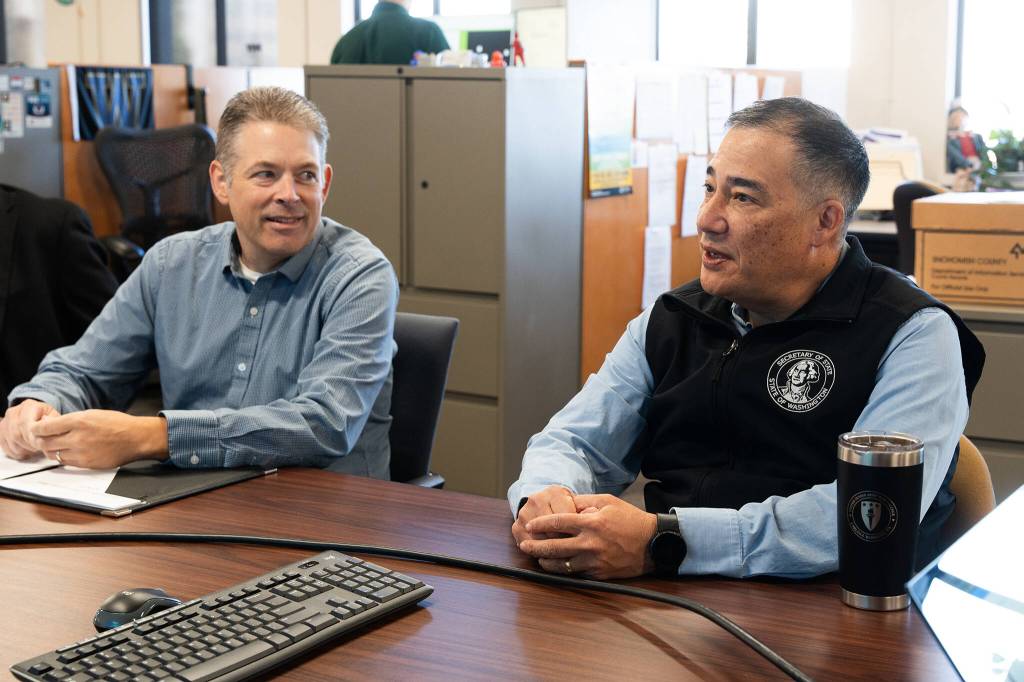
When asked during a visit to Everett on Wednesday about his reaction to the Supreme Court’s ruling, Washington Secretary of State Steve Hobbs gave two thumbs up and smiled.
“It felt like a ton of stress was lifted off my shoulders, because we were so close to the election,” he said in an interview. “There was no way that we could have effectively met the USPS rule.”
Hobbs, a Democrat and Snohomish County native who took on the Secretary of State job in 2021, cautioned that the court’s ruling was not final. The Supreme Court maintained a temporary injunction regarding the new rules, preventing them from going into effect before the upcoming election, but the case will still need to be decided at a future date.
“There’s still a court fight to be made after this is over,” Hobbs said. “But the good news is we can continue on with this election as is.”
Snohomish County Auditor Garth Fell, who oversees the county’s elections, echoed Hobbs’ reaction to the court’s ruling.
“The U.S. Supreme Court’s recent ruling provides welcome certainty that it is business as usual for the mailing of ballots to voters for the upcoming midterm election,” Fell wrote in a statement Thursday.
Even if election officials had as much time as they needed to implement the new rules, Hobbs said he had concerns over how the requirements could affect mail-in voting across the state.
One issue was the requirement to create a list of voters that will receive mail-in ballots. The Postal Service would check that list before mailing ballots to ensure it matched the state’s voter rolls.
But Washington updates its voter rolls “minute by minute,” Hobbs said. He said he wasn’t sure how often the Postal Service would keep its information up to date, which could lead to some people not being sent a ballot. According to a Congressional report, people who are not on the Postal Service list may not be aware they’ve been excluded until they don’t receive a ballot in the mail. (The Postal Service stated that the portal would allow officials to update the lists to account for new voters, absentee ballot requests or to address errors).
Washington also has multiple layers of cybersecurity, Hobbs said, but he was unsure how the Postal Service would keep the information in the lists — voters’ names and addresses — safe from data breaches. (The Postal Service has argued that it has extensive experience in maintaining public-facing data systems and would implement proper security controls if the rules were put into place).
If the rules did go into effect before the November election, Hobbs said it would have been “pretty tough.” He would have had to provide the information to the Postal Service database and also work on updates to ballot envelopes, as some counties may not have been in compliance with the new rules.
Hobbs said that the state could have encouraged counties to open more in-person election centers and tell voters to print their own ballots. He even said there was even talk about sending government workers to deliver ballots in certain areas if the Postal Service refused to send them through the mail.
“And with all of that, there still would have been disenfranchised voters,” said Randy Bolerjack, the deputy secretary of state.
The stated goal of the new rules, proposed due to a March executive order signed by President Donald Trump, was to crack down voter fraud, although there is no evidence of widespread voter fraud and individual cases of fraud are extremely rare.
Hobbs said that the state and counties do audits of their voting systems before and after each election and share information with other states so they can find individuals trying to vote twice. Officials look at Social Security records, death records and analyze signatures to ensure those who vote are who they say they are.
And when people do try and vote illegally?
“We catch these people,” Hobbs said.
Washington has seen only five documented cases of voter fraud out of 90 million votes between 2008 and 2025, Hobbs told the Washington State Standard. Since the 1980s, there have only been 15 instances of non-citizens voting, he said Wednesday.
Bolerjack touted the accuracy of Washington’s voting system as it has already gone through a serious test: a major statewide recount in 2024, when a primary race for the Washington land commissioner saw two candidates, Dave Upthegrove and Sue Kuehl Pederson, separated by 53 votes. After a hand recount of over 1.9 million ballots, the results had barely changed. The final tally had the two candidates separated by just 51 votes.
Now, with the proposed rules off the table for the November election, Hobbs said he’s focused on making sure the runs safely and smoothly.
“We’re going to do what we normally do: support our 39 counties,” he said. “We’re obviously there for cybersecurity, if need be. We’re there to counter mis- and disinformation.”
The state and its counties are staying vigilant to protect against potential threats. In 2023, Snohomish County received a suspicious piece of mail after election offices statewide received mail with powdery substances inside. And in 2024, two drop boxes in Portland, Oregon and Vancouver Washington, had incendiary devices placed inside, destroying hundreds of ballots.
Hobbs said that officials have upgraded fire extinguishing devices in many drop boxes, and counties are working to ensure ballots are picked up from the boxes more often. But coordinating with federal officials has been difficult because many federal workers have been cut during layoffs over the past two years, Hobbs said.
“The states are left on their own to look out for one another,” Hobbs said. “This is a time where we should be working with our federal government, protecting our elections.”
Both Fell and Hobbs say voters should act early when receiving their ballots for the upcoming election. If voters choose to mail their ballots less than 10 days before Election Day, Nov. 3, officials strongly recommend getting a hand postmark at a post office or dropping the ballot off in one of the county’s 38 drop boxes.
Will Geschke: 425-339-3443; william.geschke@heraldnet.com; X: @willgeschke.