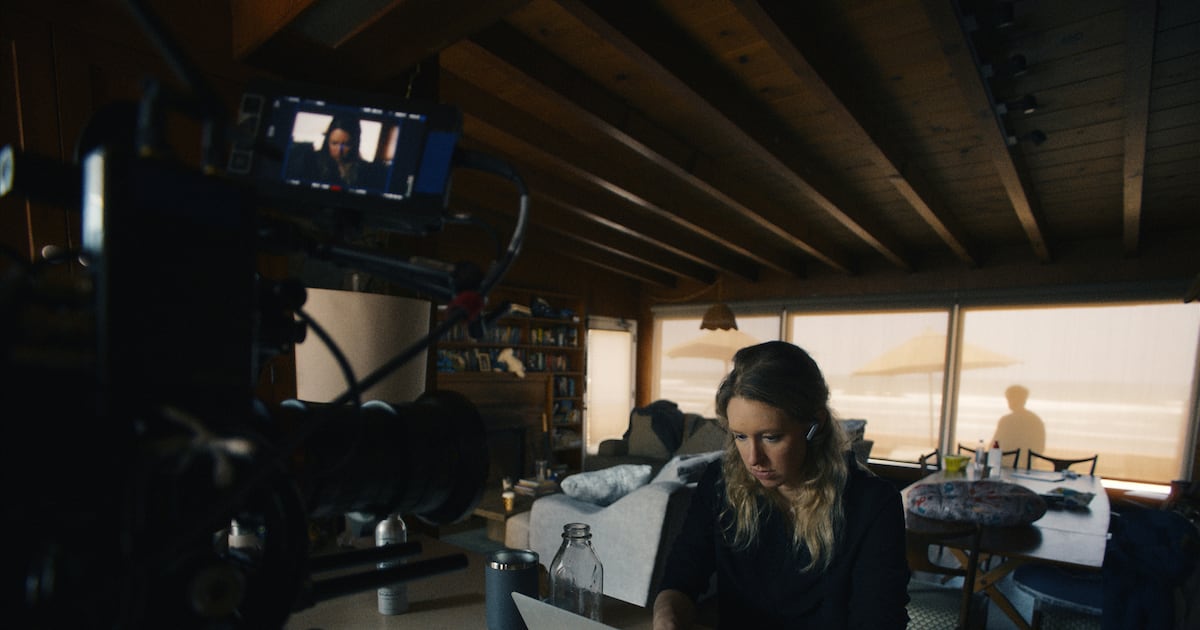
Elizabeth Holmes in “You Can See Everything,” directed by Nathan Fielder and Lance Oppenheim. (A24)
Much has been already said about “You Can See Everything,” a nearly three-hour documentary that follows disgraced Theranos founder and CEO Elizabeth Holmes in the weeks leading up to the start of her 11-year federal prison sentence for defrauding investors. After the film debuted at the Telluride Film Festival last month, the buzz became deafening. As a result, “You Can See Everything” notched the strongest opening weekend for a documentary since Michael Moore’s “Fahrenheit 9/11” in 2004, earning $15 million on only 855 theaters – and leaving audiences with more questions than answers.
One of its directors, Nathan Fielder, has garnered a reputation for high-concept works of nonfiction with “The Rehearsal,” a TV series where he helps ordinary people practice stressful situations using hired actors and lifelike sets. He’s appeared on-screen in that show, and in his breakthrough series, “Nathan for You,” as a semi-fictional, hyper-literal version of himself who struggles with social cues and interpersonal connection.
In 2022, a jury found Holmes guilty on four counts of wire fraud and conspiracy. Shortly before she had to begin serving her prison sentence, Holmes and her partner, Billy Evans, invited Fielder and Lance Oppenheim into their home with a camera crew. Fielder moved into their guest room. Chaos ensues: talks of Theranos 2.0, metatextual charades, a surprising villain and semi-genuine connections. Three Washington Post reporters got together to discuss it all. Note, spoilers ahead!
From left: Elizabeth Holmes, Billy Evans and Nathan Fielder behind the scenes of “You Can See Everything.” (Lance Oppenheim)
In conversation with
– Ethan Beck, pop culture reporter and Nathan Fielder fan who wishes he hadn’t seen everything
– Geoff Edgers, national arts reporter and always here if Fielder wants to talk
– Jade Tran, features editorial aide and soon-to-be two-time viewer of “YCSE”
Ethan: The rollout of “You Can See Everything” happened relatively quickly, with a secret screening at the Telluride Film Festival last month. Now that we’ve all seen it, why do we think this is one of the most talked-about films of the year?
Geoff: All I wanted to do after I walked out of this was text and call everyone I know and tell them to see it, and when they said they couldn’t right away, dismiss them as unworthy for continued friendship.
Jade: People were obviously tuned into the Elizabeth Holmes drama as it was going on, but people seemed to be drawn in by Nathan Fielder, someone known to push boundaries and make things really uncomfortable.
Geoff: When I mentioned the film, people said, “Oh, that Elizabeth Holmes movie.” Like they say, “Oh, that Elon Musk movie.” But this isn’t a Holmes movie. Her story matters in that it’s a vehicle for Nathan. The key being, what’s truth?
Jade: The first thing I was itching to talk about was how genius Fielder is. I was less interested in Holmes.
Ethan: Right. Liz – as Nathan semi-affectionately calls her – is an individual who seemingly has a conflicted relationship with what’s real and what’s possible, which is what landed her in prison for fraud. What did we make of the way Fielder brings us toward that question of: What’s truth?
Jade: It felt like we were there in the room with him, in real time, figuring out what to believe and what not to believe.
Ethan: Nathan as our audience-insert does grow occasionally bewildered at Liz’s insistence that, say, Theranos had a product that could test blood with the prick of a finger. My favorite moment with him is when Holmes’s partner, Billy, tells him that he knows how Nathan feels, to which Nathan shoots back: “No, you don’t.”
Geoff: Was there a lot of laughing in your theater?
Jade: Mine was pretty rowdy. People audibly gasped at everything.
Geoff: Yes, and my son, who is 16, started to get annoyed. A woman in the front kept talking back to Billy like this was “Mystery Science Theater.” She was not complimentary.
Ethan: People cracked up at everything: Fielder’s reactions, Billy’s controlling acts like grabbing the eggs out of Liz’s hands, the flirtation between Nathan and Liz.
Geoff: I think the laughter is for two reasons. Nathan does deadpan very well. Whether it’s really him or a character named Nathan, I’ll leave that up to his parents to tell us. But also, the audience is not used to people delivering blunt questions – no matter how stupid the answer. And Nathan is not afraid.
Ethan: Let’s talk about the way the film evolves.
Geoff: I think we should not hide that Amanda Seyfried is in this film. I mean, how many people have already seen it?
Ethan: A lot more than who saw “Whalefall” or the new “Sense and Sensibility” this weekend!
Geoff: And anybody who has seen Nathan’s work knows that impersonations and re-creations are basically his bread and butter. His great gift is exploring a character after he’s removed the character from the mix. Sort of like, let’s deal with your issues – at least on my terms without you getting in the way.
Ethan: I don’t think I expected to see Seyfried reckon with how her portrayal of Holmes in “The Dropout” might have affected the real-life Liz Holmes.
Geoff: Good point. It is wild to think of an actress, who played the character with really no direct knowledge of her, now being brought in to play her again. Except with a director who knows her and has given her important background and guidance. A part of me thinks: Hey Amanda, you’re amazing, but wouldn’t it have been good to do all this homework the first time around?
Jade: I was surprised by how much I enjoyed Seyfried’s screen time! She didn’t feel like an actress to me in this format, even though she spent a lot of time acting.
Ethan: She becomes a mediator for the audience, saying the things that we’re all thinking, like: What the hell is the deal with this Billy guy?
Geoff: She can be judgmental where Nathan is trying to seem to be an observer. Those headphones he wears are the perfect affect. As if he’s always listening and also to signal he’s not just a regular guy hanging around.
Jade: Except we did get to see how he was grappling with ethics – and truth – and the “care” he develops for Holmes.
Ethan: His crush on her!
Jade: The swimming scene, hello?
Geoff: Is that a crush or is that Nathan playing the part? All the close talk. Is he playing off the way anytime two screen characters remain silent and are physically close, it always ends in a kiss?
Jade: Is the whole documentary a bit? That everyone’s committed to?
Geoff: That is an amazing theory. What if this is all a lie? Everything? That everybody is in on it because it’s so insane that they would do it without some larger point.
Ethan: It makes me think of how comfortable Billy seems to be on-camera. So villainous, so intense.
Geoff: We have Lance and Nathan with 18 cameras and long lenses and lav mics on them at all times and living with them and yet … they moderate what we get to see. Right? What if Nathan is lying? What if we’re not getting the truth here? How would we know, and do we even have a right to ask that when we accept so much lying on standard TV and film?
Jade: People are used to answers. Nathan leaves everything up for interpretation.
Ethan: That’s what made my heart pound while watching the film. It’s a thrill to watch them grapple with how they might be failing, too. Especially once we get into the re-creations of Holmes in prison. He had to re-create all of that from memory. It’s bound to fail in some capacity!
Geoff: Exactly, and what if Nathan never even went? How do we know? None of it was captured on film or audio.
Ethan: Did either of you two come away from the film feeling differently towards Holmes?
Geoff: Well, the beauty of truth versus lie is we actually know the truth. If we believe in our legal system. She was found guilty by a jury of her peers.
Jade: I did leave feeling sympathetic, which surprised me. But like Geoff said, we know what happened.
Geoff: The film certainly humanizes her. We are left wondering whether she’s a manipulative nutbag or a smart oddball who has been manipulated. That’s a considerable step up from a guilty fraudster.
Ethan: She’s deeply intriguing to watch and seems to have constructed, well, a different reality. I felt bad for her in the same way you might feel bad for someone who falls down a conspiracy theory rabbit hole. I also wonder if we leave the film feeling some sympathy because much of the film is also dedicated to someone even more bizarre and frustrating: Billy!
Geoff: Sort of in a long line of bad side men, right up there with Ike Turner and Eugene Landy. Or maybe he’s just a patsy.
Jade: Most of Billy’s scenes were hard to watch. There’s been a lot of talk about which half of this couple is the true manipulator in the relationship. Is Billy the perfect guy to stand behind so she can look better by comparison?
Geoff: So are there any other movies that reminded you of this one? I thought of “Adaptation” and “Being John Malkovich,” but there must be others. Films that make you question what is true and false.
Ethan: I’ve seen a lot of people mention “Close-Up,” the Abbas Kiarostami film where reenactments are central to the film’s semi-fiction. But I also thought of the Janet Malcom book “The Journalist and the Murderer,” which gets into the ickiness of trying to represent anyone or anything real.
Jade: I personally haven’t seen anything like it. I’ve tried to snag a seat to see it a second time, and most are taken.
Geoff: I wanted to see it again today, but then I remembered I had a job.