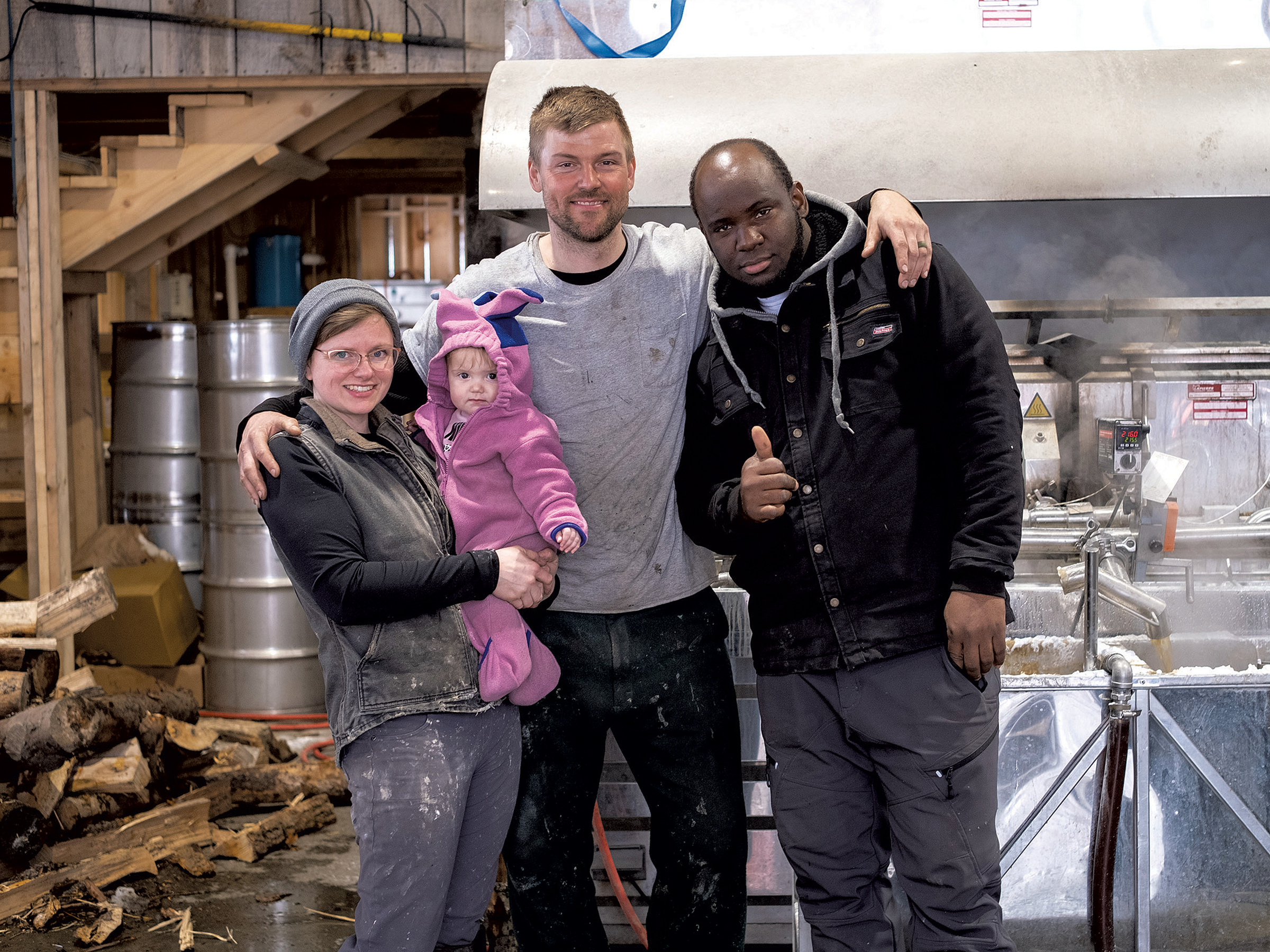
On a recent chilly afternoon in Cabot, Caitlin and Ian Ackermann fired up their evaporator for the first boil of the sugaring season. Plumes of sweet-smelling vapor rose from their sugarhouse. Caitlin stirred vats of maple syrup while holding her 8-month-old, Bailey, on her hip.
Sugaring season is intense but brief. Until this year, the couple ran their operation mostly by themselves, with occasional help of one local worker. They sometimes stayed up all night to keep pace. But as the Ackermanns increased the number of trees they tap, from 3,000 in 2013 to 18,000 today, they’ve had to seek assistance.
Their local job ads went unanswered. So they applied for a worker through the H-2A visa program, which allows U.S. employers to hire foreign laborers for temporary agriculture jobs they can’t otherwise fill.
As Vermont’s syrup producers doubled their output over the past decade — making more than half of the country’s maple syrup — sugar makers are becoming increasingly dependent on the help of migrant workers from places such as Mexico and Jamaica to sustain one of the state’s most vital industries.
“The biggest thing is, this work is so seasonal,” Caitlin said. “Because we only needed a person for four months, it’s not really feasible for a lot of people. This really was the perfect situation for us.”
A Jamaican worker, Ricardo Graham, 34, joined the Ackermanns in early February and will stay through May. He’s been coming to Vermont since 2019 to work on vegetable and fruit farms in season and in the past few years has begun working sugaring season as well.
There’s no definitive count of migrant maple workers across Vermont. But this season, eight maple producers requested 46 seasonal foreign workers through the H-2A visa program, according to data from the Vermont Department of Labor. Others hired migrant workers using out-of-state labor contractors.
In the Ackermanns’ sugarhouse, which they built themselves, Graham pitched in by throwing firewood into the roaring furnace powering the evaporator, which boils the sap and reduces it to syrup. His previous jobs involved working in the sugar bush — tapping trees, checking the tubing for punctures caused by squirrel bites — but this was his first time boiling.
Ricardo Graham Credit: Lucy Tompkins
His father has been coming to the U.S. through the H-2A program for 25 years, he said. It can be a good deal for workers because employers provide housing and fund travel and must pay wages set by the government.
Graham’s earnings support his family in Jamaica, including his 8-year-old child and 10-month-old baby, he said.
“Here, you can provide more,” he said. “If it wasn’t better, I wouldn’t be here.”
Caitlin demonstrated how to measure the syrup’s temperature and viscosity, and Graham poured bags of diatomaceous earth, a powder made from fossilized seashells, into the boiling syrup to help filter it. The syrup needs to be carefully monitored, she said.
“If it’s too thin, it’ll mold,” she said. “Too thick, it’ll crystallize.”
Once it reached the right temperature and thickness, the syrup was filtered through another machine and then transferred into a 40-gallon barrel. By the end of the season, the barn will be stacked high with about 200 of them, Caitlin said.
In Franklin County, a worker named Faustino from Veracruz, Mexico, was also working his first season in the sugar bush.
Faustino, who Seven Days is identifying by only his first name so he could speak freely about his employer, came to Vermont in October on a TN visa, which allows Canadian and Mexican citizens to work in the U.S. for up to three years in certain professional roles. Unlike the H-2A visa, it is not only for agricultural roles and isn’t confined to a certain season.
An agricultural engineer with a master’s degree in fruit farming, Faustino, 26, works for a labor contractor in Tennessee that hired him and two others out to the Franklin County farm. Its sugar bush has thousands of maple trees, he said.
They spent the winter installing taps and tubing for sap and inserted spouts in each one.
“I’m doing things I’ve never done before,” said Faustino, who experienced snow for the first time this year and was enchanted by the colorful leaves in fall. “I’ve learned a ton.”
Given the Trump administration’s harsher stance on illegal immigration, employers seem to be seeking out workers with TN visas because they aren’t at risk of deportation, Faustino said. But they also command higher pay because of their professional qualifications.
Last April, U.S. Border Patrol agents responded to a tip about men with backpacks emerging from woods near the Canadian border. When the men fled toward a farm, agents followed, detaining eight farmworkers from Mexico, most of them undocumented. The men in the woods turned out to be workers returning from a sugar bush.
“It’s sad,” Faustino said in Spanish of the risks undocumented workers face. “But in the end, this isn’t my country. And they also know they’re in a foreign country and rules are rules. The government establishes its own rules, and that’s valid.”
“We came here to fulfill certain dreams and personal goals that in Mexico, the reality is, very few people are able to achieve,” he added.
At the opposite end of the state, in Dummerston, Read Miller runs one of Vermont’s oldest farms, Dwight Miller Orchards, where trees have been tapped for maple syrup since the 1700s.
Miller, who said he’s “pushin’ 70,” said he has hired hundreds of foreign workers over the years, mostly from Mexico, to pick apples and work in his greenhouse. More recently, he’s hired migrant workers to help with sugaring. He has about 7,000 maple taps, a relatively small operation.
“Maple is different than it was 20 years ago,” he said. With the help of technology such as reverse osmosis systems that speed up syrup production, maple operations have expanded rapidly. Some have sugar bushes with hundreds of thousands of trees, and most of the work is still done manually.
“You have to touch every tree by hand,” said Allison Hope, executive director of the Vermont Maple Sugar Makers’ Association.
Read said the state’s changing demographics have also contributed to the labor challenges.
“We used to be able to get neighborhood kids to set up our operation,” he said. “This increase in production has led to the fact that we no longer have kids next door to help with those numbers. And we have less kids next door anyway.”
In December, he gave a presentation on the H-2A program at the Vermont Maple Sugar Makers’ Association annual conference, at which he encouraged his peers to consider hiring migrant workers. There isn’t a great deal of interest yet, he said. But if other sectors are any indication, it won’t be long.
“I don’t know how much Vermont milk is not made with migrant labor,” he said. “There’s probably hardly any fruit picked that doesn’t have to do with migrant labor. It’s what’s making agriculture turn in Vermont.”
Back in Cabot, Graham was getting the hang of things.
He inserted a pipette into a barrel of freshly boiled syrup and drew out a small sample of the warm amber liquid. Then he squirted it into a small glass bottle, where the syrup’s color would be used to measure its grade.
The Ackermanns poured some syrup into tiny cups to drink, a reward for their labor. Graham politely declined.
“I don’t like sweets,” he said. ➆
The original print version of this article was headlined “Sugar Makers Tap Migrant Workers | It’s no secret that Vermont’s dairy farms rely on migrant labor. Increasingly, so does another iconic sector: maple.”
This article appears in March 25 • 2026.