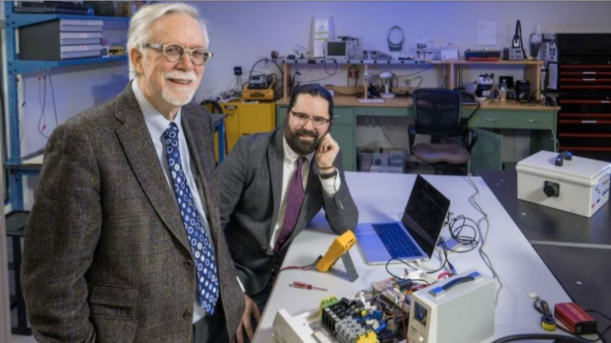
Photo – Researchers at UD, including Willett Kempton and Rodney McGee, helped make this technology more affordable and practical.
University of Delaware professor Willett Kempton helped pioneer vehicle-to-grid technology nearly 30 years ago. Now Ford says a UD-developed communications standard is part of its new affordable electric truck platform.
NEWARK, Del. — Technology developed at the University of Delaware is playing a role in Ford Motor Co.’s effort to bring bidirectional power — the ability for an electric vehicle to send electricity back to a home or the electric grid — to a new generation of lower-cost electric trucks.
Ford said Tuesday, Oct. 27, that its 2027 Fathom electric truck will use SAE J3068 with LIN-CP, a communications technology standard developed at the University of Delaware, as part of an electrical architecture intended to make bidirectional charging less expensive.
The connection puts decades of Delaware research led in part by University of Delaware professor Willett Kempton into a vehicle Ford expects to sell for a starting manufacturer’s suggested retail price of $28,350.
Ford says the truck will be capable of supplying a projected 10 kilowatts or more of alternating-current power to a home without requiring the separate wall-mounted inverter used by some earlier systems.
Delaware professor helped pioneer the technology
Kempton and University of Delaware colleagues pioneered vehicle-to-grid, or V2G, technology nearly three decades ago. The idea is relatively simple: Instead of an electric vehicle battery only drawing power from the grid, a properly equipped vehicle can also return power when electricity is needed.
The technology could turn millions of parked vehicles into distributed energy-storage resources.
“Whether it could scale cost-effectively was an open question, and we’ve proven that it can — with the right combination of policies, standards and technology,” Kempton said earlier this year after completion of a Delaware V2G pilot project.
Kempton is a professor of marine science and policy and electrical and computer engineering at UD and is nationally recognized for his work on electric vehicles and vehicle-to-grid systems.
Ford’s announcement provides one of the clearest indications yet that some of the technology developed in Delaware could move beyond research projects and limited demonstrations toward mass-market vehicles.
Ford develops lower-cost system
Ford said cost has been one of the primary barriers preventing bidirectional power from becoming widely available.
Electric vehicle batteries store electricity as direct current, while homes typically use alternating current. Earlier systems often depended on additional external equipment to convert and manage that electricity.
Ford says the Fathom will instead incorporate its inverter into the vehicle’s electrical system, allowing the truck to produce AC power without a separate wall-mounted inverter.
The company said the approach uses fewer multifunctional components and is designed to lower the cost of the vehicle and supporting home equipment.
The truck’s communications architecture is where Delaware enters the picture directly.
Ford said Fathom uses SAE J3068 with LIN-CP, describing it as an existing communications technology developed at the University of Delaware that also helps reduce the cost of the vehicle’s charger.
That distinction is important: UD did not design Ford’s new truck or its entire bidirectional electrical system. Ford says it developed the Fathom hardware and software architecture after acquiring startup Auto Motive Power in 2023.
But the automaker is incorporating a communications approach developed through UD’s work into a production vehicle designed specifically around lower cost.
Delaware research moves from laboratory to electric grid
The Ford announcement follows years of cooperation involving UD, Ford, Delmarva Power and PJM Interconnection.
In 2024, the partners demonstrated vehicle-to-grid technology in Newark using Ford Mustang Mach-E vehicles from Delmarva Power’s fleet.
The vehicles could continue performing their normal utility work while also providing grid services when they were parked and plugged in. Multiple vehicle batteries could be connected electronically and managed as a single resource known as a virtual power plant.
UD researchers also helped develop standards needed for vehicles, chargers and utilities to communicate safely and inexpensively.
Rodney McGee, director of UD’s Center for Transportation Electrification, previously led an SAE committee working on standards that incorporate LIN-CP signaling for low-cost AC charging, V2G operation and vehicle backup power.
Research suggests financial benefits for vehicle owners
The research reached another milestone this year.
A University of Delaware and Exelon/Delmarva Power report released in April found that the V2G-equipped vehicles used in the pilot successfully provided services in actual electricity markets.
Researchers calculated that, based on electricity-market prices from 2021 through 2025, a V2G-enabled passenger electric vehicle could potentially earn as much as $3,359 annually by providing grid services.
Heavier vehicles such as delivery trucks, fleet vehicles and school buses could potentially earn more than $9,000 per year because of their larger batteries.
Those figures are research estimates based on historical market conditions, not guaranteed payments for consumers.
The pilot also found no measured reduction in battery health after a year of market operation, according to UD.
The potential financial benefits are particularly significant for commercial fleet operators, school districts and utilities that could eventually use parked electric trucks and buses to generate revenue while helping stabilize the electrical grid.
A truck becomes more than transportation
For consumers, Ford is initially emphasizing two applications.
Its Home Power Management system is intended to allow customers to charge a truck when electricity is less expensive and then use some of the battery’s energy to power their homes when rates are higher.
The truck can also provide backup electricity during an outage.
Both applications require additional Ford home equipment, although Ford says its new Home Power Station is expected to cost roughly half as much as the company’s first-generation bidirectional charger. Backup operation will require an additional Home Backup Power Panel.
For Delaware homeowners concerned about rising electricity costs and reliability, the technology could eventually offer another way to manage household energy expenses.
However, actual savings will depend on electricity rates, equipment costs, vehicle usage and the availability of utility programs.
Delaware could play a role in national expansion
The larger opportunity — sending power into the electric grid and being compensated for grid services — remains more complicated.
Utilities and regulators must establish interconnection rules governing how vehicles operating as power resources connect safely to the grid.
Ford formed a working group in July with five major utilities, including Exelon, the parent company of Delmarva Power, to develop more standardized interconnection procedures before Fathom reaches customers in 2027.
That puts Delaware in an unusual position.
UD researchers helped pioneer V2G technology. Delaware was the first state to change its laws to permit electric vehicles to provide services to the electric grid. Ford vehicles have already been used in a Delmarva Power V2G demonstration, and Exelon is now participating in Ford’s effort to prepare utilities for broader deployment.
The next question: When will Delaware drivers benefit?
What remains uncertain is how soon ordinary Delaware customers will be able to use a vehicle such as the Fathom not only to power their homes but also to sell services into the electric grid.
Although Delaware has helped lead the research, broader consumer participation will depend on utility interconnection requirements, regulatory approvals, available compensation programs and the cost of compatible equipment.
Ford says Fathom arrives in 2027.
For Kempton and the University of Delaware, the launch could mark an important transition for an idea that began as university research decades ago: from proving that electric vehicles could support the electric grid to helping make the technology affordable enough to reach everyday drivers
TO GO BOX
- What: Ford Fathom electric truck with bidirectional power capability.
- When: Expected to launch in 2027.
- Starting price: $28,350 MSRP, according to Ford.
- Delaware connection: Ford says the truck uses SAE J3068 with LIN-CP, a communications technology developed at the University of Delaware.
- What it can do: Supply electricity to a home, provide backup power during outages and potentially support electric grid services where utility programs allow.
- Why it matters: UD researchers, Delmarva Power, Ford and PJM have demonstrated V2G technology in Delaware. Ford’s new truck could help bring some of that technology into broader consumer use.
Learn more: University of Delaware and Ford Motor Co..
Delaware LIVE collaborates with a network of professional journalists to cover a diverse range of stories across various fields. Staff Writers include experienced journalists and young professionals. If you have questions, please feel free to contact [email protected] or our publisher, George D. Rotsch, at [email protected]