The Trump administration has taken a flurry of actions to drive up deportation numbers as part of its large-scale immigration crackdown. These efforts include expanding the group of people who can be targeted for removal, speeding up the deportation process for others and, in some cases, tightening the rules for legal immigrants.
Below is an explanation of those efforts and an accounting of the millions of immigrants who may be affected.
Expanding the pool of who can be deported
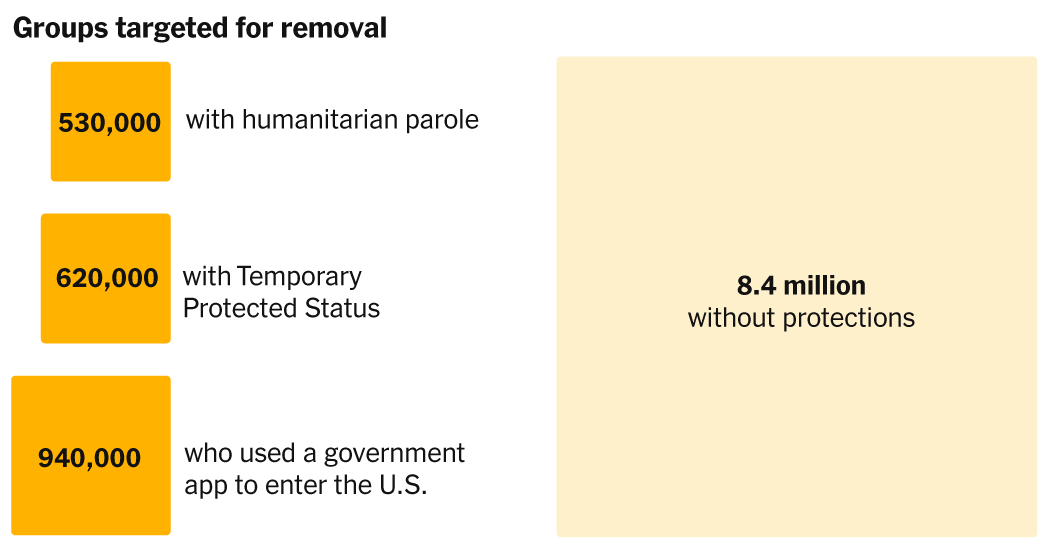
At the end of the Biden administration, as many as 40 percent of the estimated population of 14 million undocumented immigrants had some authorization to live or work in the United States.
President Trump moved quickly to end several Biden-era programs that shielded many of those people from removal.
Immigrants Trump has targeted for deportation
Many undocumented immigrants have overlapping protections from deportation that President Trump has tried to revoke.
Sources: Customs and Border Protection; Congressional Research Service; Department of Homeland Security
Note: Federal judges have temporarily blocked the removal of humanitarian parole for Cubans, Haitians, Nicaraguans and Venezuelans.
The Department of Homeland Security in February moved to terminate Temporary Protected Status for about 350,000 Venezuelans who had received the status in 2023. After a legal challenge, the Supreme Court on Monday allowed the Trump administration to remove these protections, pending appeal of the case.
Homeland Security also moved up the expiration date for Temporary Protected Status for Haitians from next year to this August.
The Trump administration said in March that it would revoke the statuses of people who entered through a program that offered Cubans, Haitians, Nicaraguans and Venezuelans the opportunity to fly to the United States, secure work authorization, and stay for up to two years. In April, a federal judge blocked this move.
In April, Homeland Security notified nearly one million people who had applied to enter the country using a government app called CBP One that they had to leave “immediately.”
And last week, the agency announced it would terminate the Temporary Protected Status for Afghans in the United States. It also plans to end the status designation for Cameroonians.
All together, the Trump administration has tried to strip protections from hundreds of thousands of people. Many immigrants have overlapping protections, however, and terminating one program does not make its participants immediately eligible for deportation. Many may have other pathways to stay in the country.
Claiming asylum is another way immigrants can be protected from deportation, at least while their cases are being decided. Very few asylum applications are eventually approved, but cases can often take several years to play out.
Mr. Trump has also taken aim at this process. In April, the Justice Department urged immigration judges to swiftly deny asylum to immigrants whose applications they deemed unlikely to succeed. That month, the denial rate, which was already trending upward, rose to 79 percent.
Monthly denial rate for asylum case decisions
Source: New York Times analysis of immigration court data
Note: Data includes only asylum cases that received a final decision from an immigration judge.
The administration has so far left protections in place for some immigrants. It has not tried to revoke the status of 240,000 Ukrainians who received parole (though it has paused new applications for that program) or 540,000 Dreamers with protection from deportation.
Speeding up the deportation process
In addition to removing protections, the Trump administration has tried to speed up deportations for some immigrants by sidestepping the normal legal process that gives people a chance to contest their removal and make arguments to stay.
It expanded a fast-track process known as expedited removal to apply to people arrested anywhere in the country who cannot prove that they have been in the United States for at least two years. Expedited removal had previously only been used to remove immigrants arrested near the border.
Mr. Trump also invoked the Alien Enemies Act, an 18th-century wartime law, to swiftly deport some Venezuelans accused of being members of the Tren de Aragua gang.
These new pathways have not yet produced large numbers of deportations.
According to the White House, 137 people were removed under the Alien Enemies Act, all of them Venezuelans who were sent to a prison in El Salvador. On Friday, the Supreme Court blocked further use of the law to deport people who were allegedly gang members.
In the first month of the new administration, expedited removal was attempted in about 7 percent of arrests by Immigration and Customs Enforcement, a slight increase from 2024, according to an analysis of data obtained by the Deportation Data Project.
The administration has also attempted to deport some immigrants to “third countries” in cases where their home countries have been reluctant to receive deportations.
Threatening to deport legal immigrants
The administration has also been willing to go after legal immigrants with stricter conditions for their stay.
About three million people with student visas or other long-term visas and 13 million green-card holders, could be targeted for removal if they are accused of committing a crime.
But immigration officials have appeared to go further, detaining several people who were legally studying in the United States and had participated in pro-Palestinian activism on campus. The administration said that the protest activities threatened the country’s foreign policy goals.
Last month, the administration temporarily revoked more than 1,500 student visas with minimal explanation before abruptly restoring them.
Effects so far
If ICE continues to deport people at the same pace it did in April, the agency would be on track to remove just over 300,000 people by the end of the year, a slight increase from 2024.
Notes: Arrests show initial book-ins to detention originating from ICE arrests. Some of those deported by ICE were initially arrested by Customs and Border Protection. Deportations show removals and enforcement returns conducted by ICE.
Stripping protections and fast-tracking the removal process are efforts to increase those numbers. But the government will not hit its stated goal of one million deportations a year without taking even more steps to expand the immigration crackdown, said Kathleen Bush-Joseph, an immigration policy expert at the Migration Policy Institute.
Those steps could include more efficient ways to find out where immigrants are, more personnel to carry out arrests, more room at detention centers, more planes to fly people out, and more agreements with other countries to receive deportations.