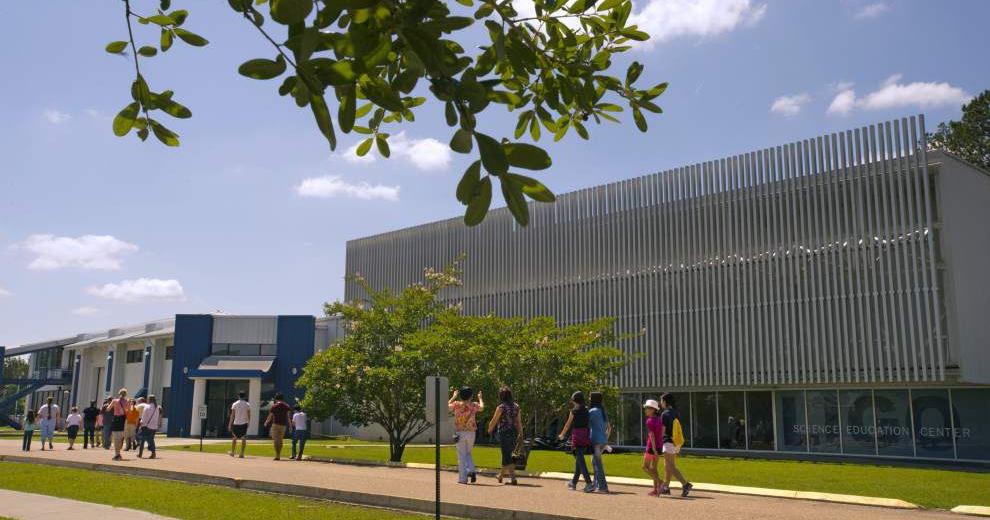
The Louisiana observatory that made a historic scientific breakthrough detecting gravitational waves in Livingston Parish is now at risk of shutting down under the Trump administration’s proposed federal budget cuts.
On Friday, the Trump administration announced a proposed federal budget request for 2026, that cut $5.2 billion, or 57% of the National Science Foundation’s $9 billion annual budget.
NSF supports facilities across the country including the Laser Interferometer Gravitational-Wave Observatory (LIGO). There are two LIGO observatories funded in the country: LIGO Livingston and LIGO Hanford in Washington.
NSF would only operate one U.S. LIGO observatory with a reduced level of spending for LIGO technology development in the 2026 fiscal year, according to the budget proposal.
The LIGO observatory in Livingston Parish made international headlines in 2015 when it detected gravitation waves from black holes more than a billion light-years away.
The proposed budget for LIGO in the 2026 fiscal year would be $29 million, a 40% reduction from the allotted $48 million in the 2024 fiscal year, according to the budget proposal document.
NSF and the Trump administration have not announced which LIGO observatory could be on the chopping block if the full budget cuts are enacted. However, the two observatories often work in tandem, conducting research together.
Joseph Giaime, the head of the LIGO Livingston observatory, said LIGO leadership is working with NSF on its next steps in response to the proposed budget. But Giaime said it’s not efficient to run only one LIGO observatory without the other.
“I personally worry about our ability to continue our education mission and do a good job as needed on our science mission… we’re going to do the best we can,” he said.
Giaime said that by only operating one LIGO observatory, it only gets about 30% of the physics out.
“We run together. We use data together. We’re able to dig more deeply into space together,” he said.
This year marks a decade since LIGO Livingston and LIGO Hanford recorded gravitational waves from the collision of two black holes more than a billion light years away. The discovery confirmed a key prediction of Albert Einstein’s general theory of relativity and kick-started a new era of astronomy.
The Livingston Parish president had not been aware of the proposed cuts at the time of publication, according to parish spokesperson Brandon Browning.