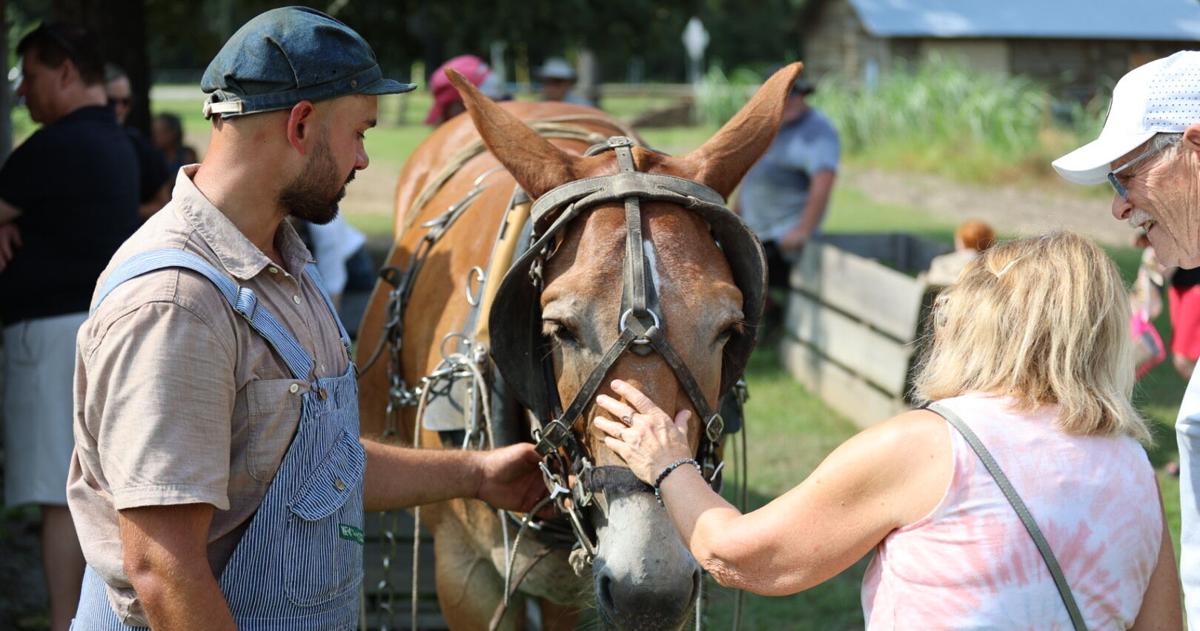
CONWAY, S.C. — “Alright now girls, back in the day y’all would be the stringers. Let’s see how it’s done,” an older Horry County native joked to a group of women gathered at the L.W. Paul Living History Farm in Conway.
None of them stepped forward, though several smiled knowingly.
“I paid my time,” one woman replied, drawing laughter from the crowd.
For many in attendance of Tobacco Heritage Day on Saturday, Aug. 1, tobacco farming wasn’t just history — it was part of their childhood. Generations of Horry County families made a living in the tobacco fields, where children often spent summers priming leaves, loading wagons or stringing tobacco by hand before it was cured in barns. Once the county’s dominant cash crop, tobacco helped shape the local economy and way of life for generations.
Although tobacco production has largely disappeared from Horry County, its legacy remains. At the L.W. Paul Living History Farm — located at 2279 Harris Shortcut Road, just off Highway 701 — employees and volunteers continue to demonstrate the labor-intensive work that once defined the Pee Dee region.
Labor intensive process
From planting to selling, raising a tobacco crop was a seven to eight-month process that required the entire family to pitch in.
Each tobacco plant produces hundreds of tiny seeds, which are planted just below the surface of the soil.
Tobacco leaves mature from the bottom of the stalk upward, so harvesting was typically done in stages. Farmers first picked the lower leaves before returning days later to harvest the remaining leaves higher on the stalk. During Saturday’s demonstration, however, volunteers harvested leaves from the entire stalk at once to give visitors a full look at the process.
Rows of tobacco were planted and harvested at the L.W. Paul Living History Museum in Conway to help educate and preserve the labor intensive practice.
By Andrew S. Brown
andrew.brown@myhorrynews.com
After harvesting, the leaves were strung onto tobacco sticks — long, narrow wooden poles used to hold the crop during curing. The job usually required several people. One person handed three or four leaves at a time to the stringer, who tied them onto the stick with twine, working from one end to the other.
By Andrew S. Brown
andrew.brown@myhorrynews.com
Stringing tobacco required a careful touch. If the string was tied too tightly, it could damage the leaves or even break them apart. If it was tied too loosely the leaves could slip off the stick during the curing process.
By Andrew S. Brown
andrew.brown@myhorrynews.com
Once leaves stretch along the tobacco sticks, they were carried into a curing barn and hung in tiers from the top down, leaving enough space for air to circulate. Heat from a wood-fired furnace gradually wilted and dried the leaves over several days, transforming them from green to the iconic golden-brown color.
By Andrew S. Brown
andrew.brown@myhorrynews.com
After curing, the leaves were removed from the sticks, bundled together by hand and prepared for grading and sale at tobacco warehouses.
Visitors to the L.W. Paul Living History Farm on Saturday, Aug. 3, got a firsthand look at the process of tobacco farming. Volunteers at the farm (which mirrors what a farm looked like and operated like from the early to mid 1900s) explained the process of tobacco farming including cropping, stringing and curing the plant which was a main cash crop for the Carolinas for much of its modern history.
File photo
Made in Horry County
For Conway resident Brad Tucker, Tobacco Heritage Day was more than a history lesson — it was a chance to relive his childhood.
“Truly, it was like stepping back in time,” Tucker said. “I used to work on a tobacco farm when I was younger. My older brothers and I would help our parents on the small Tucker farm.”
Tucker said events like Tobacco Heritage Day at the Living Farm help both preserve Horry County’s agricultural heritage and educate younger generations about the hard work that once defined life on local tobacco farms.
“It would be cool for every kid now to experience this,” Tucker said. “There are so many smartphones and devices. They don’t know how food is made and don’t appreciate modern technology.”
While many visitors spent the day reminiscing about long hours in the tobacco fields, younger attendees also experienced the process for the first time. Children gathered around the demonstrations, asking questions and trying their hands at the same tasks that kids their age once did just a few decades ago.
For one generation, Tobacco Heritage Day was a chance to remember. For another, it was an opportunity to discover a chapter of Horry County’s history that mostly exists today through stories, photographs and the L.W. Paul Living History Farm.
The living history farm is open Tuesdays through Saturdays from 9 a.m. to 4 p.m.. Special events and programs like Tobacco Heritage Day are held throughout the year.