Recent news that Oklahoma was one of five finalists to become the home of a federal Nuclear Lifecycle Innovation Campus was met with excitement over energy production and the potential for thousands of new jobs.
But there’s a tradeoff that didn’t get much attention. The campuses are designed
to include facilities for storing and disposing of used nuclear fuel, and the federal solicitation that launched the program envisions selling disposal services to outside utilities and federal agencies and asks states to address interstate corridors for moving used fuel and high-level waste. Much of the material would originate outside the host state.
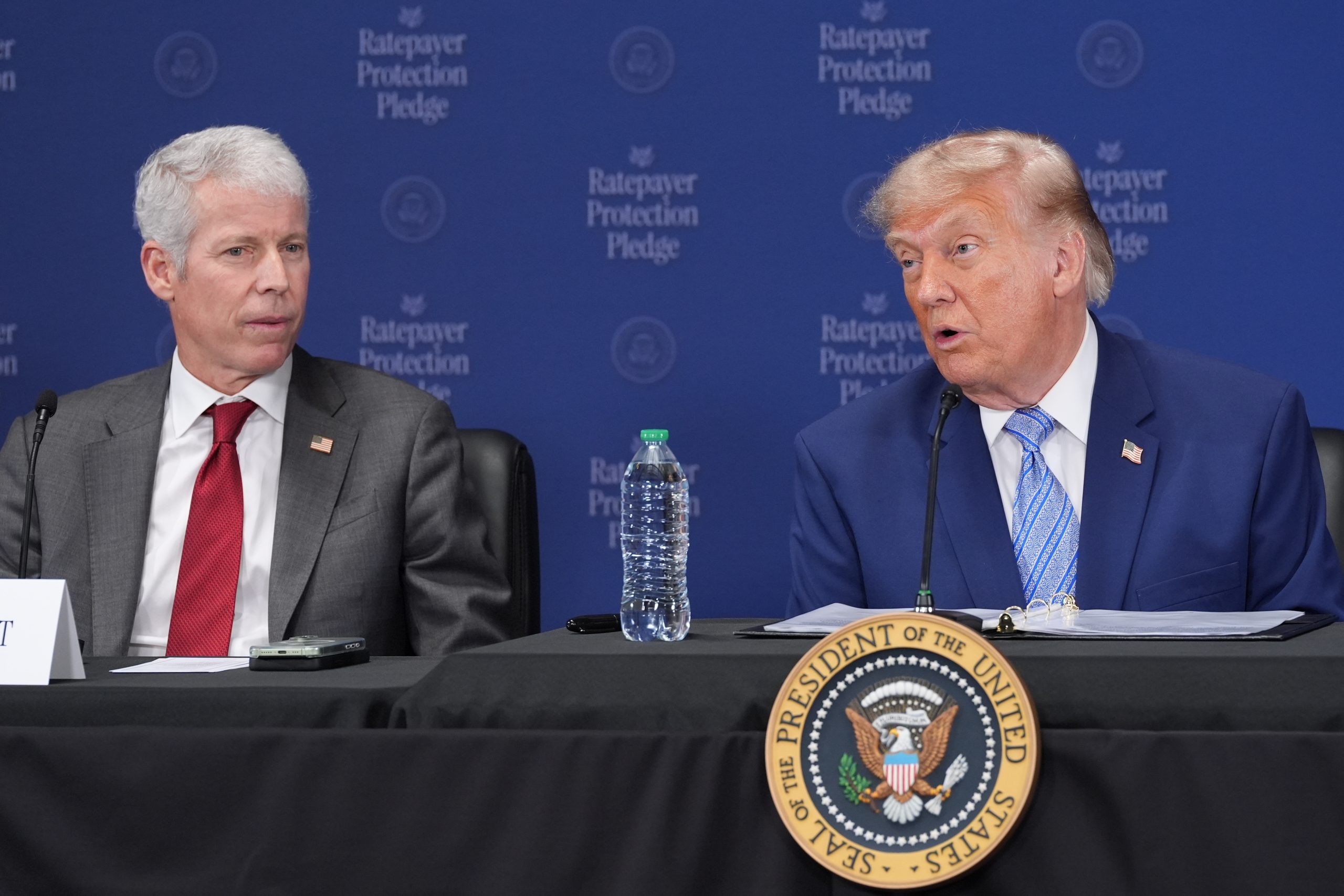
The states — Tennessee, Louisiana, Oklahoma, Utah and Idaho — all have Republican governors who say they welcome the chance to help America reclaim its leadership in civilian nuclear energy. The U.S. Department of Energy said it selected them after reviewing 28 applications from 26 states. Energy Secretary Chris Wright signed non-binding memorandums of understanding with the five states in late July to keep evaluating potential sites and commitments. States that decide to move forward would negotiate hosting agreements later.
Spent fuel is currently stored at nuclear plants and former nuclear sites nationwide and is piling up, and tens of thousands of metric tons are awaiting a permanent home. Plans for an underground storage facility at Nevada’s Yucca Mountain have long been stalled because of staunch opposition from most residents and officials.
Under the agreements, the states could host campuses that would include waste
sites as well as uranium enrichment, spent-fuel reprocessing and fuel fabrication. The campuses may also host advanced reactor deployment, power generation and data centers, the Energy Department said.
Nuclear Campuses Could Boost State Economies
A single campus has the potential to attract up to $50 billion in capital
investment, generate as much as $10 billion in state and local tax revenues and
create nearly 25,000 jobs, the Energy Department said in a statement. Eligible
nuclear projects could access federal loan support through the department’s Loan
Programs Office.
“These campuses will be massive generators of economic growth … and be crucial to
unleashing America’s nuclear renaissance,” Wright said in a written statement. He
called the proposed campuses an “innovative concept” that will “get America’s
nuclear industry growing again.”
Tennessee is home to the Oak Ridge National Laboratory, which enriched uranium
during World War II as part of the Manhattan Project, while Idaho hosts the Idaho
National Laboratory, a key research site for nuclear energy and national security.
Utah was a source of raw uranium for the Manhattan Project and a training site for
crews that dropped atomic bombs on Japan in 1945.
“As the global epicenter of nuclear energy, Tennessee is honored to be selected as
a finalist to host a Nuclear Lifecycle Innovation Campus,” said Tennessee Gov. Bill Lee. “Our state answered the call during the Manhattan Project and helped shape the course of history, and Tennessee stands ready once again to advance the safe, reliable energy solutions our nation depends on.”
Oklahoma’s history with nuclear energy includes the Cimarron facility near Crescent, operated by a Kerr-McGee subsidiary from 1965 to 1975, which fabricated enriched uranium and mixed-oxide fuels for experimental nuclear reactor rods. The plant drew national attention through Karen Silkwood, a technician and union activist who raised safety complaints there and was found to be contaminated with plutonium in 1974. Her family’s lawsuit against Kerr-McGee reached the U.S. Supreme Court before it was settled.
Kerr-McGee opened a second nuclear plant in 1970 near Gore, in Sequoyah County, that converted uranium concentrate into uranium hexafluoride. On Jan. 4, 1986, an overfilled cylinder ruptured while being heated, killing one worker and injuring dozens, and about 100 people were taken to a local hospital for screening. By then the plant was run by Sequoyah Fuels Corp., a Kerr-McGee subsidiary formed in 1983 and sold to General Atomics in 1988. Another accident in 1992 injured 21 workers, and the plant closed in 1993 after years of environmental and safety violations.
“Getting a community to accept a long-term repository for nuclear waste has been a big challenge in the United States politically. It’s been a hard pill to swallow for certain communities.”
Scott Roecker, Nuclear Scaling Initiative
Public Service Company of Oklahoma announced plans in May 1973 to build the Black Fox Nuclear Power Plant near Inola. Regulatory hearings that began in 1976 stretched on for 18 months amid legal challenges from Carrie Barefoot Dickerson,
who founded Citizens’ Action for Safe Energy and sold her family farm and nursing home to fund the opposition. The first construction permits were not granted until the summer of 1978. Opposition intensified after the 1979 Three Mile Island accident, and hundreds of protesters attempted to occupy the site that June. PSO
canceled the project on Feb. 16, 1982, as costs climbed from an initial $450 million into the billions.
Removal of the highest-risk radioactive waste from the Gore site was completed in 2018, when the last of 511 truckloads left for a disposal site in Utah. The site is to remain in long-term federal custody. At Crescent, buildings, contaminated soil and buried waste have been removed, and a final phase of groundwater treatment is
underway to meet federal criteria for releasing the property from radiological controls.
Solution for Storing Waste Needed to Expand Nuclear Power
The announcement comes as President Donald Trump attempts to quadruple domestic nuclear energy capacity because of surging electricity demand due to a data center and artificial intelligence boom. Trump also has moved to reshape the independent Nuclear Regulatory Commission to speed up nuclear reactor development. Under Trump’s direction, the commission has proposed eliminating a foundational safety principle that for 50 years minimized the radiation people in the United States are exposed to.
The NRC proposal would abandon a philosophy to keep radiation exposure “as low as reasonably achievable,” instead setting a separate standard on maximum radiation exposure that includes several actions facilities must take depending on the potential dose of radiation to workers.
California Rep. Mike Levin said the nuclear fuel announcement was a long time coming and required bipartisan collaboration to fix difficult nuclear waste challenges. Levin, a Democrat, has pushed to allocate funding to safely remove and dispose of spent nuclear fuel from decommissioned nuclear plants, including the closed San Onofre nuclear power plant in Southern California.
“Today’s selection of states is a monumental step in the right direction,” Levin said in a statement. “For the first time in decades, states are raising their hands” to accept nuclear waste.
Scott Roecker, a former official at the National Nuclear Security Administration who now advises the Nuclear Scaling Initiative, a pro-nuclear group, said the campuses are a good idea, though he cautions that spent nuclear fuel should not be reprocessed there to be recycled for new fuel because of the cost and security issues.
“Getting a community to accept a long-term repository for nuclear waste has been a big challenge in the United States politically. It’s been a hard pill to swallow for certain communities,” he said in a recent interview. “The fact that they’re talking about sort of the whole fuel cycle at these centers is a positive thing. Basically, you’re getting the consent of that community for that long-term repository.”
Congress now must work to authorize the campuses and establish clear oversight,
Levin said.
Additional reporting by Oklahoma Watch.
MORE FROM ASSOCIATED PRESS
Oklahoma Holding Back on AI Regulations Amid Trump’s Order for States Not to Stifle the New Technology
Most Oklahoma legislative attempts to regulate artificial intelligence stalled this session, even as other states pushed ahead despite President Trump’s executive order discouraging state AI regulation. Bills targeting deepfakes in political ads and AI chatbot safety for minors failed to advance, while a narrower school AI transparency law succeeded.
Keep reading
June 18, 2026
Election Results
State Question 832 (Proposal to Raise the Minimum Wage) Republican Primary Races Democrat Primary Races
Keep reading
June 16, 2026
Alan Armstrong Sworn In to Complete Mullin’s Senate Term
Oklahoma’s governor has appointed energy executive Alan Armstrong to fill a newly vacant U.S. Senate seat through the end of the year. The announcement Tuesday came after former Oklahoma Sen. Markwayne Mullin was confirmed as the Trump administration’s new homeland security secretary. Armstrong is the chairman and former CEO of Williams Companies, a major pipeline…
Keep reading
March 24, 2026March 24, 2026
Support our publication
Every day we strive to produce journalism that matters — stories that strengthen accountability and transparency, provide value and resonate with readers like you.
This work is essential to a better-informed community and a healthy democracy. But it isn’t possible without your support.