Across Main Street from Conway City Hall, the “F.G. Burroughs Steamboat” mural is an icon that recalls Conway’s rich history as a Southern river city.
The original mural by Jim Frisino was dedicated in 1983, making it the senior of Conway’s growing mural scene. Most were done, by various artists, in the past decade or so. The city continues to invest in its art scene downtown.
The F.G. Burroughs was restored by Tommy Simpson in the summer of 2015. Simpson also did the Kingston Park Shoo-Fly, depicting an 1880s locomotive of the Wilmingtown, Chadbourn & Conwayboro Railroad on the corner of Main Street and Fourth Ave. in downtown Conway.
The Conway mural depicts the F.G. Burroughs Riverboat steaming up the Waccamaw River delivering freight and people. This picture was taken in April of 2014 and shows how the mural looked before it was restored the next year.
File photo
Artist Frisino started the 20-foot by 60-foot steamboat mural in the spring of 1983 and finished it in December. At the Dec. 17, 1983 dedication, retired Marine Brigadier Gen. Hoyt McMillian, shared some of the history he wrote on the steamboat era on the Waccamaw River.
“I hope it was a bright, pretty day, such as this, in 1898, when the steamboat F.G. Burroughs was launched at the old shipyard here at Conway. I know it was a gala day for the local citizens. In those days, everyone from miles around came to join in the excitement and pleasure of the launching of a new steamboat.”
Courtesy photo
“Everyone was aware of the importance of these vessels in their day-to-day lives … [riverboats were] recognized by all as being the most reliable and efficient means of transportation.”
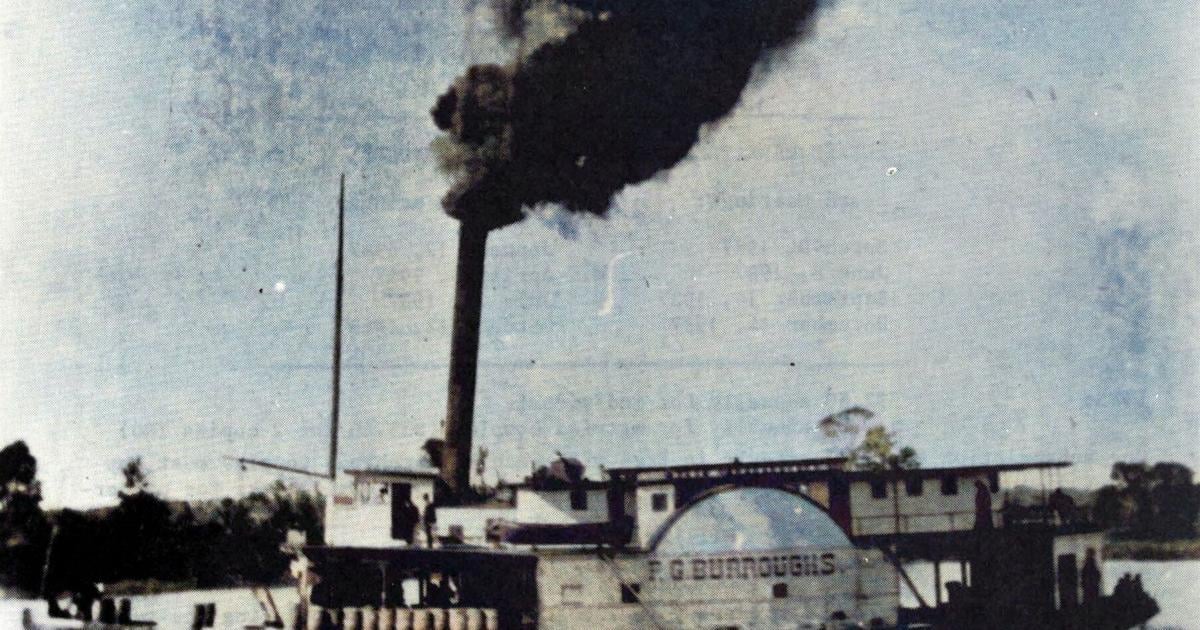
The F.G. Burroughs was a sidewheeler, meaning the huge paddlewheels which powered the vessel were on the side. On bigger rivers, such as the Mississippi, the boats were sternwheelers, with a single paddle at the back of the boat. Steam engines powered the paddles.
The F.G. Burroughs, 125 feet in length and 20 feet wide, had steam engines for both side paddles. Ben Burroughs of the University Archives at Coastal Carolina University, described how the separately driven paddles gave the F.G. Burroughs the ability to navigate the curves of the Waccamaw. The captain ordered ‘ahead’ (forward) on one side and “astern’ (reverse) on the other.