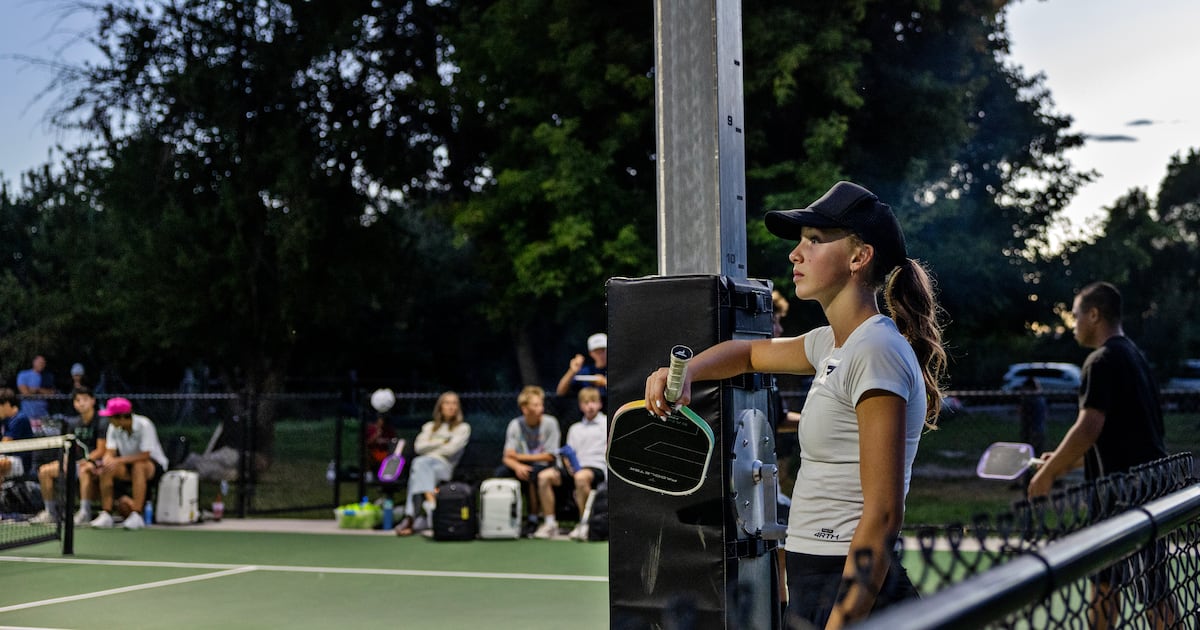
Elsie Hendershot, now a member of the Chicago Slice of the PPA Tour, is on track to be one of the tour’s most popular and marketable players. (Kim Raff/For The Washington Post)
BY THE TIME SHE LANDED in Vietnam, Elsie Hendershot figured the hard part was over.
She and her dad had driven from Utah to Las Vegas, flown to San Francisco, stayed overnight because they missed a connection, hauled 11 hours across the Pacific to Japan and then flew another five to Hanoi.
Elsie, 13, was learning about a long commute to work. Next up: a lesson in travel visas.
After landing at Noi Bai International Airport, her father, Kade, requested a visa. When your daughter hopscotches the globe playing pickleball, you are dad, manager, agent, travel planner and chaperone, so Kade had researched this.
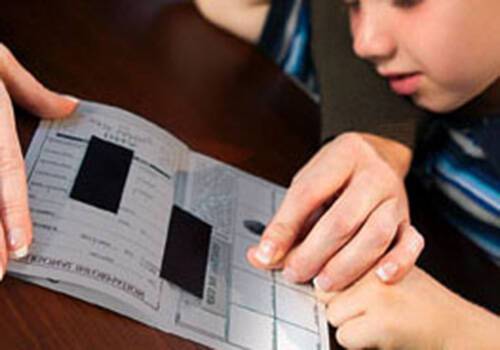
But his research had steered him wrong. Visitors to Vietnam could no longer obtain a visa that way, so they were sent back on a plane to Japan. Elsie, it seemed, might miss the event she traveled half the world to compete in.
Back home in Mapleton, Utah, the mountain town where the Hendershots built two pickleball courts at their home so the entire family could play, Elsie’s mom, Megan, felt powerless. “Why is this so hard sometimes?” she wondered.
Elsie could be back in Mapleton, hanging with her four siblings, who range from 7 to 17. But her talent was too undeniable for that. She is part of pickleball’s next wave and has become a household name to the small but growing number of fans who follow the pro game. Chasing the pro circuit and potential stardom, however grueling it may be, is what she feels she was called to do.
Elsie Hendershot, at home in Mapleton, Utah. (Kim Raff/For The Washington Post)
So here she was in Japan, camera pointed at her face, explaining an intercontinental nightmare.
“Hey guys,” Elsie said in a video posted to Instagram that day. She begins all her videos with that intro, “Hey guys,” with a cheery lilt, though sleep deprivation sapped some of her usual buoyancy.
“I have no idea what a visa is,” she said. “But I know that we needed it, really badly.”
SOON AFTER SHE STARTED playing at age 10, Elsie and her father were watching an interview with teenage superstar Anna Leigh Waters, who mentioned her goal was to compete in the Olympics – if pickleball is ever added.
“When I heard it,” Kade said, “I thought this was our journey.”
Elsie had already demonstrated raw ability. She could keep up with her older brothers, and when she played in competitive tournaments, she routinely beat girls with much higher ratings. Then, last September, when Elsie was still 12, she received a contract offer to go pro. The “journey” had progressed in a blur.
The Hendershots, members of the Church of Jesus Christ of Latter-day Saints, pray together every day. They prayed on this, too, and Kade and Megan met with each family member to try to convey just how much their lives would change.
The Hendershot family, praying together at home in Utah. (Kim Raff/For The Washington Post) Elsie Hendershot, middle, with her mother, Megan, and father and coach, Kade, in their kitchen in Utah. (Kim Raff/For The Washington Post)
Elsie was unfazed. Having laid waste to junior level competition, winning 16-and-under tournaments as a 12-year-old, she knew the only way she could keep improving was to move up. She made it easy for her parents to trust she’d do her part, too, waking early to make breakfast – eggs and her specialty, German pancakes – before training. “I’m totally ready,” she told her parents.
Playing on the pro tour at 12 isn’t unprecedented. Waters, the most successful competitor ever and still dominant at 19, did just that in 2019, in the early days of the pickleball boom. But there was no contract to sign when Waters was 12, only prize money, and everything about the pro game seemed makeshift. In those ramshackle days, Waters might find herself up against lawyers and teachers who considered pickleball a side quest. Her doubles partner was her mom.
“This was nobody’s professional career,” said Chris Patrick, the chief business officer at Pickleball, Inc., the parent company of the professional tours.
Investors, including Apollo Sports Capital, which has invested in the New York Yankees, Wrexham AFC and other pro clubs, have poured millions into the company, including $225 million in May, to further legitimize the pro game. But that means the tours need talent. Realizing that a growing number of top-ranked pros were athletes who came into the sport naturally, rather than converting from tennis, Patrick has made a point of targeting teens (or, in this case a pre-teen) who grew up playing pickleball.
The best prospects have the skills to make up for the fact that their bodies are mid-development. That includes Elsie, a lefty who has grown six inches to 5-foot-8 in the past year and a half, forcing her to adjust her strokes to where the net is relative to her body.
Also from Gen Alpha are Kelly Goodnow, who went pro just before she turned 14 this year, and 15-year-old Tama Shimabukuro, a skateboarding convert who was a surprising runner-up at a men’s singles event in May. Before he signed a deal with Luzz this month, Shimabukuro was negotiating a paddle sponsorship in the neighborhood of $300,000 to $400,000, Patrick said.
Sponsors drive most income for pickleball pros, and Elsie would eventually court those, too. In mid-August, Elsie signed a multiyear deal with Paddletek, the brand she had been using and that donated to a nonprofit youth team she played with. Importantly, the company will pay for her travel.
Tour contracts like the one Elsie and her family was considering are more complex. Of the overall wages, 20 percent goes toward guarantees and 80 percent toward prize money and appearance fees. But unlike in other sports, little is known about what individual players actually make.
Hendershot works out as her uncle and trainer, Taylor Hendershot, watches. (Kim Raff/For The Washington Post) The Hendershots built two pickleball courts at their home so the entire family could play. (Kim Raff/For The Washington Post)
“If you’re in the top 20 with us, you’re making really good money,” Patrick said. “Top five or six are making seven figures.” Waters, the forever No. 1 who wins just about every event she enters and has sponsorships from Nike, Franklin and others, grosses “close to 8 figures” according to an email from her representation.
It’s natural, if unfair, to wonder whether Elsie could be the next “Anna Leigh.” Elsie watches film of Waters but isn’t starstruck playing her. Asked if she idolizes Waters, Elsie goes, “Ummmmm … no.”
Her dad interjects to make sure she knows what “idolize” means – and maybe to avoid a lesson about bulletin board material. Elsie reconsiders but seems content with her answer.
Kade Hendershot, middle, shows his daughter footage as she works out at a VASA Fitness in Utah. (Kim Raff/For The Washington Post)
“I mean, yeah, maybe I look up to her – like, she’s the No. 1 and obviously worked super hard to get there,” she said. “So I think that’s really cool. But when I was in juniors and stuff, I never wanted any pro signatures or anything. Because I want to get to this level as soon as I can.”
Anna Bright, the No. 2-ranked player and Waters’s doubles partner on the PPA Tour, says it shouldn’t be long.
“There are not many women who I think could get better than me,” the 26-year-old said of Elsie. “Getting better than Anna Leigh is kind of a different question. But I think Elsie will be better than me. She should be better than me.”
NEARLY 20 YEARS AGO, Kade and Megan attended a One Republic concert on a blind date, finished the night at IHOP and married four months later.
Every year, on the day they met – “Henderholiday,” they call it – the family heads for a meal together at IHOP. They secure the same booth and include their kids. Even when the increasingly fraught logistics of their lives make it difficult to celebrate on Henderholiday proper, Kade finds a way to make it happen.
So while Kade beats himself up over the Vietnam fiasco – “A huge dad fail,” he said – he’s the hero of that story to Megan.
“One of Kade’s greatest strengths is he’s really good under pressure,” she said. “I was grateful of him because I would have cried and given up and gone home. And he was like, ‘We’re gonna do this.’”
When Kade and Elsie were rejected at the visa desk, he found an airline employee and asked what it would cost for the man to be their concierge and track down an emergency visa overnight.
Kade and Elsie killed time at a bathhouse near the airport in Japan, trading messages with their new contact, praying and binge-watching episodes of “Lost.” They were soon on another flight to Hanoi. Elsie got five hours of sleep, woke up and played in the event.
Beyond those extremes, the sheer volume of travel is most destabilizing. The Hendershots are self-described homebodies, but hanging in their bedroom is a black and white calendar, all 12 months of 2026 visible in a grid, displaying each of Elsie’s trips:
Punta Gorda, Florida; Rancho Mirage, California; Cape Coral, Florida; Mesa, Arizona; McKinney, Texas; Santa Clara, Utah; Hanoi; Sacramento; Atlanta; Grand Rapids, Michigan; Dallas; Columbus, Ohio; St. Louis; St. Petersburg, Florida; New York; Chicago; Orlando; Shenzhen, China. Some of those places she’s visited twice this year, including Mesa, where she’s been playing on the PPA Tour this week.
An Elsie Hendershot pickleball trading card. (Kim Raff/For The Washington Post) The sun sets on the pickleball courts in the Hendershot’s backyard this month. (Kim Raff/For The Washington Post)
“If we were outsiders looking in on someone doing this, we’d probably think, ‘You’re crazy.’” Kade said. “It’s not the life we signed up for.”
Kade started a marketing agency with his best friend in 2012 and spun that company into an AI marketing and transformation agency. Before Elsie went pro, he was planning on taking a step back to spend more time with family.
Now, Kade and Megan spend time apart as different parts of a family: Kade and Elsie on the road, Megan and Elsie’s four siblings at home. Megan, who studied elementary education, has home-schooled her kids on and off, but now all but Elsie are attending traditional schools.
Elsie Hendershot and her brother Rowe enjoy a fun moment at home during a break in her travel schedule. (Kim Raff/For The Washington Post) Elsie Hendershot holds court with family and friends at home in Utah. (Kim Raff/For The Washington Post)
For seventh grade, she went to middle school for science, math and language arts and was otherwise home-schooled. This fall, Elsie is enrolled in an online charter school that allows the flexibility her life demands. She attends junior high for painting and drama classes when she’s home.
Initially, when Elsie and Kade would travel, the older boys would test their mother, seeing if she’d budge on how much they could play video games or use their phones. While they eventually settled into groove, there were “growing pains,” Megan admits.
Megan Hendershot, right, curls Elsie’s hair. (Kim Raff/For The Washington Post)
And family politics to work through. Elsie got an iPhone before her 15-year-old brother and former pickleball partner, Thane, who’s stuck with the kid-safe Troomi.
The parents justified the privilege by calling it “The Pickleball Phone,” because it was for Megan and Elsie to stay connected. They FaceTime each other and exchange photos and videos. For Elsie, that includes attending her first baseball game, at Wrigley Field. For Megan, it’s seeing the baby ducks outside their house or relaying news about Lindy, Elsie’s beloved 7-year-old sister and roommate.
There is one other use for “The Pickleball Phone,” of course.
HERE ARE THE RULES for content: Kade manages the accounts. Elsie shoots her own videos and writes her posts in the Notes app. No browsing. She gets 15 minutes of supervised social media time per day, when she can tell Kade how to respond to comments.
“We want her to have influence,” he said. “To let her light shine.”
Elsie doesn’t “love being on camera and on Instagram and stuff, but I think it’s good for me to do,” she said. “It kind of helps me maybe think through things. I mean, I don’t love being on camera, so I don’t look forward to that type of stuff. But it’s fine. It’s something that I have to do, so …”
Bright, the No. 2-ranked woman, is one of the game’s most prolific content creators, writing a newsletter, posting instructional videos and sharing plenty of personality with her 136,000 Instagram followers. She can feel pressure to produce when fans ask when the next newsletter is dropping, but she finds it mentally stimulating and positive for herself and the sport.
“Especially if you’re not regularly winning, I think you need to be doing things to grow otherwise and elsewhere,” Bright said. “Pickleball needs it. Pickleball needs to become more known to fans, more known to the masses as more than just a sport that geriatrics play.”
Elsie’s reach is still modest – @leftyhendershot has roughly 10,000 followers on IG – but it’s easy to project a future where she’s one of the most popular and marketable players. Patrick says his 9-year-old daughter’s favorite pro isn’t Waters or Bright. It’s Elsie.
For now, Elsie’s account is mostly a creative outlet. Midway through her rookie season with the St. Louis Shock, a Major League Pickleball team, she began making appreciation posts for her teammates.
The first was for Bright, whom she thanked for being a big sister and for drilling with her.
Then Kate Fahey, known partially for her on-court screaming. Elsie confesses she thought Fahey was “crazy” and “scary” but learned she’s actually “sweet” and “funny.”
And Gabe Tardio, a Bolivian who reluctantly agreed to fund a swear jar: two minutes of practice time with Elsie for every curse.
Lastly, there’s Hayden Patriquin, another 20-year-old star whose penance is cold hard cash. “Every time he swears I get $2,” Elsie says. “He already gave me $30. I bought an outfit at Target a week ago. And I already have, like, 40 more dollars.”
A day after making her appreciation post for Patriquin, Elsie, then a seldom-used reserve for the powerhouse Shock, played with him in mixed doubles and got her first MLP win: 11-0, what’s known as a pickle.
It capped a busy opening stretch for the Shock – the only team to compete in the league’s first three events. The Hendershots welcomed a two-week break to reset. But before they could unpack, Elsie got another lesson – and shot another video.
“Hey guys,” she said from New York. “All this stuff has been really crazy that’s been going on with all the trades and stuff. I’m gonna be honest, I’m definitely missing my St. Louis team.”
Traded for a veteran singles specialist, she was now a member of the Chicago Slice. Her next match was Thursday.
Hendershot, center, plays professionally on the PPA Tour. (Kim Raff/For The Washington Post)
MEGAN FLEW TO NEW YORK, where she and Elsie went to Times Square and saw “Aladdin” on Broadway. Then Elsie played her first game for her new team – against Waters and the New Jersey Fives.
Elsie says she wasn’t nervous because there was no pressure on the underdog. She played under control, and she and her new women’s doubles teammate lost, 11-5, a respectable result. For the entire New York event, the Slice dropped all four of its overall matches.
The team was planning for the future. Team captain Zane Navratil, just 30 but a fixture of the pro game, adopted Elsie as his protégée. The two had played together on the PPA Tour before; now they became consistent drilling buddies.
Watching his pointers quickly become winning moves on the court, Navratil has witnessed up close what people across the sport see in Elsie: an obsessive hunger for coaching, and an unnatural ability to absorb instructions.
“If she’s got a weakness yesterday,” he said, “it’s gone today.”
The trade happened in late June, three months removed from her odyssey in Asia. The travel was only accelerating. After New York, she went to Grand Rapids and then Chicago, where she led the crowd in “Take Me Out to the Ballgame” during a Cubs game, then helped the Slice win three of its six matches, good for fourth place out of 11 teams.
Next she went to Disney World, not to ride coasters but to compete for a playoff spot. She began the weekend in Orlando in style, snapping an opposing women’s doubles team’s 18-game winning streak.
To stay alive, the Slice needed a win against the California Black Bears. They were tied late, setting up a “Dreambreaker,” which pits players against each other, four points at a time, in singles.
Elsie struggled through two rotations. On the sideline, after being swept for four straight points, she cried.
“The criers are a little more dangerous,” said Bright, who cheered on her former teammate from the stands, “because they want it so bad.”
Minutes later, having suppressed her tears, Elsie turned to Navratil and asked how long until it was her turn.
“You’re in,” Navratil said, wondering whether Elsie knew how Dreambreakers work.
“All right, I’m ready.”
The game was to 21, win by two. The score was tied at 22.
She lost the first point. One more mistake and the Slice was done. Then Elsie scored to tie it. She scored again to take the lead.
“Her mental capacity is just different,” Kade said. “She has some psycho.”
A serve and two vicious backhands later, Elsie lifted the Slice to victory in front of 2,500 screaming fans. More tears. The best kind.
The Slice won again the next day to clinch a playoff spot. So instead of catching her breath before an event later that month in China, Elsie went home for two days then got on another flight – with mom, dad and her little sister this time – and headed to Dallas.