As high as expectations soared after a clobbering of Clemson to open the Lane Kiffin era, there was opportunity for a nosedive after an overtime loss at Kentucky.
The Tigers’ rumored $50 million roster, short a couple of star players to injuries, failed to overcome the upstart Wildcats, led by a first-time head coach, Will Stein, who just won a game on a two-point conversion call for a second week in a row.
This wasn’t a game LSU could afford to lose if it wanted any margin for error heading into a November slate that includes Alabama, Texas and Tennessee.
Then again, Texas just lost to Oklahoma. Tennessee struggled to beat Arkansas. Alabama is no longer unbeaten after a loss to Georgia.
Ole Miss, the other team LSU nearly beat on the road, has since lost big to Florida, which has just lost back-to-back games to Missouri and South Carolina — the latter being the other team Kentucky beat on a two-point conversion.
“I know everyone gets tired of me saying the SEC is so hard,” Kiffin said, “but this year in the SEC, I really feel like you can win every game on the schedule, and we can lose every game on the schedule.”
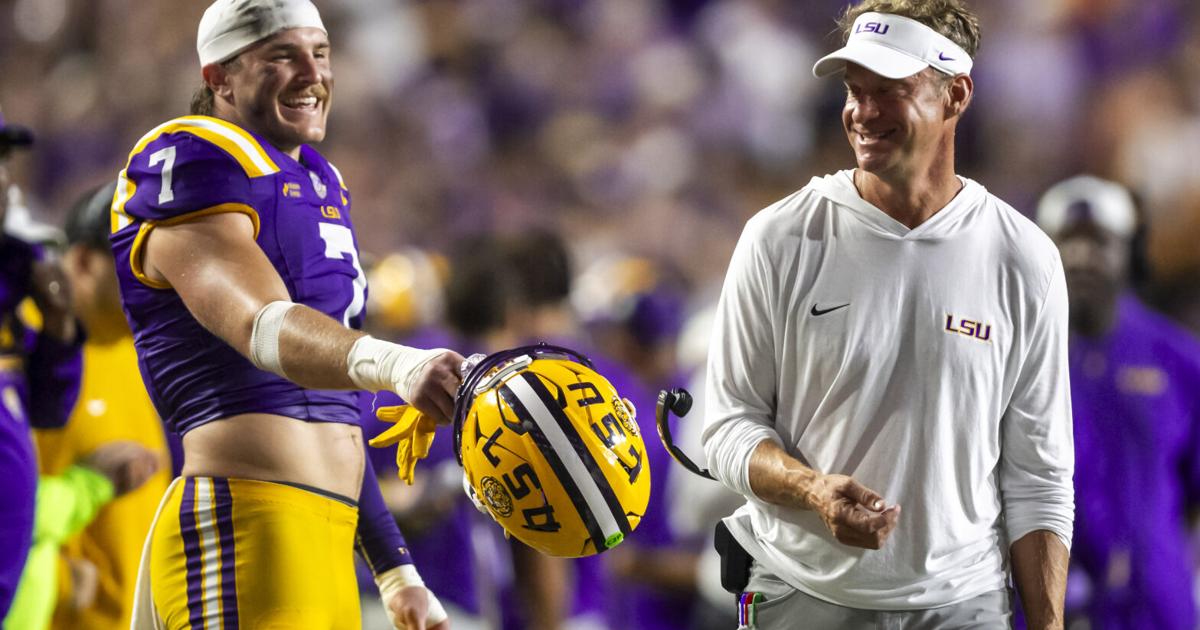
This might just be life in the SEC during the transfer portal era, a time when parity is ruling college football. Maybe there’s no amount of money LSU could have spent to assure Kiffin clinched the playoff in Year 1, especially with No. 7 jersey wearers Trey’Dez Green and Whit Weeks sidelined with injuries.
But a loss at Kentucky demands a reassessment of where now-No. 22 LSU (4-2, 1-2 SEC) stands halfway through its regular-season schedule — and where the Tigers’ stock just took the biggest dips.
LSU’s defense
Belief in Blake Baker’s unit had never been higher coming into Saturday’s contest.
Through five weeks, the Tigers were second nationally in total defense and sacks, fourth in rush defense and seventh in first downs surrendered. Opponents were converting just 26% of their third downs, which nearly matched Kentucky’s woeful 25% success rate.
But the Wildcats converted 36% of their third downs on LSU and became the second straight SEC home team to put up 30-plus points on the Tigers. It’s reasonable to ask how much Baker’s defense was feasting on lesser offenses.
Clemson and Texas A&M are the 118th- and 113th-ranked offenses in the country, respectively, and Louisiana Tech sits at 61st. McNeese State is ranked 46th in the FCS.
This isn’t to say the Tigers are bad defensively. They were much better in the second half at Kentucky, allowing just 24 rushing yards after surrendering 131 in the first half. But it was jarring to see LSU notch just one sack and fail to really affect quarterback Kenny Minchey.
Minchey also had free access to the end zone on a two-point conversion run, partially due to a called adjustment to LSU’s pass rush that wasn’t executed by one defender.
The Tigers’ defense just wasn’t elite, which maybe isn’t a surprise given injuries to Weeks and safety Dashawn Spears (ACL tear) have thinned the Tigers’ ranks. They could still be very good, but they have much to prove this weekend against Mississippi State.
LSU’s offensive line
On the flip side, Kentucky seemingly won the line of scrimmage.
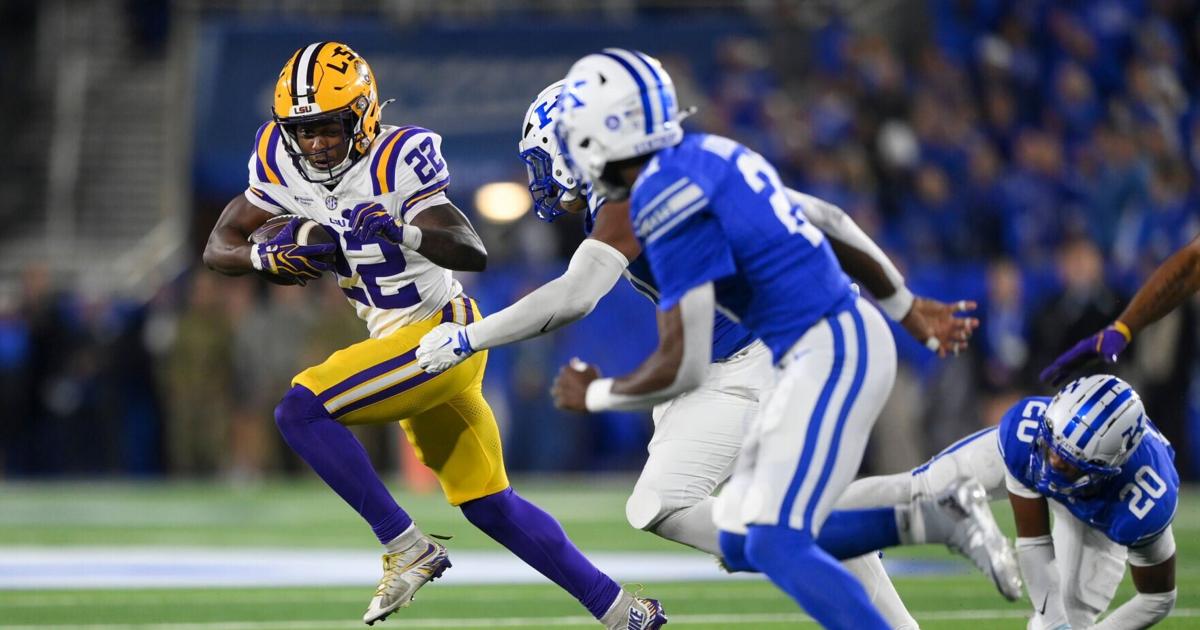
The Wildcats racked up eight tackles for loss, including three sacks. Sam Leavitt was the Tigers’ most productive rusher, removing sack yardage, gaining 61 yards on 12 rushes versus Dilin Jones’ 56 yards on 16 carries. Harlem Berry had three rushes for just 4 yards.
It was never expected this LSU offensive line would be road-grading, but the Tigers’ inconsistencies in run and pass blocking appear to have limited the ceiling of Charlie Weis Jr.’s first offense.
On LSU’s first drive, these were the yardage outputs on five running back carries: 2, minus-1, 11, 2 and minus-4. That possession stalled in the red zone for a chip-shot field goal.
The very next series, there were three carries: minus-2, zero and zero. It took a flea flicker from Leavitt to tight end Zach Grace to earn LSU a touchdown.
“There was some really inconsistent play up front,” Kiffin said, “which led to a not great game running the ball.”
It’s hard to consistently overcome long down-and-distance situations with quarterback runs and trickery. And Leavitt gets into trouble when he’s trying to do too much.
LSU still ranks 27th nationally in rushing offense at 213 yards per game, but the Tigers are averaging 133 yards per contest in SEC games with some unproductive quarters sprinkled in. There’s definitely room to grow there.
The quarterback
Quarterbacks always receive too much credit and too much blame. And it’s not like Leavitt hasn’t improved in many respects.
He’s completed better than 73% of his passes in three straight games, which follows a 62% success rate in his first three contests. His touchdown-to-interception ratio of 7-to-3 in LSU’s past three games is better than his 3-to-5 output to open the season.
But it remains troubling that Leavitt has an interception in every game, and his fumble in LSU’s own end, even though it didn’t result in points, handed an additional opportunity to Kentucky while stealing another chance from LSU to build positive momentum.
“Sam played really well, majority of his plays,” Kiffin said, “and then had two really bad plays.”
LSU is in the red in turnover margin, giving away two more than it has forced in six games. The Tigers rank 90th nationally in that ratio.
Leavitt, in particular, needs to cut out the errors if the Tigers are going to resuscitate their CFP hopes.