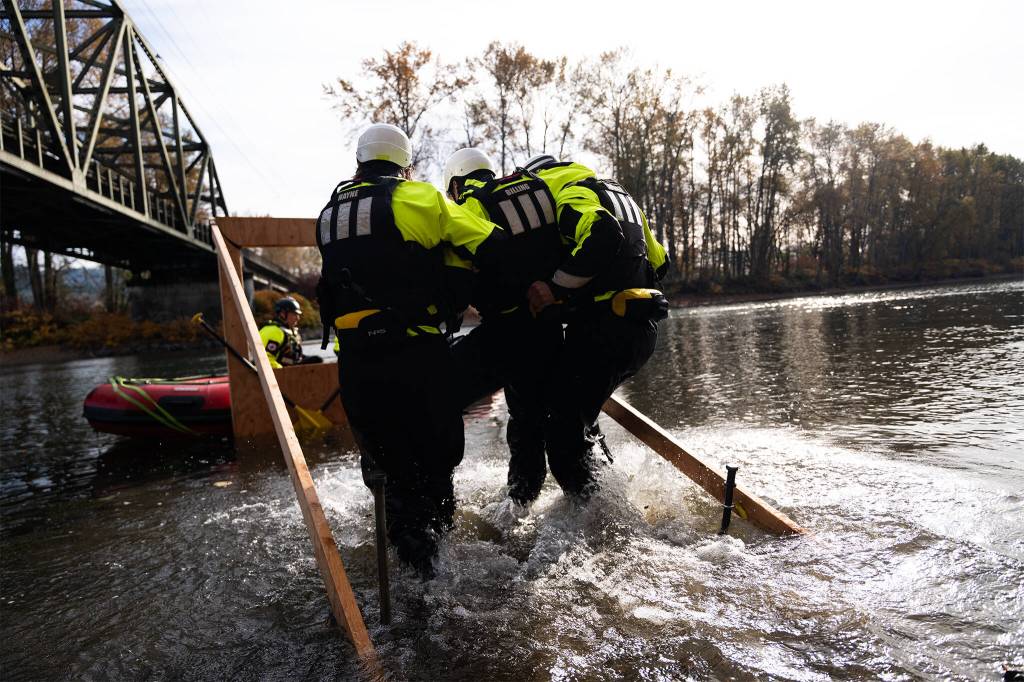
MONROE — First responders from across Snohomish County gathered Monday ahead of flood season on the banks of the Skykomish River for a four-day swiftwater training refresher led by Snohomish Regional Fire & Rescue.
Groups of firefighters rotated between four training stations. Each station provided hands-on practice with a different skill, including vehicle rescue in moving water, practice with an inflatable rescue boat, paddling and boat-handling skills and an introduction to a new real-time reporting software called the Search and Rescue Common Operating Picture or SARCOP.
“We really want to stay current and we want to stay capable,” water rescue team lead Jamal Beckham said on Monday in between training. “We want to make sure that we are ready for anything, so we don’t put ourselves in harm’s way; we understand our capabilities and limitations and our equipment’s capabilities and limitations.”
First responders utilize training refreshers throughout the year to keep their skills fresh, Snohomish Regional Fire & Rescue spokesperson Kaitlin King said on Monday. They must take a separate, more formal course to become certified in swiftwater rescue, she said.
“Luckily, our department supports going out to conferences and classes, so we have the best practices and current knowledge,” Beckham said.
“Our people that teach love coming out here to teach because they’re just passing on the knowledge.”
Last year’s recording floods in December inspired some of the training stations, including one that simulated a rescue through the window of a submerged home. A submerged truck, gutted of any hazardous material, simulated a vehicle rescue.
Snohomish Regional Fire & Rescue firefighters rescued 34 people in last year’s floods, Beckham said.
“It was busy,” firefighter Branden Huber said on Monday.
“The biggest takeaway from those was just the fatigue. I knew I was going to get tired and worked, but I didn’t know I was going to get that tired and worked.”
He said trainings like the one on Monday and flood-specific planning ahead allowed for smooth operations.
“Our water team is super squared away,” Huber said. “We have a ton of support from our department and admin, so we train a lot.”
Huber partnered with Drew Schwitters, a principal geographic information systems analyst with the county’s Department of Emergency Management, to demonstrate the SARCOP software, which is used across the county by all urban search and rescue teams, Schwitters said Monday.
“It’s a way for first responders to send information back,” he said, “and just making sure everybody’s playing on the same sheet of information.”
It allows crews to report locations of people needing rescue, damage observations and other pieces of information, Schwitters said. Support staff can then analyze the information and make informed decisions, he said.
“People on the state level and county level can see what we’re up to out here in our little slice of the incident,” Huber said. “Once it gets dark, we’re going to use what we’ve learned with SARCOP and the other stations, and we’re going to do one big, large-scale night operation.”
The night-time training lasted until 8 p.m., King said on Tuesday.
Taylor Scott Richmond: 425-339-3046; taylor.richmond@heraldnet.com; Bluesky: @btayokay.bsky.social