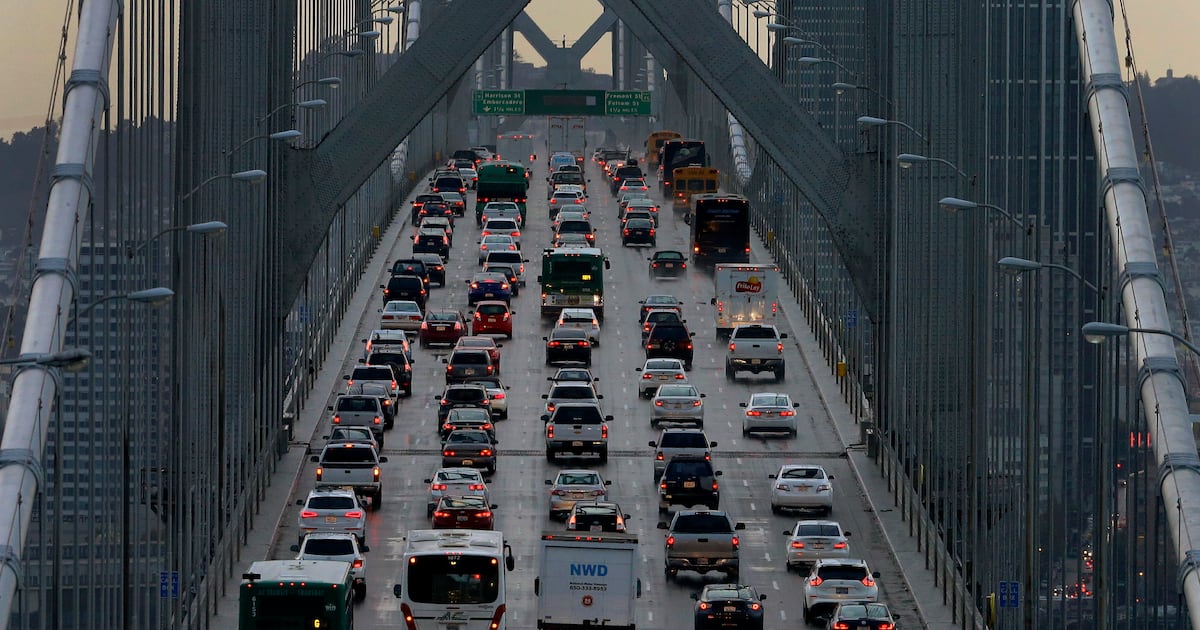
Vehicles make their way westbound on Interstate 80 across the San Francisco-Oakland Bay Bridge as seen from Treasure Island in San Francisco. (AP Photo/Ben Margot, File)
The Senate voted Thursday to block California from enforcing a rule that would ban sales of new gasoline-powered cars in the state by 2035, a move that could have far-reaching implications for auto sales in a dozen states.
The vote marks Republicans’ latest effort to curtail state-level efforts to tackle climate change, even as President Donald Trump and congressional leaders have empowered states to set their own education policies and abortion laws.
This month, the Justice Department sued New York and Vermont over their “climate Superfund laws,” which seek billions of dollars from oil companies to help cover the costs of coping with climate disasters. Last month, the Justice Department also brought unusual lawsuits against Michigan and Hawaii over their plans to take legal action against fossil fuel firms. And in February, the Transportation Department revoked its approval of New York’s congestion pricing program that charges drivers who enter Lower and Midtown Manhattan during peak hours.
“The Republican Party is not content to strip the federal government of any meaningful authority to deal with climate change, but now, they’re going after the states that are trying to fill some of the gaps,” said Pat Parenteau, an emeritus professor and senior fellow for climate policy at Vermont Law School.
White House spokeswoman Taylor Rogers said in an email that the GOP “is right to ensure that Americans in both red and blue states are not beholden to state overreach that stifles American energy.”
“The left’s radical climate agenda has gone beyond constitutional and statutory authorities,” she added.
The Senate voted 51-44 to pass a resolution blocking the California rule, which ranks as one of the nation’s most ambitious policies aimed at promoting electric vehicles. The House already passed the resolution, which now heads to Trump, who has indicated he will sign the measure into law.
Under the Clean Air Act, California can receive a waiver from the Environmental Protection Agency to set tougher vehicle emissions standards than those of the federal government. California regulators approved a rule in 2022 that would phase out sales of new gas cars by 2035, and in December under President Joe Biden, the EPA granted the state a waiver to enforce the regulation.
Eleven other states have pledged to adopt California’s rule and end sales of gas cars within their own borders by 2035. Together, the states account for about 40 percent of the U.S. auto market.
Republicans argue that these states are preventing consumers in the rest of the country from choosing what kind of cars to drive. Sen. Shelley Moore Capito (R-West Virginia) introduced a resolution to revoke California’s waiver under the Congressional Review Act, which allows lawmakers to nullify a regulation within 60 days of its enactment with a simple majority vote.
“This is not just a California problem – it is a nationwide assault on gas-powered cars,” said Sen. John Barrasso of Wyoming, the second-ranking Republican in the chamber. “The California mandates cover nearly 40 percent of all new cars in America.”
Barrasso added that he saw no conflict between supporting states’ rights and opposing California’s car rule.
“Wyoming is a states’ right state,” he told reporters Wednesday. “We pass laws, we set rules for our state. What we’re doing here today is dealing with a rule that … is subjected to the Congressional Review Act, and we plan to use it.”
But some environmental lawyers and advocates said Congress is trampling on California’s long-standing authority.
Congress passed the Clean Air Act in 1970 “with almost unanimous bipartisan support on the basis that states would play a central role – federal standards would be the floor, not the ceiling,” said Michael Gerrard, who founded Columbia Law School’s Sabin Center for Climate Change Law. “Lots of states were eager to have cleaner cars, and now that option is being taken away from them.”
Republicans, he added, “only talk about supporting states’ rights when they like what the states are doing.”
Conservative environmental lawyers, however, said California is overstepping its powers. They said the Golden State is effectively regulating auto pollution in the rest of the United States, since its stricter standards have a significant impact on automakers’ plans to produce and sell more electric vehicles nationwide.
“When one state is essentially trying to regulate activity that occurs outside of its state, that’s not something that is protected by states’ rights,” said Jeff Holmstead, a partner at Bracewell LLP and a former top EPA official under President George W. Bush. “States have jurisdiction within their own borders.”
In forging ahead with Thursday’s vote, Senate Republicans sidestepped legal opinions from two nonpartisan watchdogs. The Senate parliamentarian and the Government Accountability Office have concluded that California’s waiver is not subject to the Congressional Review Act, since it is not a regulation.
Sen. Adam Schiff (D-California) warned before the vote that ignoring these findings would set a “dangerous” precedent.
“If the Senate goes nuclear, overruling the parliamentarian, there is no telling where the Congressional Review Act will be used in the future by Republicans or Democrats,” Schiff said. “Could the Senate merely vote to wipe out an entire four years of actions taken by a previous president? Will your state’s regulations be next?”
The GOP has also targeted several climate efforts in New York, another blue state that has long led the nation in setting environmental policies.
New York Gov. Kathy Hochul (D) in December signed the state’s climate Superfund law, which would fine the largest greenhouse gas emitters $3 billion annually for the next 25 years. The charges would be based on the companies’ contributions to overall emissions between 2000 and 2018. The money would be used to cover the costs of repairing the damage already done to homes, roads and bridges – and to prepare for increasingly extreme weather in the years to come.
In a statement announcing a lawsuit against that law, Attorney General Pam Bondi said the measure would undermine Trump’s “energy dominance agenda.”
“The Department of Justice is working to ‘Unleash American Energy’ by stopping these illegitimate impediments to the production of affordable, reliable energy that Americans deserve,” Bondi said.
Paul DeMichele, a spokesman for Hochul, said in an email that the governor would continue defending the climate Superfund law “because she believes corporate polluters should pay for the damage done to our environment – not everyday New Yorkers.”
“We will not back down – not from Big Oil, and not from any federal overreach,” he said.
—
Theodoric Meyer contributed to this report.