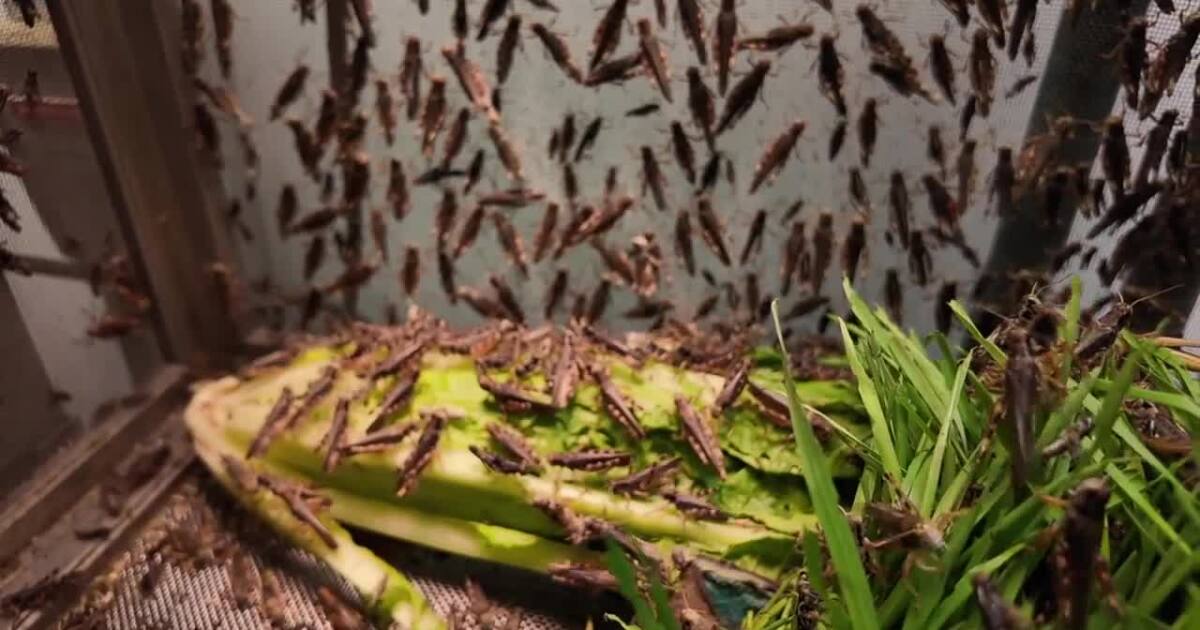
TEMPE, AZ — Many people across the Valley say they’ve noticed more grasshoppers hopping around their neighborhoods lately.
For Phoenix resident Landin Vance, the increase became obvious while spending time with family.
“The first time I actually noticed it, I was hanging out with my nieces, and they were trying to catch them with bowls,” Vance said. “Honestly, this is the first year I feel like there’s been more than usual.”
Researchers at Arizona State University say the insects people are seeing right now are pallid-wing grasshoppers, a species commonly found in the desert.
Sydney Millerwise, a PhD candidate working in ASU’s Locust Lab, says the recent increase is not unusual.
“It’s a little over a month since we had those rains,” Millerwise said. “Those eggs have hatched, and now we’re seeing the first generation of the year.”
According to Millerwise, grasshopper numbers can spike when weather conditions are right.
“Generally speaking, we get about three generations per year,” she said.
While the insects may appear to be in large groups, experts say these are not locusts. Locusts are a special type of grasshopper that can transform behaviorally when populations become dense, forming massive swarms capable of devastating crops.
Instead, Millerwise says the grasshoppers showing up around the Valley are mostly just a nuisance — and even helpful for other wildlife.
“The birds and the lizards and coyotes… they’re very excited. It’s a feast,” Millerwise said.
If grasshoppers are bothering your yard or garden, Millerwise recommends natural deterrents rather than pesticides.
“The best you can really do is keep scaring them away and maybe put out some bird feeders,” she said. “Try and get more of those lizards and critters to come in that are going to eat them.”
Researchers say the current surge should only last a few weeks. Grasshoppers typically go through multiple generations each year, and the next group could appear around early summer.
Scientists at ASU are also studying locust behavior around the world and looking for ways to stop destructive swarms before they spread. You can learn more about that research in our previous coverage:
Watch: ASU scientists find new ways to stop locust swarms before they spread