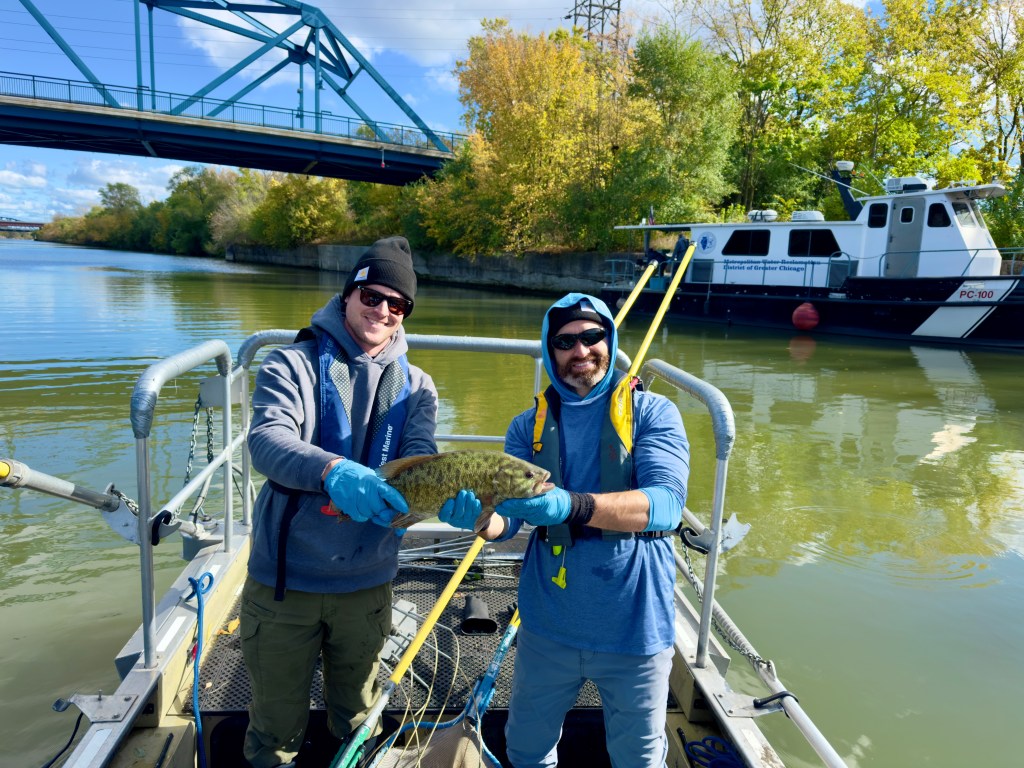
Mike Ress, an environmental research technician at the Metropolitan Water Reclamation District of Greater Chicago, said he was anxious at first to work in the Cal-Sag Channel, as his south suburban family told him to avoid the waterway growing up due to its reputation for poor water quality.
But Ress said through his work with the MWRD he has found the channel has become a wild, vibrant ecosystem with herons and beautiful fish species such as the pumpkinseed, which he and other MWRD scientists attribute to regulatory changes and new water treatment systems.
Most recently, Ress and his coworker, Mike Portala, who is also from the south suburbs, made history in finding the largest smallmouth bass in more than 51 years of MWRD fish monitoring on the Chicago Area Waterway System.
The fish weighed 3.9 pounds with a length of 19.7 inches and was returned to the waterway.
The duo found the fish in October on their last day of surveying for the season, which begins in June, and the find has been championed by MWRD officials as a significant positive indicator for water quality and ecosystem health.
“This is something I never really expected based on the hearsay I’ve been hearing my whole life,” Ress said. “It’s even kind of a good chance to bird a little bit, like it’s a very active ecosystem.”
Thomas Minarik, who has worked for the MWRD for 26 years and is now the principal environmental scientist, said it would have been a miracle to find any fish at all in the waterway 50 years ago, when the Cal-Sag really garnered a poor reputation.
The 16-mile long Cal-Sag Channel was part of the project to reverse the flow of the Calumet River out of Lake Michigan. Human waste was often dumped into the river and would flow freely into the lake, contaminating drinking water and causing fatal cholera outbreaks, officials said.
Minarik said back then there were not a lot of regulations, and people were “dumping anything and everything” into the waterway.
“To find any fish back then was a miracle, considering the water quality was very poor,” he said.
The 3.9-pound, 19.7 inch smallmouth bass that Metropolitan Water Reclamation District scientists caught Oct. 30, 2025, on the Cal-Sag Channel near Blue Island. (MWRD)
Now, he said scientists find growing numbers of fish and fish species in the Cal-Sag Channel.
He said that MWRD staff could only find 10 species in the entire Chicago Waterway System when they first started conducting fish surveys in 1974. Now, he said they have found 77 species, and there is a lot more diversity among the fish.
He also said catch rates have steadily increased, from an average of 22 fish per hour in the 1970s to 436 fish per hour in the 2010s at electrofishing sites on the channel.
He said game fish species such as the smallmouth bass are sensitive to pollutants, temperature changes and low dissolved oxygen levels. Their increasing presence suggests the water conditions can support the high energy demands needed for fish to grow large, he said.
The construction of the tunnel and reservoir system built in the 1970s in the Calumet area was a huge contributor to the decrease in sewer overflow incidents, he said.
“When you have a combined sewage overflow, that brings in a lot of pollutants and things into the system, and it consumes a lot dissolved oxygen and makes it a stressful environment for the fish,” Minarik said. “So by getting rid of that, we have a higher quality water environment for the fish, for them to thrive and live in.”
Compared to 50 years ago, he said, there are now water quality standards that have to be met, and businesses and facilities are required to attain a permit before they can release treated wastewater into public sewers or natural waters, he said.
He also said one of the biggest changes began when scientists started to realize how important it is to have a certain level of oxygen in waterways for fish and started implementing aeration stations in the 1990s.
The Calumet system has five of those systems, which pull water in from the canal and let it cascade through a series of waterfalls, increasing the oxygen in the water, he said.
The record-breaking fish was discovered near the sidestream elevated pool aeration station in Blue Island, according to MWRD. The station was built in the early 1990s to reduce odors, improve water quality and help fish populations.
An elevated pool aeration station at Fulton and Chatham streets in Blue Island was created to add oxygen to the Cal-Sag Channel. It’s operated by the Metropolitan Water Reclamation District of Greater Chicago and is the site of the annual Blessing of the Waters gathering. (Melinda Moore/Daily Southtown)
The station has also been a site where the community gathers every year to promote healthy water quality for an event called the Blessing of the Waters.
Tom Shepherd, one of the event’s founders, said the October bass finding means a lot environmentally, culturally and socially.
“Water is our life, it’s important as our blood that flows in our veins, and its also completely important to the wildlife, the deer, that come down to the waterfront and drink from it, and fish that birds will catch, and it’s just important for the whole chain of life that we experience,” Shepherd said.
He said the river also flows through a lot of Black history landmarks, such as the Robbins airport.
He said the Little Calumet River Underground Railroad Project plans to launch a kayaking club this spring that would feature Black history along the river.
Portala recommended readers check out upcoming virtual tours hosted by MWRD that begin Jan. 14, where attendees can travel back in time to early Chicago to see how the MWRD reversed the Chicago River and developed wastewater treatment technology.
awright@chicagotribune.com