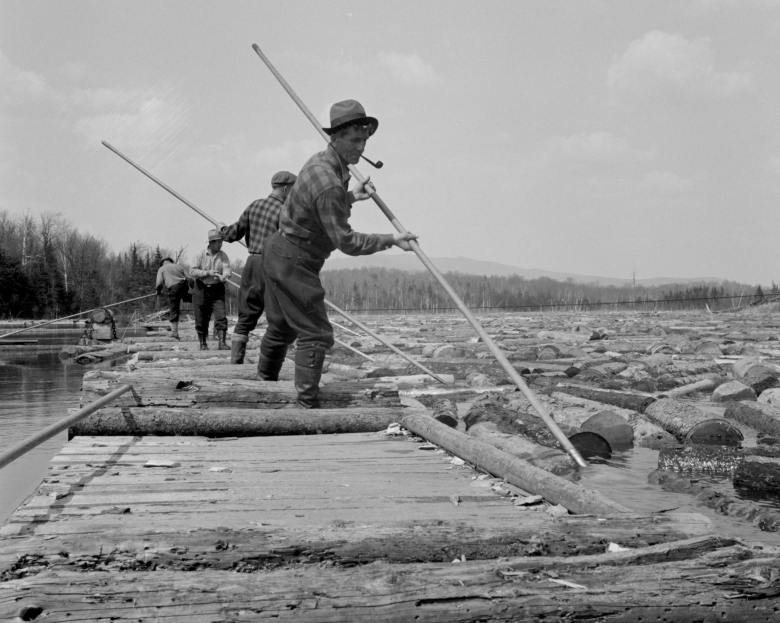
River drivers often stood on walkways with pickpoles to move 4-foot pulpwood down the Kennebago River. Pulpwood was converted into paper at downriver mills.(Photo-by John Collier Jr. in May 1943)
North America’s last log drive concluded on Kennebec River in 1976, halted by environmental regulations and a legislative ban. This also marked the end of the historic Kennebec Log Driving Company (KLD). Founded in 1853 by 63 sawmill owners, the company was formed to coordinate wood transport, manage log-driving dams, and minimize conflicts among river drivers.
Dave Calder, 76, of Canaan, was one of the last KLD workers.
“I started working on the log drives in June 1967 when I was 17 years old,” said Calder. “Because my dad was a river driver, I wanted to work on the river too. Earning one dollar an hour for a 55-hour work week, I was bringing in pretty good money back then.”
His first day made a lasting impression: “Working the shoreline below Madison’s Abenaki Dam, I spent the hot, humid day wrestling stranded, four-foot pulpwood back into the Kennebec River. By late afternoon, pure exhaustion left me barely able to move. Ernest Creamer, a rugged, 62-year-old river driver, reached down and helped me up the steep riverbank. At the top, he smiled, tipped his cap, and said, ‘You’ll eat your beans and johnnycake tonight, young fella!’”
Legendary Kennebec River foreman Leonard “Buster” Violette, a river driver since 1946, supervised Calder and his crew.
“Buster was an outstanding leader and a great man who really looked out for his men,” Calder said.
“Each year, beginning in early April, our work began in Hallowell by hanging booms at the midriver crib and rock piers.”
Made of 20-foot spruce logs chained together, these floating barriers corralled pulpwood that drifted down the Kennebec River each June to feed the paper mills.
As springtime unfolded, Calder worked his way upriver.
“From Hallowell, we’d spend a month or so hanging booms in Waterville, Skowhegan, Madison, Solon, and Bingham,” he said.
In June, the river’s dams were releasing 400,000 to 500,000 cords of pulpwood from the Moosehead Lake region. Recalling the grueling work, Calder said, “All month, we boated up and down the Kennebec repairing booms that broke apart.”
River drivers are moving pulpwood with pickpoles on the Kennebago River. The wood fed the Brown Paper Co. mill. (Photo taken by John Collier Jr. in May 1943)
In mid-May 1969, Calder recalled that a large holding boom broke in Solon, dumping 15,000 cords of spruce and fir pulpwood downriver just before the main sluicing season. Once the spring runoff subsided and water levels dropped, the timber was left stranded on a dozen gravel islands.
“I spent the next few months,” Calder said, shaking his head, “throwing pulpwood back into the river.”
In early August, Calder and his crew returned to The Forks — a remote community where the Dead and Kennebec rivers converge.
“That’s when we began clearing the rear,” Calder said, describing the laborious cleanup. It was a final effort to toss stranded pulpwood logs back into the Kennebec before the season ended.
At Wyman Lake, river drivers in small boats used picaroons, pick poles, and pulp hooks to corral scattered pulpwood into small booms, which were hauled to a 40-foot, 23-ton tugboat named Kennebec. Once the crew filled the tugboat’s 20- to 30-acre teardrop-shaped boom with wood, the tug towed it to the dam’s sluiceway, where the logs were flushed downriver by lifting the sluice gates.
“Working near dams was very dangerous,” said Calder. He knew of one Wyman dam worker who was sent through the sluice gates.
“In December 1973, heavy rains necessitated opening the gates of the Weston Dam in Skowhegan,” Calder said. “Dam worker Aimee Gallant slipped and fell on a patch of walkway ice and was flushed downriver. His body was recovered in Benton the following October. I watched as they pulled him from the water, where he had been pinned beneath tree roots.”
The annual work wrapped up during Thanksgiving week when the booms were stored on shore. Calder noted that the seasonal log drives began each April at Brown’s Island in Hallowell and wrapped up at the very same location in November.
One freezing November day, Calder leaned over the bow to drag a log boom into his boat. “My cant-dog hooked onto the heavy chain,” he recalled with a laugh, “but it just flipped me right into the river.”
Leonard “Buster” Violette was a legendary river boss for the Kennebec Log Driving Co. Note the 4-foot pulpwood behind him on Wyman Lake. (Photo courtesy of Dave Calder)
Crewmates hauled him from the icy water and raced him to Brown’s Island. There, they stripped off his wet clothes and sat him near a roaring bonfire. To Calder, it was just another day on the job. “Heck, we were soaked to the bone half the time anyway,” he said, “no matter the season.”
Now retired, Calder has become a treasured guest speaker at local historical societies, where his stories of the log-drive era captivate audiences. He breathes life into the legendary river drivers, bringing their tales alive with his acoustic guitar and timeless ballads. A particular favorite is “The Jam on Jerry’s Rocks,” a 19th-century tribute to Monroe, a young river boss who perished on the Penobscot River — a song famously championed by folksinger Pete Seeger. Calder’s reverence for the era courses through his veins. In 2007, he brought graveside mourners to tears with an original ballad dedicated to his late, beloved mentor, Buster Violette.
Ron Joseph of Sidney is author of Bald Eagles, Bear Cubs, and Hermit Bill: Memories of a Maine Wildlife Biologist, published by Islandport Press