Redding Consortium Recommends Landmark Merger of Wilmington’s Four Northern School Districts After Heated Meeting
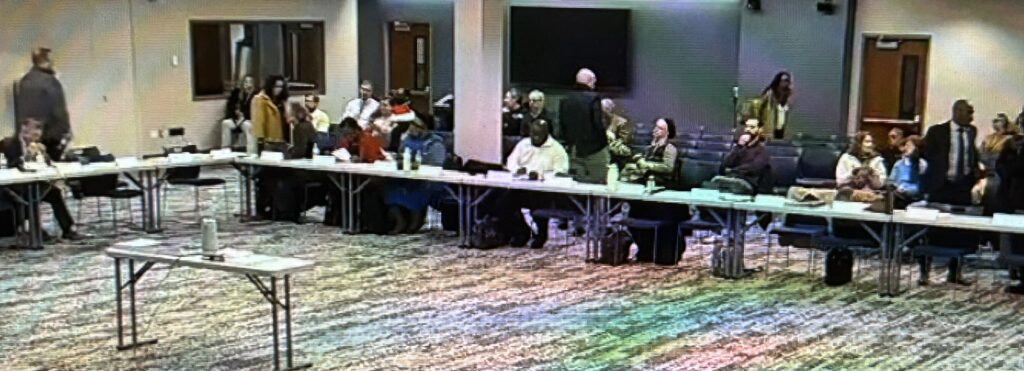
Redding Consortium meets to render redistricting recommendation.
After a three-hour meeting marked by intense debate and a brief racist “Zoom bomb” interruption, Delaware’s Redding Consortium for Educational Equity voted Tuesday night to launch a full investigation into creating one unified school district for nearly all public school students in New Castle County north of the C&D Canal — a move that could redraw decades of educational history.
By a vote of 19–2, with three abstentions and one vacancy, the consortium agreed to conduct a two-month study into consolidating the Brandywine, Christina, Colonial, and Red Clay Consolidated school districts into a single system. If implemented, that restructuring would, for the first time since 1978, place all Wilmington students under one district — undoing the decades-old divisions that dispersed city schools into suburban jurisdictions.
Breaking decades of fragmentation
The Redding Consortium, created in 2019 by unanimous vote of the General Assembly, was tasked with addressing decades of racial and socioeconomic inequities in Wilmington’s public schools. Its decision to advance the “Northern New Castle County Consolidated School District” marks the most ambitious step yet to simplify Delaware’s fragmented education system.
Today, roughly 11,000 Wilmington students navigate a patchwork of four traditional districts, about 40 public schools, and 18 governing bodies. The average high school bus ride from central Wilmington lasts 30–45 minutes. As of 2024, consortium data show these students were 71% Black, 58% from lower-income households, and 24% living with disabilities. Fewer than 1 in 5 students are proficient in English, and only 1 in 10 meet math benchmarks.
Independent researchers from American Institutes for Research (AIR) found that Wilmington’s divided system “diminishes access to support services,” creating a “fragmented experience for students and families” and perpetuating racially identifiable, high-poverty schools.
Inside the vote
Tuesday’s meeting at Delaware Tech’s Wilmington campus stretched for hours, drawing around 50 live audience and almost 500 online participants. About midway through, the session was disrupted as an online intruder took advantage of an open online microphone and shouted racial slurs. Attendees and virtual participants regrouped after the incident and spent significant time discussing the personal reactions to that behavior and the harm of such language before resuming deliberations.
Deliberation took the form of each consortium member sharing their initial thoughts, prior to the formal vote. Several members voiced preference for the so-called “River Plan”, which would extend the boundaries of Brandywine and Red Clay into the city, absorbing the students currently assigned to Colonial or Christina. They cited the belief that this would be less disruptive to the districts and provide a more stable environment, while meeting the consortium mandate of “no more than two school districts with jurisdiction over the city schools and students.” Approximately half of the members making initial comments favored the Northern New Castle County plan, with a single district combining Brandywine, Red Clay, Colonial and Christina.
When the dust settled, the final roll call saw near-unanimous agreement among consortium members — though not without caveats. The only “no” votes came from Brandywine Superintendent Lisa Lawson and Christina Superintendent Deirdra Joyner. Both questioned whether consolidation would genuinely improve outcomes for Wilmington students.
Lawson said she has not seen “data-driven reasons to believe any changes will actually help Wilmington students,” while Joyner cautioned, “We can’t legislate our way to proficiency.” Both echoed concerns from Brandywine constituents who spoke out at a raucous town hall earlier this month, where more than 1,000 residents either attended or tuned in virtually.
Other prominent members abstained, including Delaware State Education Association President Stephanie Ingram, State Sen. Eric Buckson, and Latin American Community Center CEO Maria Matos, who lost her virtual connection but had previously expressed support.
Still, a wide range of leaders — from Wilmington Mayor John Carney to Red Clay Superintendent Dorrell Green and Colonial Superintendent Jeffrey Menzer — backed the motion despite initial misgivings.
A full roster of votes included YES votes from Co-Chairs Sen. Elizabeth “Tizzy” Lockman and former Lt. Gov. Matt Denn, as well as leading advocates like Raye Jones Avery of the Wilmington Center for Educational Equity, Rep. Nnamdi Chukwuocha, Joseph Jones of New Castle County Vo-Tech, Christopher Curry of Ezion Fair Baptist Church, and City Council President Ernest “Trippi” Congo.
Debate, costs, and next steps
The consortium’s vote initiates, but does not finalize, change. The recommendation is nonbinding and kicks off a two-month study period to explore cost, operations, and governance. Members must address 13 stipulations including fiscal impacts, community engagement, and leadership structure.
A draft plan is expected in early February 2026, followed by public hearings in each of the four current districts, including at least two in Wilmington. If the timeline holds, the Redding Consortium hopes to deliver the final plan to the State Board of Education by late February.
Once approved by the State Board, the proposal would move to the Delaware General Assembly, where the Controller General’s Office would conduct a fiscal review. Lawmakers aim to vote by June 30, 2026. Even with full legislative approval, implementation could take years — possibly into the next decade — as planning, staffing, and financial systems adjust.
Preliminary cost projections from AIR estimate the transition could increase annual expenditures by roughly $18 million, or about 1.4% of the current $1.3 billion combined budget for the four districts. Much of that increase would come from raising educator salaries in Christina’s city schools to match their suburban counterparts.
Diverging visions and philosophies
The meeting underscored competing philosophies about education reform in Wilmington.
Rep. Nnamdi Chukwuocha, who gave the final speech before the vote, said a transformation this large is necessary to confront entrenched inequities.
Rep. Nnamdi Chukwuocha
“This system is broken,” he said. “We live in a world with no rules, where we blame our children, their families, and their communities — but never, ever question the quality of their schools. Where so many of our children aren’t being taught, they’re just tolerated.”
Raye Jones Avery, representing the Wilmington Center for Education Equity and Public Policy, argued that the one-district model provides the strongest foundation for change:
“When parents are given the choice of geographic proximity or higher-quality learning environments, they’ll choose the higher-quality environments without fail.”
Joseph Jones, superintendent of New Castle County Vo-Tech, cautioned against seeing consolidation as a cure-all.
“If that is the end point, it will fail. We have to do more for our students — the investment has to occur.”
Former Lt. Gov. Matt Denn
Two veteran statewide leaders, Carney and Denn, expressed mixed feelings. Carney admitted he initially saw the countywide option as his least favorite, warning, “I don’t think it has a chance in the General Assembly.” Denn suggested a smaller-scale merger between Red Clay and Brandywine would have faced fewer political hurdles, noting:
“There are children who are dependent on us getting something done now… Why take the risk, when there’s another model that accomplishes what we want?”
Long road to reform
Even as optimism built in the room, many acknowledged that consolidation alone cannot fix deeper social issues. Sen. Lockman tempered expectations before the vote:
Sen. Elizabeth “Tizzy” Lockman, Co-chair of Redding Consortium
“Schools can’t do this work by themselves. Any implementation we pursue must be paired with serious state investment.”
The Redding Consortium’s vote represents not just a procedural milestone, but the latest chapter in a decades-long struggle for educational equity in Wilmington. From the 1978 desegregation orders that broke up the original Wilmington School District to the failed 2016 redistricting plan, generations of commissions have sought — and failed — to unify the system.
Whether this attempt succeeds depends on Delaware’s political will. But for its champions, Tuesday’s vote signals a long-awaited moment of clarity. Dr. LaRetha Odumosu, Director of Wilmington’s Office of Educational Advocacy, said “Our students should not and cannot afford to be the victims of systems that do not serve them.”