“Nuclear New Hampshire” has a pleasant ring to it, especially now that everyone is talking about electricity and its affordability.
After all, nuclear-powered generators do not belch carbon dioxide into the atmosphere. And unlike other carbon-free technologies such as solar panels, wind turbines and hydro-electric facilities, nuclear plants can run in the dark, operate when the wind isn’t blowing, and produce when the water isn’t flowing.
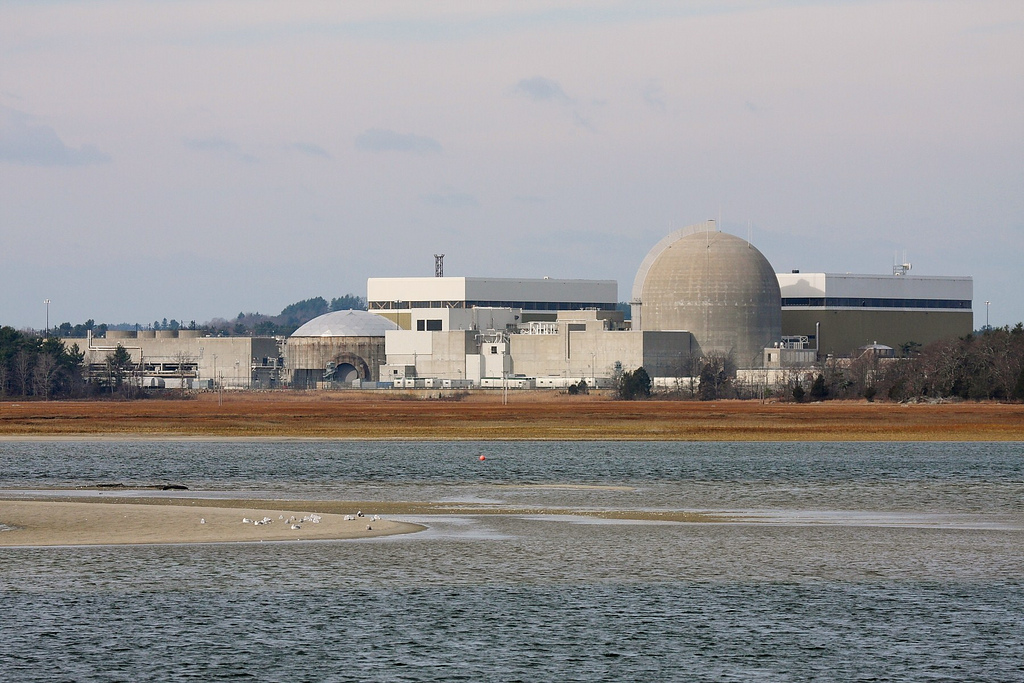
Furthermore, Seabrook Station has been chugging away on the seacoast since 1990. At 1,200 megawatts, Seabrook is by far the state’s biggest producer of electricity and it has a license to operate until 2050.
So, as we contemplate our future electricity needs at a time of both rising prices and rising demand, why not think about building more nuclear facilities in New Hampshire? Gov. Kelly Ayotte has made this the centerpiece of her energy policy and in an executive order has directed her Department of Energy to come up with a “preliminary roadmap to foster new nuclear generation in New Hampshire” by late September.
To that end, the Department has just wrapped up a three-day “nukefest” at the Pease International Tradeport. In my capacity as the statutorily designated advocate for the state’s residential utility customers, I had the honor of speaking at the first day of the gathering — and I also did some listening.
My assigned topic was the state’s “anti-CWIP” statute. “CWIP” stands for “construction work in progress.” The law, adopted in 1979, is what eventually triggered the bankruptcy of Public Service Company of New Hampshire because the statute prevents utility projects from getting into rates until they are actually fully built and serving customers. Seabrook was notorious for its construction delays and cost overruns.
In quest of getting to the heart of things, I stressed that at the heart of the anti-CWIP statute is ensuring that investors, as opposed to captive utility customers, bear the financial risk of new generation facilities. To that end, in the wake of the Public Service Company of New Hampshire bankruptcy, we have long since forced our utilities to sell their generation assets. Seabrook is now owned by Florida-based NextEra as part of its so-called “merchant generation” fleet.
Ayotte, the Department of Energy, and many of the leading voices in the Legislature are intrigued by new and emerging nuclear power technologies. There is much talk about “SMRs” – small modular reactors. Creating them is more like building airplanes than airports, noted Rep. Keith Ammon (R-New Boston), the leading voice for new nuclear at the General Court.
Rolling new reactors off assembly lines is a compelling image but, as I explained at the nukefest, financial analysts seem skeptical about whether this can be done in a way that will save customers money. By “save customers money” I mean “be less expensive than other potential sources of new generation capacity.”
“The jury is still out [on] the quest for affordable small modular reactors,” wrote Michael Cembalest of J.P. Morgan in March. “[W]e’re analyzing something for which there’s no economic proof of concept yet. With enough money, time and regulatory approvals, SMRs can certainly be built. The question is whether they would be affordable.”
The standard metric for such prognostications is known as “levelized cost.” Cembalest noted that estimates for the levelized cost of new natural gas generation run from $55 to $85 per megawatt-hour. The comparable figure for SMRs is between $141 and $200, according to the investment banking firm Lazard, whose annual report on such things is considered the gold standard.
Thus it was not surprising to hear economist James Richards of the Nuclear Innovation Alliance urge the nukefest audience not to rely simply on estimates of levelized costs but also to take into account “nuclear energy’s longterm reduction in volatility.” According to its website, the Nuclear Innovation Alliance is a nonprofit think tank that is “catalyzing the next era of nuclear energy.”
Working their way to Ayotte are two bills that would authorize the state’s electric utilities to get back into the nuclear power business, either by signing power purchase agreements or building small reactors. So when it was Eversource’s turn to speak on Day 1 of nukefest, the omissions were the most noteworthy.
The three Eversource executives who spoke said not one word about their company being interested in getting into the nuclear power business. Instead, their slides warned that “any new nuclear contract will likely be more exensive than existing market-based power” and even if we add nuclear capacity “New England will remain natural gas dependent.”
My points exactly. There are compelling reasons to build new nuclear facilities in New Hampshire — they would advance decarbonization and help stabilize wholesale energy markets by cranking out power steadily and reliably. (I think that’s what the guy from the Nuclear Innovation Aliance meant by “reduction in volatility”)
But there is no reason to suppose that new nukes in New Hampshire — big or small, utility-owned or otherwise — will bring down electricity rates. In that sense, new nuclear is no different than offshore wind, net-metered solar energy, ridgetop wind or wood-fired generation — all technologies for which elected officials of various stripes have sought ratepayer or taxpayer subsidies in recent years to further various policy and political objectives.
New nuclear might be the right play for New Hampshire, in pursuit of fuel diversity, decarbonization and predictability. But ratepayers should keep an eye on their wallets.
Attorney Donald M. Kreis is the state’s Consumer Advocate, representing the interests of residential utility customers.