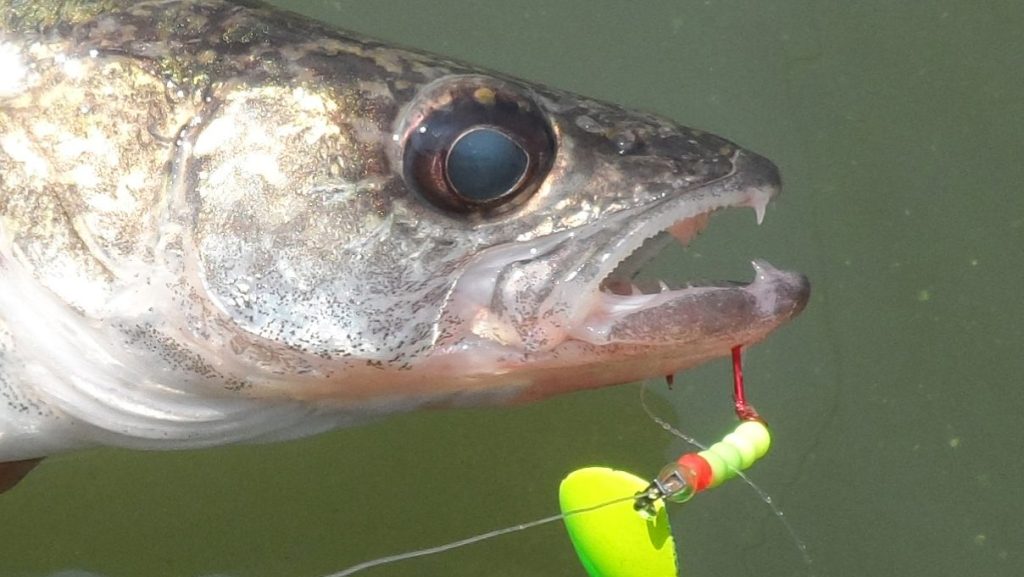
The Eyes Have It. In many fertile waters across southern North Dakota, walleyes stocked as fingerlings this year may reach lengths of 14 inches by 2028. Simonson Photo.
By Nick Simonson
The number of fishable waters in North Dakota has tripled in the last thirty years. With the wet cycle in the 1990s and the sustained water levels since then, there’s hardly a community in the Roughrider State that doesn’t have a great fishery in its backyard, and many of them boast the region’s favorite fish – the walleye – in catchable quantities and quality sizes thanks to stocking efforts by the North Dakota Game & Fish Department (NDG&F), and the agency’s partnership with expanded hatcheries in the state, according to Jerry Weigel, Supervisor for the NDG&F Fish Production and Development Section.
“The NDG&F has always partnered with U.S. Fish and Wildlife Service (FWS), who are our hatchery folks, to collect the eggs, and so the state is predominantly the go-to workforce there,” Weigel explains, adding transport from the hatchery ponds is an amazing process, “we roughly drained six ponds a day, we’ve got 64 ponds we’re trying to harvest and ship, so it amounts to two trucks every day loading up with between 450,000 and 700,000 walleye fingerlings, and going to between 10 and 15 lakes each day. We repeat that for 10 or 15 days until we’re all done, and we roughly average 1,000 miles for every million fish, or ten to twelve thousand miles over those two weeks to get them all trucked to the lakes.”
This year nearly 12 million walleye fingerlings were stocked in nearly 170 lakes in the state, going far beyond the typical walleye destinations of Devils Lake and Lake Sakakawea. Thanks to more than 40 additional rearing ponds at the U.S. Fish and Wildlife Service’s (FWS) Garrison Fish Hatchery supported by NDG&F funding and cooperation, the facility has expanded by leaps and bounds since 1980 when there was just 24. In total, the Garrison facility accommodated about 11 million walleye fry this spring, and additional rearing waters at the FWS Fish Hatchery north of Valley City raising almost another million, the partnership between NDG&F agents and those federal employees is moving the needle on good fishing in the state’s waters.
“Sakakawea and Devils Lake are still there, we can still adequately stock them, but we’ve committed – because that’s what our anglers want – almost all the ponds at Garrison for walleye production. When you go all-in, you’re able to push out the nine-to-12 million fingerlings, so I’d say over the last decade we’re stocking between 150 and 180 fishing waters each year; this year was just short of 170 fishing waters,” Weigel states.
Many of the smaller prairie pothole lakes are primed for supporting these young walleyes, according to Weigel, as water levels remain good and forage bases consisting of freshwater shrimp and resident fathead minnows and limited predator species in the waters, allow the stocked fish to grow quickly. In the southern tier of the state, studies are showing that the two-inch fingerlings are reaching lengths of 14 inches within two or two-and-a-half years of their stocking in ideal destinations. This is due in part to the fertile waters and the fact that they typically warm faster and allow for better feeding activity. Those waters in the northern third of the state and the bigger waters like Sakakawea and Devils Lake still produce 14-inch walleyes within four years, and the state has an overall average of around 3 years to reach that length in stocked walleyes.
All of this adds to up great fishing, as the stocking efforts help make up for what limited natural reproduction can’t fulfill. Additionally, the stocking supports those fertile boom-or-bust shallow prairie lakes, but they are also waters loaded with forage and provide good habitat for fast-growing walleyes, giving anglers more options statewide and more choices closer to home to pursue the king of fish in the upper Midwest.
“A lot of those lakes are very species-limited, in that some of them literally have the walleyes and the food supply, or walleyes and some perch and the food supply. So, they’re far less complicated and have a lot less competition than say a Sakakawea or Devils Lake with the variety of species,” Weigel states, “we’re pretty darn loose about what we’re willing to work with to create a walleye fishery. We actually have a handful of walleye lakes, and in some they’re amazing what kind of production they provide, that literally have a maximum depth of 10 feet or 11 feet,” he concludes.
Summerkill hasn’t been an issue in the recent past even on shallower lakes, with only one significant season of winterkill on some walleye lakes three years ago during the cold and snowy winter of 2022-23. Even with the recent heat, Weigel suspects that the cooler spring conditions which allowed for better tolerance of transport and transplanting gave this year’s stocked walleyes a leg up on establishing a solid year class for anglers to enjoy in the near future and keep the good fishing coming statewide.
Simonson is the lead writer and editor of Dakota Edge Outdoors.