Louisiana keeps doing well in important ratings of state business climates, while policy initiatives and practices by Gov. Jeff Landry’s administration should further improve the situation.
The latest ranking came early this month from Area Development magazine, which said Louisiana has the ninth-best overall business atmosphere in the country, with significant improvement in some areas of focus.
State business rankings sometimes can seem a dime-a-dozen, but GNO Inc. President Michael Hecht — referring to the heavy-analytics approach to baseball made famous by the book (and subsequent movie) by New Orleans native Michael Lewis — calls Area Development “effectively the ‘Moneyball’ of economic development journals. It is the journal of record for site selectors and business consultants.” Hecht particularly lauded the journal’s “level of detail and … level of credibility.”
Adam Knapp, CEO of Leaders for a Better Louisiana, agreed that Area Development is “well respected across the industry” for its “breadth and consistency sustained over time.”
The ratings are compiled in four broad categories with five subcategories each, so the thoroughness adds heft. Louisiana has always done reasonably well by Area Development’s standards because of its inexpensive and abundant energy supplies. Indeed, this year it ranks second in the country for lowest energy costs and fourth for energy availability and grid capacity.
This year, though, our state’s advantages are far more widespread, ranking in the top 10 in an impressive nine of the 20 factors analyzed: fourth in workforce training programs; seventh for labor cost competitiveness, water and wastewater capacity, regulatory environment and property tax environment; eighth for business incentive programs; and ninth for what’s called “overall speed to market.”
And as Justin Shea, media director at Area Development, told me by email, even where Louisiana is weakest — ranked number 32 for “climate risk and resilience” — that’s hardly the fault of Louisiana residents ourselves. The natural problem we face, he said, is that “roughly 40% of Louisiana’s developed land is in a high-risk flood zone.”
Asked an open-ended question about “the most hopeful signs for Louisiana’s business climate,” Shea highlighted its fourth-ranked workforce training, plus the reports they are getting “about the state’s focus and investment in site readiness.”
As it happens, Hecht, when asked the same question, also immediately noted site readiness, which he called a huge factor in what Area Development categorizes as “overall speed to market.” What that means, Hecht said, is “the time that’s going to develop between a project being considered and the doors literally opening or the first product being delivered or the first container being moved off the dock.”
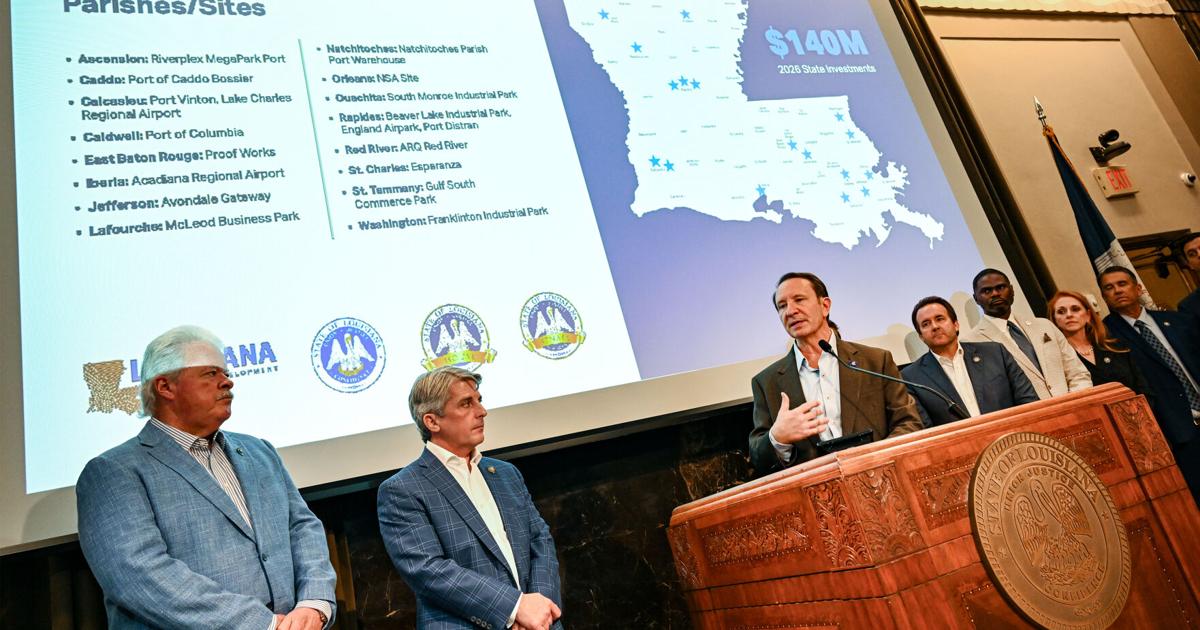
Both he and Knapp said that recently enacted policies will serve to hasten Louisiana’s move up the rankings in “speed to market.” Hecht particularly pointed to the Fast Sites initiative overseen by Susan Bourgeois, the secretary of Louisiana Economic Development. As described in an earlier column here, Fast Sites is a “revolving fund” used to get potential business sites ready at the front end with water service, roads, high-transmission wires and other infrastructure, so companies can actually get operational much more quickly once they move in.
The other element improving our speed to market, Hecht said, “is less a policy and more an attitude” involving the Landry administration’s highly focused “whole of government” approach to “bring everybody together in the same room” to coordinate business-recruitment plans.
Knapp specifically identified the same thing, with the administration “making sure we’re better coordinated up and down the chain of government. … It’s this idea that if you have the Public Service Commission talking to the Department of Economic Development talking to the transportation department, talking to local governments, too, that they have this ability to have a kind of cross-government coordination.”
Finally, Knapp credited — among a longer list of improvements in the state’s business climate — the Landry-backed tax changes passed in late 2024 which reduced business and personal income taxes, along with investments in Louisiana’s transportation infrastructure, including the major new port facility coming in the town of Violet.
As Bourgeois told me, “Louisiana is delivering at a speed and a scale that we have never delivered on before … with multiple projects in diverse regions in diverse kinds of companies.”
She said that with high-profile new business investments from Hyundai and SpaceX and Meta, among others, people are saying, “Louisiana is ‘having a moment.’ But we’ve turned that ‘moment’ into ‘momentum.’” Better yet, she stressed, she sees that momentum continuing at full tilt.
Shea, speaking from Area Development’s analytic perspective, summed it up: “Louisiana is working on the practical things that matter when companies and their advisers are trying to get shovels in the ground.”
Good. Let’s keep it up.