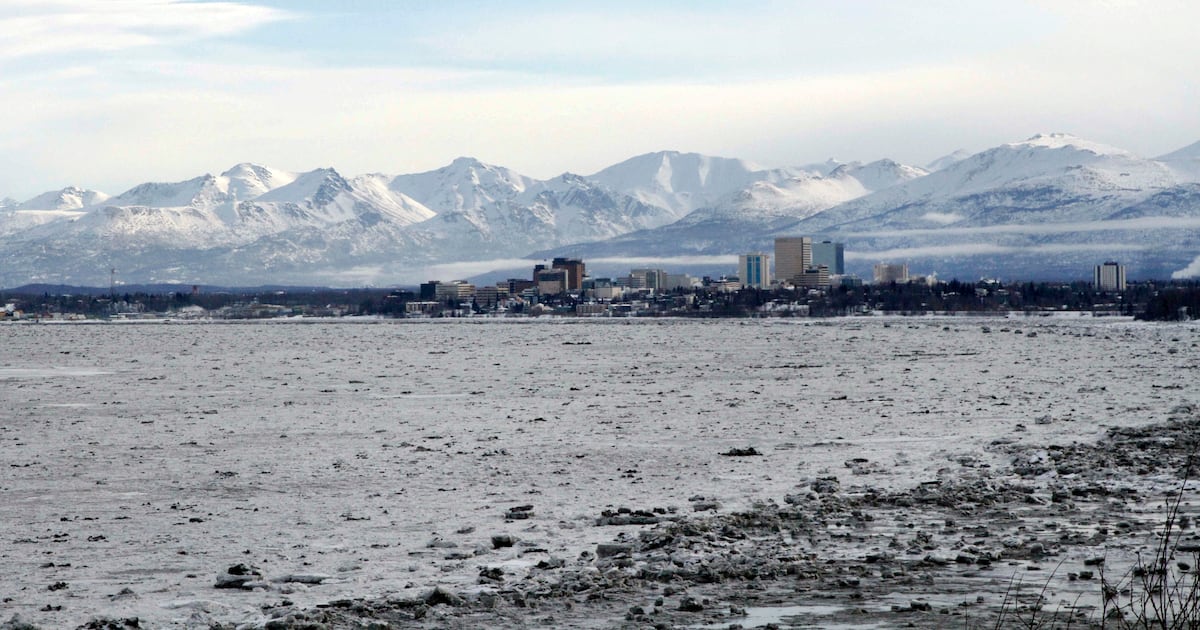
Downtown Anchorage is dwarfed by the snowy Chugach Mountains and fronted by Cook Inlet on March 11, 2024. (AP Photo/Mark Thiessen)
Let’s be real: The Municipality of Anchorage doesn’t have the resources it needs to deliver the services residents want and deserve. We are nearing a breaking point decades in the making, and it’s time to decide what we’re going to do about it.
Over the coming months, we’re asking you to join the conversation about our fiscal future. To do that, here are five things you should know about where we’ve come from and how our budget has changed.
The muni’s budget has been capped for 40 years
The year is 1983. With 231,000 residents, Anchorage is growing rapidly. The trans-Alaska pipeline is flowing, and so is the money. The municipality’s budget is $194 million ($655 million in 2026 dollars), and 42% of it is funded by the state of Alaska.
Amid an explosion of population growth, capital investments and government spending, voters enact the tax cap.
Enshrined to this day in our municipal charter, the cap limits the municipality’s budget to no more than the previous year’s budget, adjusted for inflation and population change.
Today, Anchorage has 291,000 residents, a sprawling footprint to maintain, a $666 million municipal budget and only $1 million to $4 million from the state. Capped for the past 40 years, the Muni has cut staff, trimmed or eliminated services and chased funding to fill the gaps in our strained budget.
Cutting spending and taxes means cutting vital services
Over 60% of the municipal operating budget funds three departments: the Anchorage Police Department ($145.9 million), Anchorage Fire Department ($123.3 million) and Maintenance & Operations ($117.8 million).
Most of the budget is spent on labor — the people who work every day to run government, from fixing light poles to answering emergency calls. A meaningful property tax decrease will cut departments that keep our community safe and open for business.
No two service areas are the same
When the city of Anchorage and Greater Anchorage Area Borough unified in 1975 to become the Municipality of Anchorage, a core merger dispute was resolved by a system that shapes our government to this day: service areas.
The basic concept is that certain geographic areas vote to fund certain public services. Voters in the Anchorage Roads & Drainage Service Area may approve bonds to improve streets, roads and sidewalks within the area. Smaller areas, like the Glen Alps Limited Road Service Area, approve their own mill rates to fund their own road maintenance.
The amount we all pay to fund the municipality’s general government — libraries, planning, administration, municipal prosecutors, etc. — is very small. A typical tax bill is mostly levying dollars that can only be used in a particular service area for the area’s functions: police, fire, parks, building safety or roads.
For 50 years, the service area concept has allowed communities to vote themselves into the level of government they want and retain a measure of local control. As a result, not everyone pays for the same services, and some people use services and amenities they don’t pay for.
The state doesn’t pay our bills anymore
Remember when we mentioned that 42% of the municipal budget in 1983 was funded by the state of Alaska? Its contribution helped build new things and maintain them too. But in 2026, that rate is down to 0.05%.
Our three big problems are related
We have three big problems: 1) we have billions of dollars in backlog as the port, schools and municipal facilities, stormwater drainage, pipes and roads are all reaching the end of their lives; 2) we built a sprawling city without enough housing to sustain it; and 3) our current budget structure doesn’t have enough flexibility to address today’s reality. Each problem stands as a barrier to the next, but to solve one nearly solves all three.
Of the 346 U.S. cities with a population over 100,000, we rank No. 1 in geographic area and No. 75 in population. We have fewer people paying for more infrastructure, and that infrastructure is reaching the end of its life expectancy. We built a city we can’t afford to maintain, and now we have a lot of work to do with about a billion dollars we don’t have.
The math starts to change when we add more housing to the existing footprint of our infrastructure. Housing that fills in the gaps along our roads and utility lines increases the tax base that funds that infrastructure. Taxpayer density brings financial stability; more housing means more people pay their share in the long run.
But we don’t live in the long run. We live today.
Today, the cost of keeping our streets safe is bursting under the tax cap. Without further investment, the only option is less — of everything.
Today, the municipality is facing tough fiscal decisions, and we’re asking you: What level of service are you willing to fund through your local government?
You can weigh in at the MOA Fiscal Future Summit on Oct. 30 at the University of Alaska Anchorage Student Union. Doors open at 9:30 a.m., and while it’s not required, register today to get event updates and reserve your lunch.
Or … take this short survey.
Anna Brawley is chair of the Anchorage Assembly and represents District 3, West Anchorage.
Erin Baldwin Day represents District 4, Midtown Anchorage, on the Assembly.
• • •
The Anchorage Daily News welcomes a broad range of viewpoints. To submit a piece for consideration, email commentary(at)adn.com. Send submissions shorter than 200 words to letters@adn.com or click here to submit via any web browser. Read our full guidelines for letters and commentaries here.