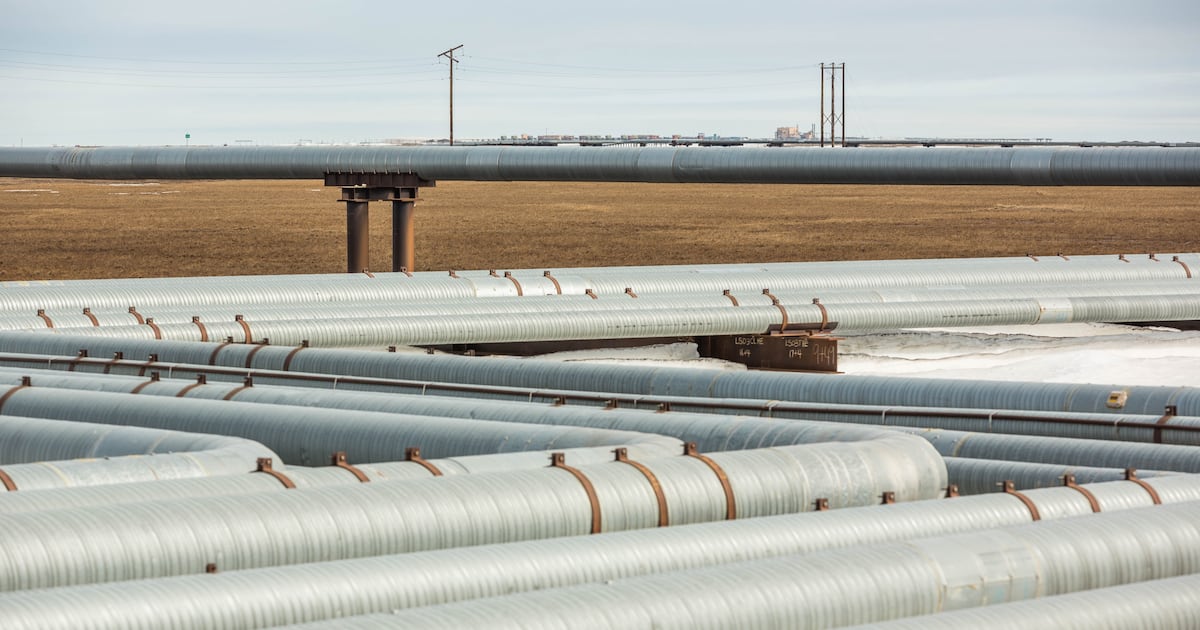
Pipelines at Prudhoe Bay on Alaska’s North Slope. (Loren Holmes / ADN archive)
Alaska is actively committing the ultimate economic sin: government-sanctioned resource waste. For decades, the Alaska Oil and Gas Conservation Commission has operated under a razor-sharp mandate. We were established in a sacred partnership with the people of this state to ensure maximum value for Alaskans from our oil and gas resources. We protect groundwater, ensure public safety, strictly defend correlative rights so every owner gets a fair share and, above all else, are legally and morally bound to prevent waste.
Right now, 35 trillion cubic feet of conventional natural gas sits stranded on the North Slope. It is treated as valueless. It is treated as a mere tool to keep oil flowing, reinjected into the earth because a broken, antiquated tax structure holds it captive.
The Senate majority coalition has a historic opportunity to end this paralysis. By forwarding a clean gas property tax restructuring bill modeled after House Bill 381, this Legislature can remove a fatal barrier to entry. To do anything less is a direct violation of the fiduciary duty this state owes to its residents.
The illusion of ‘stranded’ gas
Let’s dismantle the biggest myth in Juneau: the idea that North Slope gas is financially or operationally stranded because pulling it would hurt oil recovery. Years ago, the AOGCC approved the offtake allowance. That regulatory milestone proved definitively that gas is no longer financially stranded for the purpose of raising oil.
Most importantly, the technical baseline is already set: We will not lose additional oil production. The rules of the road are established, the protections are in place and the pool mechanics are fully understood. The technical hurdles have been cleared. The regulatory path has been paved. The only remaining barrier isn’t geology, and it isn’t engineering — it is political will.
Keeping this resource locked down out of fear or institutional inertia is a choice. Having a massive potential global market at our fingertips while simultaneously failing to exercise a legislative option to create value is the very definition of waste. The AOGCC is legally obligated to prevent the waste of our oil and gas resources. But regulators cannot fix a broken tax code. That duty falls squarely on the shoulders of the Senate majority. Failing to pass this bill means choosing to let billions of dollars in Alaskan wealth rot in the ground.
A prerequisite for opportunity
Let’s be entirely realistic: This property tax restructuring bill is not a silver bullet. Passing this legislation will not magically solve every commercial hurdle, nor will it single-handedly construct an 800-mile pipeline overnight. There are complex global dynamics and massive infrastructure demands at play, and it is going to take a lot more than just a tax bill to fully unlock this market and realize the gas line’s true value.
But make no mistake: Without this bill, no market is possible.
Our current property tax framework acts as an immediate dead end. It kills the conversation before a single shovel hits the dirt. No sane investor is going to finance a megaproject when the host state demands massive upfront tax payments before a single cubic foot of gas is sold. This bill doesn’t guarantee a finished project, but it guarantees us a seat at the table. It transforms an absolute impossibility into a viable commercial opportunity.
Zero state funding, fierce global competition
Opponents of progress will cry, “Look at the state coffers.” Let me be unequivocally clear: This restructuring requires absolutely zero additional state funding to incentivize construction. This is not a government handout. It is not a subsidy. It is a structural modernization.
Right now, Alaska’s property tax system on oil and gas infrastructure is a global anomaly. A front-loaded 20-mill property tax during construction — when the project generates precisely zero revenue — makes the infrastructure unfinanceable. It smothers the economics of a megaproject before it can even draw breath.
While the Senate majority debates attaching unrelated regulatory and corporate income tax expansions, our competitors are moving aggressively to swallow our market share. Aggressive multibillion-dollar export hubs along the U.S. Gulf Coast, like Cheniere’s Sabine Pass expansions, and fast-tracked megaprojects in Qatar and Australia are actively locking down long-term supply contracts with Asian buyers. These regions utilize predictable, volumetric or production-tied tax structures. They do not penalize a developer for laying pipe before the gas flows.
Passing a clean bill modeled after HB 381 replaces a toxic tax framework with a volume-based structure. It aligns Alaska with global standards, transforming an uncompetitive paper pipeline into a bankable asset. It turns a valueless asset into a global commodity without costing the Alaska taxpayer a single dime.
Exercising the option
As a past chairman of the AOGCC and during my tenure as the governor’s policy director and a legislative staff member, I spent years looking at our resource landscape through the lens of maximizing value for Alaskans. We pride ourselves on being a resource state, yet we are behaving like an unmotivated landlord.
If built, the Alaska Department of Revenue estimates this project will inject more than $21 billion into the Alaska treasury through 2062. We have the gas. The world wants the energy. The AOGCC already proved the mechanics work. House Bill 381 provided the blueprint.
Now, the Senate majority coalition must finish the job. If the Legislature refuses to exercise this option, it is actively choosing to devalue Alaska’s future. It is time to stop apologizing for our wealth, fix the tax structure, end the waste and finally deliver the full value of Alaska’s gas to the Alaskans who own it. Pass the bill.
Brett Huber is Alaska state director for Americans for Prosperity. He is also the immediate past chairman of the Alaska Oil and Gas Conservation Commission.
• • •
The Anchorage Daily News welcomes a broad range of viewpoints. To submit a piece for consideration, email commentary(at)adn.com. Send submissions shorter than 200 words to letters@adn.com or click here to submit via any web browser. Read our full guidelines for letters and commentaries here.