Hollywood is having something of a love affair with physical film formats from the past. This renaissance will be celebrated at the Academy Awards on Sunday with a slew of nominated movies that were shot and released on old-school celluloid. These high-profile productions are riding, and fueling, a surge of audiences interested in watching analog prints at cinemas that still run reel-to-reel projectors.
Tom Welch has been experiencing this celluloid revival firsthand as lead projectionist at the Coolidge Corner Theater in Brookline. “It’s routinely packed in here for our screenings in premium formats,” he said. “Boston especially seems to embrace seeing film on film.”
Tom Welch, lead projectionist at the Coolidge Corner Theater, loads a reel of film onto one of the projectors. (Artemisia Luk/WBUR)
Last year the first-run features on film just kept coming, including “Sinners” and “Marty Supreme” in 70mm, “Frankenstein” in 35mm, and “One Battle After Another” in VistaVision. They were brought to life inside the majestic main movie house’s dimly-lit projection booth.
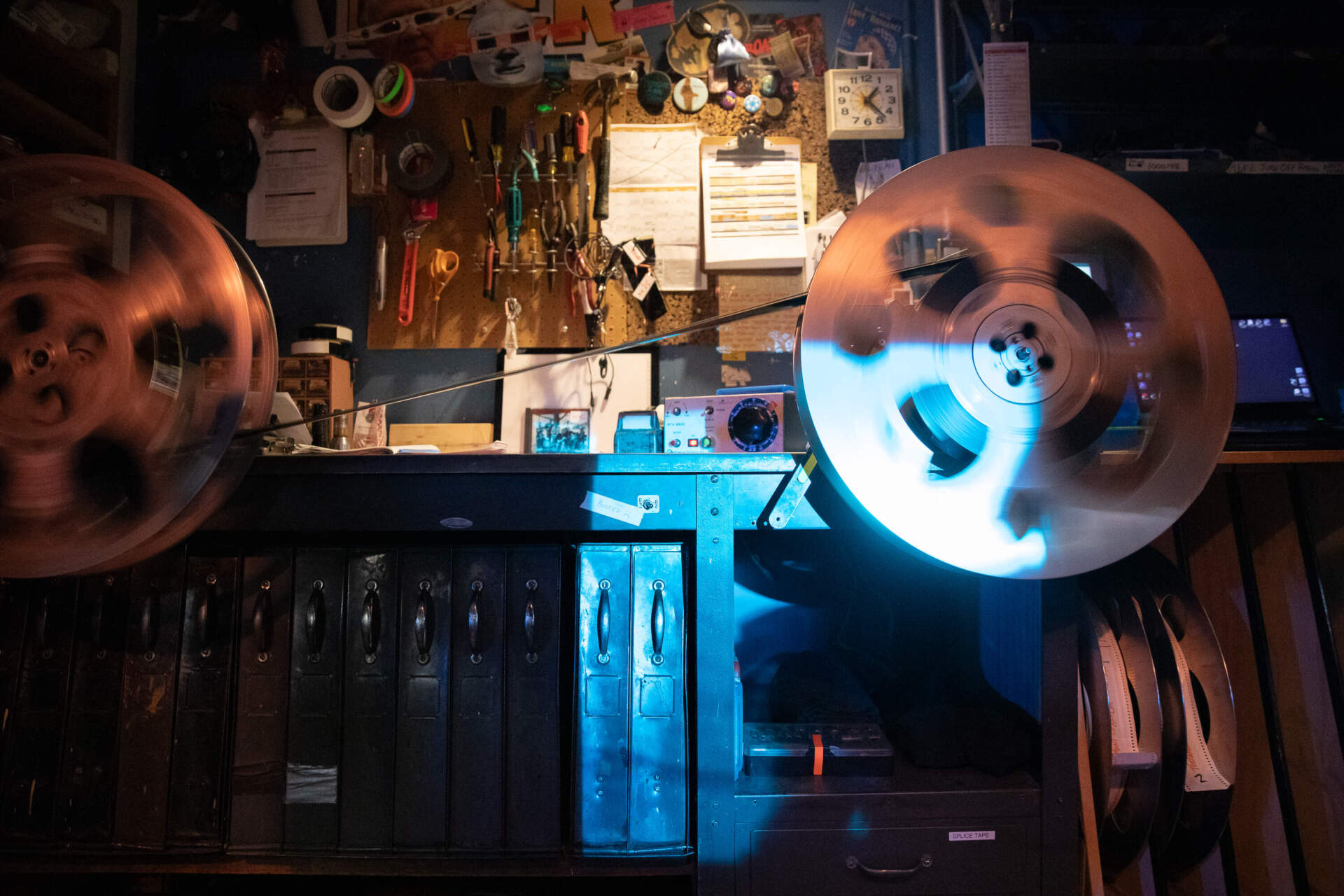
“On either side of me right now I have two Norelco AA2 projectors, which are 35 and 70 mm projectors,” Welch said as he moved around the tight space. “We’re about to do a screening of the ‘Testament of Ann Lee’ which is 10 reels. We switch back and forth 10 times, and if you’re in the audience you don’t notice.”
Welch hoisted a metal reel onto one of the hulking 1950’s machines and started to thread a wide strip of 70 mm film through its spools. “Now that I have the projector laced up I’m advancing it by hand to make sure the film path is correct,” he explained.
Projection booth view of Moviehouse 1 at Coolidge Corner Theater as “The Testament of Ann Lee” plays. (Artemisia Luk/WBUR)
The machine purred as the reels rolled into action and Welch peered through the booth’s tiny window to adjust the focus. He said he loves how huge and crisp 70 mm film looks on screen. “The whole frame just pops.” Artistic director Mark Anastasio concurred. “I just think people look more alive when you’re watching them on film,” he said.
The Coolidge was one of only four theaters in the world chosen screen to “One Battle After Another” in VistaVision, a rare, widescreen format. To do that they used refurbished vintage projectors on loan from the George Eastman Museum.
“It ended up being the highest grossing film in Coolidge history — by a long shot,” Anastasio said. “There has to be something to the format driving that interest.”
Coolidge Corner Theater artistic director Mark Anastasio sits in Moviehouse 2 at the cinema. (Andrea Shea/WBUR)
All movies used to be shot and projected on celluloid. But about a decade ago, digital’s arrival seemed to ring a death knell. Anastasio remembers receiving a fax from the major film studios saying, “You’ve got about a year to convert to be ready for digital cinema because we are no longer going to be producing films in 35.”
The Coolidge installed digital projectors, but continued screening older, analog films for its series and special programs.
70 mm was also left for dead until director Quentin Tarantino brought it back for “The Hateful Eight” in 2015. Since then, Anstasio said the format, “went from this oddity that would only happen once each year to now with three, four, five films a year.” The next big 70 mm release is “Project Hail Mary” starring Ryan Gosling.
The Coolidge’s listings even specify which screenings are 70 mm, 35 mm or digital. And Anastasio said younger filmgoers are showing up for celluloid. Their enthusiasm reminds him of the revival of interest in vinyl records. Folks are willing to pay extra to see movies in 70 mm – tickets cost about $25 rather than $17.
“The higher price lets people know they’re not only getting a premium viewing experience,” Anastasio said, “but that there’s also someone behind the scenes working incredibly hard to give them that experience.”
Printouts on a clipboard list Coolidge Corner Theater’s film lineup for a week in early February. Twenty 70 mm showings of “The Testament of Ann Lee” were scheduled. (Artemisia Luk/WBUR)
For 29-year-old Isabella Amparan celluloid is worth it. Standing in the Coolidge’s lobby she said, “If you’re going to spend money on something, why not spend it on seeing art the way the artists want you to see it?”
Amparan was determined to catch the last showing of “The Testament of Ann Lee” in 70 mm. “For the rest of the week it’s only in digital,” she said, “and I had to see it on film.”
In a technology-drench world Amparan said she’s been seeking out physical and analog media, like cassette tapes. Her obsession with celluloid took hold about a year ago. “Suddenly it became this thing where I was like, ‘I want to see as many films on film as I can.’”
She’s not alone. Other film on fans were playing hooky in Cambridge at the Brattle Theatre’s 35 mm Friday matinee. The time-worn “Dangerous Liaisons” print that lit up the screen was an original from the movie’s release in 1987.
After the credits rolled, Emerson College freshman Nadia Rosa said, “I’d never seen a film on 35 mm, and it made it really special — like there’s a little piece of history still left.”
“When you can see a little bit of residue of history, you’re really connecting to everybody who’s ever watched that particular print over its existence,” says Brattle creative director Ned Hinkle. (Andrea Shea/WBUR)
The print’s scratches and dings are part of the celluloid experience for Brattle creative director Ned Hinkle. “When you can see a little bit of residue of history, you’re really connecting to everybody who’s ever watched that particular print over its existence,” he said. You’re doing a little bit of time traveling.”
Hinkle has also observed the swell of interest in films on film, both old and new. He thinks Hollywood’s buy-in — along with its marketing — are raising awareness, and some hype, about celluloid.
“It’s great that it’s happening, and I hope people continue to be interested in seeing films on film,” he said. “But mostly I just want people to continue seeing movies in a movie theater — not just because I run a movie theater — I do think it is the best way to see a film.”
Somerville Theatre. (Andrea Shea/WBUR)
Somerville Theatre creative director and co-owner Ian Judge agreed with Hinkle’s sentiment as he got ready for a 35 mm showing of “The Wizard of Oz” in eye-popping technicolor.
“You can see the most beautiful print of the Mona Lisa, but people still travel to the Louvre to see the painting because it’s the real deal,” he said., “And I think when you’ve got something filmed on film, and projected on film, you’re getting a similar experience.”
The Somerville routinely screens movies in 35 mm and 70 mm. It also hosts an annual 70 mm festival that celebrates the glories of celluloid as part of its mission to introduce new audiences to cinema traditions. Judge acknowledged how, at a time when multiplexes are going dark, Boston film fans are lucky to have so many independent theaters dedicated to keeping their projectors rolling.