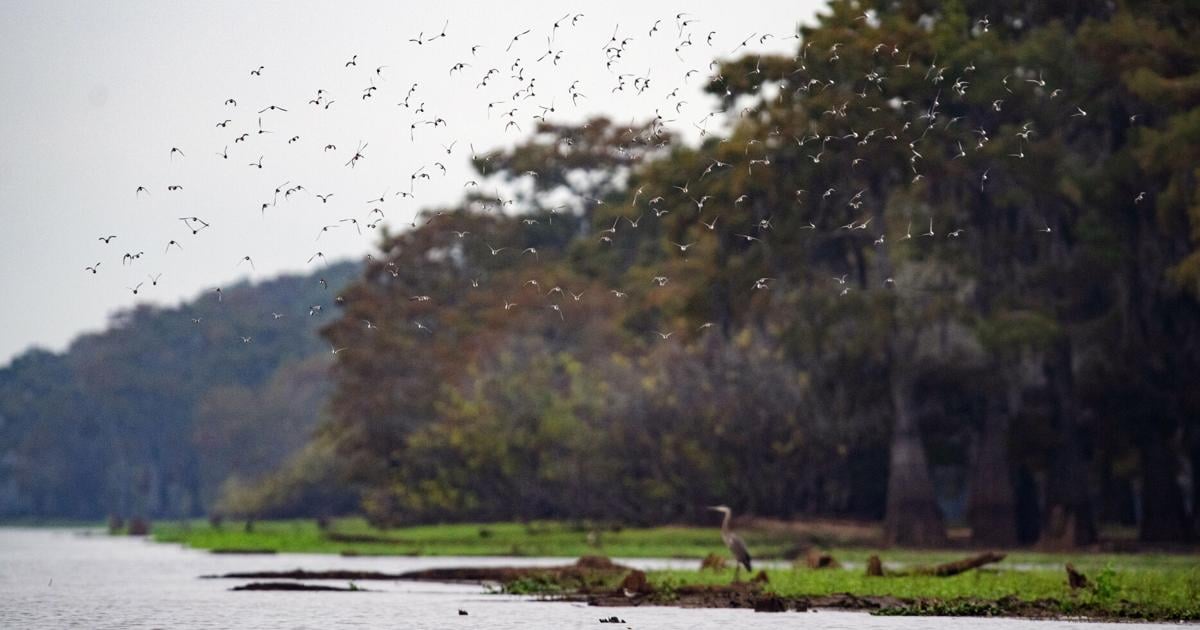
A newly created state legislative panel focused on the Atchafalaya Basin is tackling a bedeviling problem: how to reverse the declining health of an economic and cultural touchstone for Louisiana.
The two main problems the joint committee will tackle, members said Friday, are the sedimentation believed to be slowly filling many parts of the basin and the volume and quality of water entering the swamp.
Larger than the Florida Everglades, the nearly one-million-acre basin is the largest river swamp and contiguous hardwood bottomland forest in the nation. The forested backyard for many in south Louisiana, the basin stretches from near Simmesport to the Gulf 140 miles to the south, according to the basin’s National Heritage Area agency.
Crisscrossed by pipelines and elevated highways, pocketed by oil and gas wells, leveed off for flood control and prized for its hunting, fishing and crawfishing, the basin and the river with the same name also have many concerned with their future, advocates and observers say.
Senate Concurrent Resolution 29 formed the Joint Legislative Committee on Atchafalaya Basin Water Quality this spring and anticipates that the panel will hear from public agencies and private interests before the committee submits its recommendations by April 1.
On Friday, the panel was supposed to have its first formal meeting at the State Capitol in Baton Rouge, but didn’t have a quorum. The members who were there couldn’t pick leadership as planned but discussed the panel’s mission.
A sign marks the area of a pipeline in the Atchafalaya Basin on on Wednesday, February, 8, 2017. Numerous pipelines cross the Atchafalaya Basin. (Photo by Brett Duke, Nola.com | The Times-Picayune)
BRETT DUKE
State Sen. Caleb Kleinpeter, R-Port Allen, one of the authors of SCR 29, said that for him and other legislators on the panel, the committee is a response to recreational and commercial fishermen worried about the basin’s declining water quality.
“Our constituents deserve answers, and that’s the thing that we’re here for — to listen and to make recommendations,” he said.
Kleinpeter said he hopes the panel receives answers from the U.S. Army Corps of Engineers, the state Coastal Protection and Restoration Authority and others but also wasn’t promising those agencies would heed the panel’s final ideas.
“I’m just here fighting for my constituents and fighting for the water quality in the basin,” he said.
‘Fix the water quality’
The CPRA and Corps are already both engaged in long-term planning processes that affect the basin. The CPRA is in the middle of a master planning process for the basin itself. The Corps is looking at its operation of the river control structures that regulate water flow in the lower Mississippi and Atchafalaya rivers and, by extension, the basin.
Brian Lezina, CPRA chief of planning and research, said the state coastal agency traditionally had not incorporated the basin in its planning efforts, but is now developing the master plan to look at it more holistically.
He said the basin’s sedimentation problems are well known and the CPRA planning effort is focused primarily on habitat health.
Kleinpeter told Lezina that legislators in the past have run into “some roadblocks” with the Corps, but Lezina said the current commander of the Corps’ New Orleans District, Col. Scotty Autin, a Houma native, is among the most receptive to “things in the basin proper.”
The Low Sill Structure, part of the Old River Control Structures, can be adjusted to allow the mandated amount of water flow through to the Atchafalaya River. Federal law mandates 70% flows down the Mississippi and 30% down the Atchafalaya.
STAFF PHOTO BY DAVID GRUNFELD
“So, right now while we have him here, it’s a good time to do that,” Lezina said.
No Corps officials spoke at the meeting.
State Rep. Jeremy LaCombe, R-Livonia, another member of the panel, added that he’d like to look at the causes of dead zones in the basin reported by fishermen and crawfishermen.
Brennan Spoor, staff attorney with the Atchafalaya Basinkeeper advocacy group, said the committee also needs to consider the number of spoil banks and other actions that, he alleges, the Corps has allowed that blocked water flow and often waterway access.
“Until we know, to the extent, how many there are and how much they’re blocking flow, then we probably can’t accurately figure out how to fix the water quality,” he said.
‘Have to keep working’
Rebecca Triche, executive director of the Louisiana Wildlife Federation, said the basin and its companion river remain “a dynamic” system affected by “a long history of navigation, flood control, and oil and gas development projects” and warned how hard it has been to find a consensus on management.
“With so many stakeholders and their interests, identifying solutions that everyone will embrace has been difficult, as we’ve seen over decades of planning and project proposals,” Triche, who attended the committee meeting, said in a later statement. “But we have to keep working on addressing the severely altered water flow that contributes to poor water quality, degraded fisheries habitat, and declining forest health in some parts of the basin.”
In late March, Atchafalaya Basinkeeper and others successfully sued to block a key Corps permit for a CPRA project that the agency says would have improved the basin and wetland health through water and sediment diversion into East Grand Lake.
A spider web holds condensation deep in the Louisiana swamp.
Andy Crawford
But Atchafalaya Basinkeeper and its expert argued the Corps ignored their warnings that the project would only have worsened sedimentation and filled in the swamp as other, older projects in the area had already demonstrated.
In ruling for the Basinkeeper and others on East Grand Lake, U.S. District Judge Brian Jackson of Baton Rouge recognized the push-pull that has gone on for years.
“It is evident that all parties involved in this action understand the indispensable value that the Atchafalaya Basin provides to Louisiana, and, indeed, our nation,” Jackson wrote. “However, the parties disagree about the appropriate methods for remedying the basin’s deterioration.”