I have been exploring New Jersey ghost towns since before I knew what to call them.
My father was a genealogist. Weekend trips sometimes meant what he called graveyard picnics — packing a lunch and driving out to old Pine Barrens cemeteries and abandoned villages to look at headstones and foundations and try to feel something of the people who used to live there. I was a kid. I thought it was strange. Now I think it was one of the best things he ever did for me.
I wrote about New Jersey ghost towns back in March — Pine Barrens places mostly, the iron furnace villages and glassmaking towns that the forest swallowed up when the industry died. Johnson Place, which still shows up on Apple and Google Maps as a faint echo of something that used to exist just outside Chatsworth.
But this summer I am heading north. And the ghost town waiting for me up there is one of the most haunting in the state.
SEE ALSO: Old Mine Road: the NJ drive I almost missed — and you should take
Walpack Township (Google Maps)
Walpack Township (Google Maps)
Walpack Center — the town that shouldn’t be empty
Most New Jersey ghost towns died because the industry died. The iron furnace shut down, the glassworks closed, the paper mill burned, and the people simply left for better work somewhere else. That is how most of these stories end.
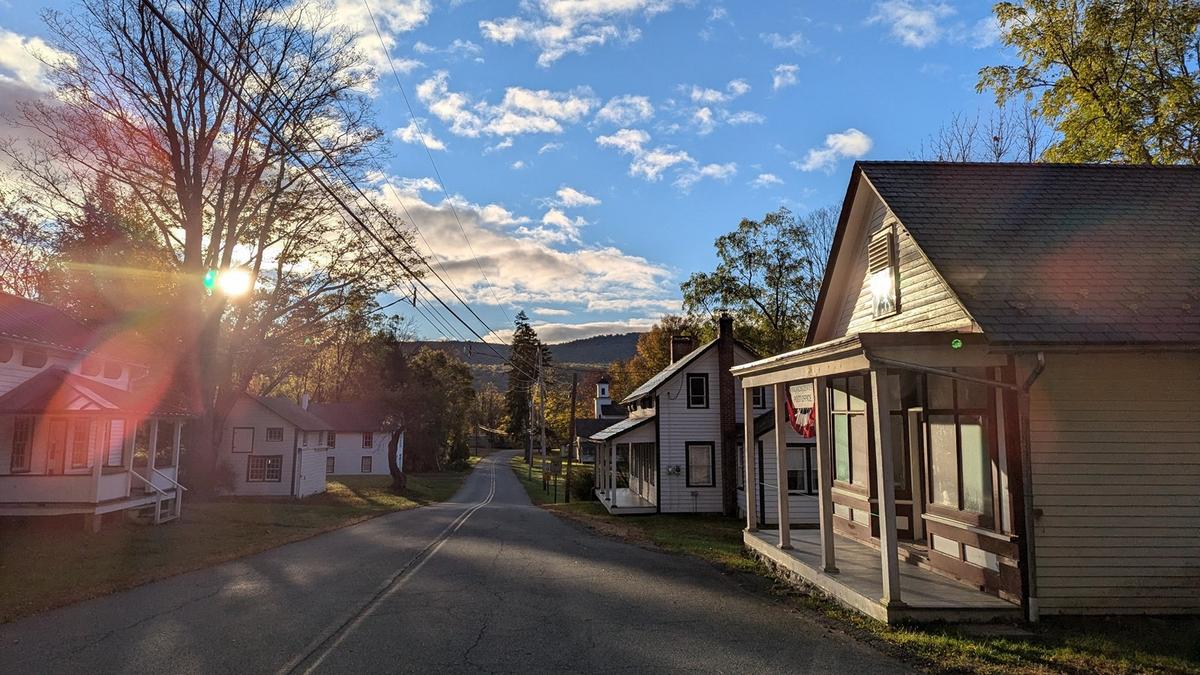
Walpack Center in Sussex County is different. The people who lived there didn’t leave because the work dried up. They were forced out.
In 1965 the federal government invoked eminent domain to clear the entire Delaware River valley in anticipation of the Tocks Island Dam — a massive flood control project that would have created a 37-mile reservoir stretching from the Water Gap north into Pennsylvania. Families who had lived along that river for generations were told to pack up and go. Their homes were taken. Their community was erased.
The dam was never built. The reservoir never filled. The government changed its mind and the project was quietly abandoned in 1992. But the people of Walpack were already gone. Eleven historic 19th-century buildings still stand in the village today — a post office, a church, farmhouses — frozen exactly as they were left, listed on the National Register of Historic Places, belonging to no one.
I paddled past Walpack Bend on a canoe trip on the Delaware back in the 1990s without knowing any of this. I am going back this summer with Wayne Cabot to actually stand on that ground. That piece is coming. But if you want to go before we do, the village is accessible from Old Mine Road — which you should also be driving, and which I wrote about yesterday.
The ghost towns worth visiting this summer — north and south
New Jersey has more abandoned villages than most people realize. Here is a guide spread across the state — something for every direction.
Feltville — the Deserted Village, Union County. Built in 1845 by papermaker David Felt who ran it like a personal kingdom, earning him the nickname “King David.” After he left in 1860 he reportedly said “King David is dead and the village will go to hell.” It briefly became a summer resort before being abandoned for good in 1916. It sits inside the Watchung Reservation in Union County — surprisingly close to everything, surprisingly forgotten.
Waterloo Village, Sussex County. A Revolutionary War-era village that became a bustling Morris Canal stop during the Civil War, then went completely silent when the canal was abandoned in 1903. The village sits preserved along the Musconetcong River in the hills of northwest Jersey. This one is practically on the way to Walpack if you are making a day of it.
Allaire Village New Jersey | Google Maps
Allaire Village New Jersey | Google Maps
Allaire Village, Monmouth County. A thriving 19th-century iron-making community that made household goods and stoves. When cheaper Pennsylvania iron arrived, the village emptied almost overnight. Today it is a living history museum inside Allaire State Park with 13 preserved historic buildings. One of the best preserved sites in the state and worth a full afternoon.
Weymouth Furnace, Atlantic County. Once a successful iron works and later a paper mill community, abandoned in 1887. Grand stone arches, a towering chimney stack, and moss-covered foundations still stand along the Great Egg Harbor River. This is South Jersey ghost town territory — close to home for me, and one of the most quietly beautiful sites in the state.
Whitesbog, Burlington County. A former cranberry and blueberry farming village — and actually the birthplace of the cultivated highbush blueberry. The workers’ cottages, general store, and collapsed cranberry packing house still stand alongside working bogs that remain active today. A Pine Barrens essential.
Allaire Village Wedding Chapel | Google Maps
Allaire Village Wedding Chapel | Google Maps
Why these places matter
I used to think ghost towns were just curiosities. Something to drive past and wonder about. The older I get the more I think they are something else entirely — a reminder that the communities we live in right now are not permanent, that prosperity is not guaranteed, and that people can be displaced from the places they love by forces completely outside their control.
Walpack Center makes that point harder than anywhere else I know of in New Jersey. The dam was never built. The town is still empty. Somewhere there are people in their seventies and eighties who grew up on that river and were told to leave and never came back.
This summer I am going to stand in that village and think about that for a while.
You should too.
Batsto Village and pine barrens lake trail — photos from April 2026
A family hike along the Batsto Lake Trail in Wharton State Forest, Burlington County, New Jersey — April 2026. The flat four-mile loop behind historic Batsto Village winds along the Batsto River and Lake through the heart of the Pine Barrens. The trail is easy, well-marked with white blazes, and accessible to hikers of all ages. Along the way — pitch pines, cedar water, spring wildflowers including a purple pitcher plant, and at least one unbothered garter snake.
Gallery Credit: Photos by EJ