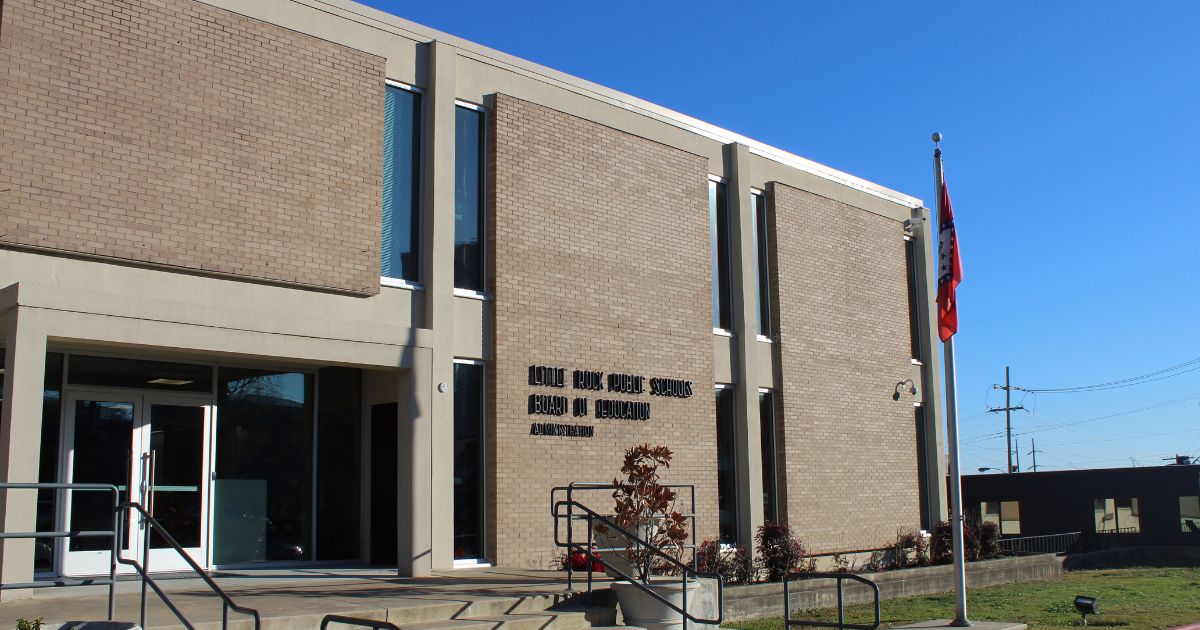
Though several other items were discussed, the biggest items on Thursday’s Little Rock School Board agenda were the opening configuration for the new West Little Rock High School, which is scheduled to open in the fall of 2027, and a discussion on potential attendance boundaries following West High’s opening.
The district recently unveiled two potential attendance zone maps, both of which are likely to prompt strong reactions from the community.
Superintendent Jermall Wright stressed that this was only the first step in the process and that no decisions were being made during this meeting. The presentation was intended to provide the board with information and gather feedback before staff returns with a formal recommendation.
West High School logistics
Documents provided by the district explained that the opening of West High School presents the first opportunity in many years to redraw high school attendance boundaries across Little Rock. In developing the potential boundaries, administrators considered projected enrollment, facility capacity, transportation, staffing, operational costs, student programming, and community impact.
The primary goals guiding the process include balancing enrollment across the high schools, avoiding significant over- or under-utilization of facilities, creating sustainable attendance boundaries that support the long-term success of West High School, minimizing disruption for students and families, preserving specialized programming, ensuring equitable access to academic and extracurricular opportunities and carefully considering the financial impacts of staffing, transportation, operations, athletics, instructional programming, and facility utilization. Discussion focused on two possible approaches for opening the new high school.
The first would open West High School as a traditional high school serving grades 9 through 12 from day one. Students would have access to all four grade levels, allowing the school to offer a broader selection of Advanced Placement courses, concurrent credit opportunities, Career and Technical Education capstone courses and upper-level electives, assuming enrollment and staffing support those offerings. Juniors and seniors living within the new attendance zone could transfer immediately, and the school could begin building traditions, student government, clubs, and upperclassman leadership opportunities from its first year.
Administrators also outlined several challenges associated with opening as a full 9-12 campus. The largest concern is financial. Because the district would need to hire teachers and staff for all four grade levels before actual enrollment is known, lower-than-expected enrollment could result in excess staffing, under-enrolled classes, higher per-pupil costs and difficult staffing reductions after the school’s first year.
Athletics also present a significant challenge. Under Arkansas Activities Association rules, varsity team sports — football, basketball, volleyball, baseball, softball, and soccer — would not be eligible for conference competition during the school’s first year. Those teams could only play non-conference games and would not be eligible to compete for conference or state championships. Scheduling opportunities would depend on other schools having available non-conference openings.
Junior varsity competition would still be allowed, and individual sports such as golf, tennis, wrestling, swimming, cross country, track and field, and bowling would remain eligible for conference and state competition. District officials acknowledged that because football and basketball often drive school identity and enrollment decisions, particularly for upperclassmen, the lack of conference varsity athletics could discourage some students from transferring to the new school.
Staff also noted that juniors and seniors are generally less likely to change schools because they are already established in athletics, extracurricular activities, and academic programs. As a result, enrollment in grades 11 and 12 could be significantly lower than projected.
The second option would phase in the new high school by opening with only ninth and tenth grades during the first year and adding grades eleven and twelve the following year. District staff explained that this approach would better align staffing with actual enrollment because recruitment efforts would focus primarily on incoming freshmen and sophomores, who are generally more willing to change schools than upperclassmen. Staffing could then increase as each class advanced through the school, reducing the likelihood of overstaffing while lowering financial risk.
Administrators argued that the phased approach better matches the timeline for developing athletic programs. As additional grade levels are added, athletic programs would mature alongside the student body, allowing the school to gradually develop a more complete athletic program.
The district also acknowledged several disadvantages to the phased approach. For instance, some families may perceive a school serving only ninth and tenth grades as incomplete, requiring the district to clearly communicate its long-term vision.
Additionally, while clubs, performing arts, leadership organizations, and individual varsity sports could begin immediately, the absence of conference varsity team sports during the first year means students would not initially experience the full range of activities many families associate with a traditional comprehensive high school, and school traditions and rivalries would take longer to develop.
Drawing new attendance zones
After discussing the two opening models, district staff presented two possible attendance boundary scenarios.
The first proposal, Boundary Scenario 1, divides the district into three attendance zones focused around West High School, Central High School and Southwest High School. Under Scenario 1, the West attendance zone would occupy the northwestern portion of the district and include the Hall-West School of Innovation. According to demographic projections, the area would remain majority white, with the white population projected to change only slightly from 65.5 percent in 2020 to 64.9 percent in 2030. The Black population is projected to decline modestly from 21.1 percent to 20.1 percent, while the Hispanic population should increase from 4.2 percent to 5.2 percent. The total population of roughly 74,000 is projected to remain essentially unchanged, and approximately 91 percent of these residents speak English at home.
The Central attendance zone under Scenario 1 would become the district’s smallest zone, both geographically and by population. It includes Central High School, Mann Magnet Middle School and the downtown corridor extending east toward College Station and the airport. Demographic projections show this area would remain majority Black, declining only slightly from 55.4 percent to 54.2 percent by 2030. The white population would remain around 31 to 32 percent, while the Hispanic population is projected to increase from 7.2 percent to 8.1 percent. Total population is projected to decline from about 50,000 residents in 2020 to 49,000 in 2030, the largest projected decline among the three Scenario 1 zones, and approximately 93 percent of residents speak English at home.
The Southwest attendance zone would include Parkview High School, Southwest High School and the southern portion of the district extending to Alexander. This zone would have the highest percentage of Black residents in Scenario 1, although that is projected to decline from 57.6 percent in 2020 to 54.4 percent in 2030. This zone would also experience the district’s fastest Hispanic population growth under this scenario, increasing from 22.8 percent to 26.0 percent by 2030. The white population would remain between 15 and 16 percent. The total population would remain nearly unchanged over the 10-year period at roughly 57,000 residents. Approximately 79 percent of these residents speak English at home, while 20 percent speak Spanish, the highest percentage among the Scenario 1 attendance zones.
The district then presented Boundary Scenario 2, which also divides the district into West, Central, and Southwest attendance zones but redraws the boundaries differently.
Under Scenario 2, the West attendance zone becomes substantially larger than under Scenario 1. It includes Hall-West School of Innovation and Parkview High School while extending farther south and east than the first proposal. The total population would be approximately 181,500 residents in 2020, declining slightly to about 180,000 by 2030. The racial composition would be much more balanced than under Scenario 1, with the Black population projected to decline from 42.2 percent to 40.3 percent while the white population remains around 40 to 41 percent. The Hispanic population would increase from 10.8 percent to 12.6 percent. Approximately 88 percent of residents in this zone speak English at home.
The Central attendance zone under Scenario 2 follows a narrower corridor through central Little Rock, extending east toward College Station and the airport. The area would remain majority Black, with the Black population projected to decline slightly from 47.9 percent to 47.4 percent, while the white population would increase modestly from 40.6 percent to 41.4 percent. The total population would decline slightly to about 43,000 residents by 2030, approximately 94 percent of which speak English at home, the highest percentage among all of the proposed attendance zones.
The Southwest attendance zone under Scenario 2 remains similar geographically to the first proposal, serving the southern portion of the district around Southwest High School and Alexander. The Black population would decline from 56.9 percent to 53.6 percent by 2030, while the Hispanic population would increase from 23.7 percent to 27.8 percent, representing the largest projected Hispanic population increase under either scenario. The total population would remain essentially unchanged at just over 52,000 residents, with approximately 77 percent of residents speaking English at home, while 22 percent speak Spanish.
West High principal offers thoughts
Following the district’s presentation, West High Principal Steven Helmick shared his perspective on both the opening of the new school and the proposed attendance boundaries. Helmick emphasized that West High is not simply a new building but an opportunity to strengthen the entire Little Rock School District.
He told board members that community interest in West High has been strong. Approximately 150 people have toured the building, he said.
The school has also begun a significant community engagement effort. Helmick said he recently met with families and residents and plans additional meetings throughout the summer and fall. He has contacted approximately 65 neighborhood associations and property owners’ associations, offering to meet with residents about the vision for West High.
Discussing the attendance boundaries, Helmick expressed strong support for Boundary Scenario 2.
“To me, this is such an easy decision,” Helmick said. “Boundary scenario two is the only way that we can go.”
Helmick said Scenario 2 best reflects the district’s stated values of diversity and equity. While acknowledging that demographic projections cannot predict exactly which students will attend each school several years from now, he said the projected composition of the West High attendance zone under Scenario 2 represents the kind of school community he believes LRSD should build.
He pointed to projections showing a West attendance zone that would be approximately 40% Black, 40% White, 10-12% Hispanic, with additional representation from Asian and Indian communities.
“As not only a principal but also as a parent that has kids within the district, I get excited because that’s the real world,” Helmick said. “That’s who they’re going to be interacting with when they leave the school system.”
He argued that Scenario 1 does not create the same level of representation.
“Quite frankly, I don’t like it,” Helmick said. “I don’t think it’s representative of ensuring that all high schools look like as much of our district as we can with where our student population lives.”
He said Scenario 2 also provides a clearer geographic structure. He described the West High area as generally including areas west of University Avenue, north of Interstate 630, and extending into the Parkview and John Barrow areas.
Helmick stressed that the purpose of boundary changes cannot simply be moving students from one LRSD school to another.
“If we just shuffle our kids around, it’s not solving anything,” he said.
Instead, he argued that the district’s larger challenge is bringing students back into LRSD by creating schools families want to attend. Helmick said strong feeder patterns can influence whether families remain in the district. He noted that Roberts grew from approximately 650 students when it opened 16 years ago to nearly 1,000 students today, in part because families saw a pathway into a strong middle school experience at Pinnacle View.
He said the same principle must apply across the district. While West High will receive significant attention because it is new, Helmick said the goal cannot be creating one successful school at the expense of others.
Helmick also believes opening West High as a 9-12 school would create a greater challenge for adults but would provide a better experience for students. He argued that opening as a 9-10 school would create a unique set of challenges because the district would effectively be managing two major transitions at the same time: opening a new school while preparing to add two additional grade levels the following year.
“If we opened up 9-10, the complexity of that is that really we have two openings,” Helmick said. “We will be running a full school and then also having to hire a whole half of our staff in the next year while we’re operating a school.”
Helmick said opening as a 9-10 school could create a perception problem among families and the community. He argued that the district has already been facing questions about whether West High will be viewed as a “real” high school because of the Arkansas Activities Association restrictions that will limit varsity competition during the first year.
“We’re already fighting the battle because of the AAA complexity that we’ve got,” Helmick said. “People are already saying that we’re not going to be a real high school, real sports and all that, even though we’re going to have a 2,400-seat arena and all the things.”
Helmick also raised concerns about how a 9-10 opening could affect families with children in multiple grade levels. He used his own family situation as an example, explaining that when West High opens, he will have both a junior and a freshman. Under a 9-10 model, his freshman would attend West High while his junior would remain at another school.
Helmick acknowledged that transferring upperclassmen creates its own complications. Juniors and seniors are often already established in academic programs, athletics, extracurricular activities and friendships, making transitions more difficult. He argued, however, that building the school culture from the beginning is a rare opportunity that the district should maximize.
“You only get one chance to build,” Helmick said. “You’re building your culture. You get one shot at it. Our first year is going to speak volumes to our community of if they’re going to trust us in year two through 20.”
He said the goal is for students entering West High on the first day to feel that the school has been intentionally designed for them.
“I don’t want year one to be, now we’ve got to figure out our motto, now we’ve got to figure out our fight song,” he said. “When kids walk into our school day one, we want them to feel like this day has been planned for, we’re ready for them.”
Helmick acknowledged that there are legitimate arguments on both sides of the decision and that reasonable arguments can be made for either approach depending on the perspective of the person being asked. As the person responsible for leading the new school community, however, Helmick said he is prepared to open West High as a 9-12 school.
“I’m ready to roll with my 9-12 reality because I think what that says is that we’re here, we’re ready, we’re offering everything,” he said.
Helmick concluded by telling the board that his commitment to West High comes from his belief that the community is ready for the school and that it can become a successful part of LRSD. He said regardless of the board’s final decision, the West High team will move forward.
“If you decide 9-12, we’re going to make it work,” Helmick said. “If you decide 9-10, we’re going to go, ‘dang,’ but we’re going to make it work.”
No recommendation was made between the two attendance boundary scenarios during the presentation. District officials emphasized that these options are intended to begin the discussion and gather board feedback before staff refines the proposals and returns with a final recommendation for future board consideration and formal action.
If you have thoughts on these attendance zones, you can email Superintendent Wright (jermal.wright@lrsd.org) and members of the school board.