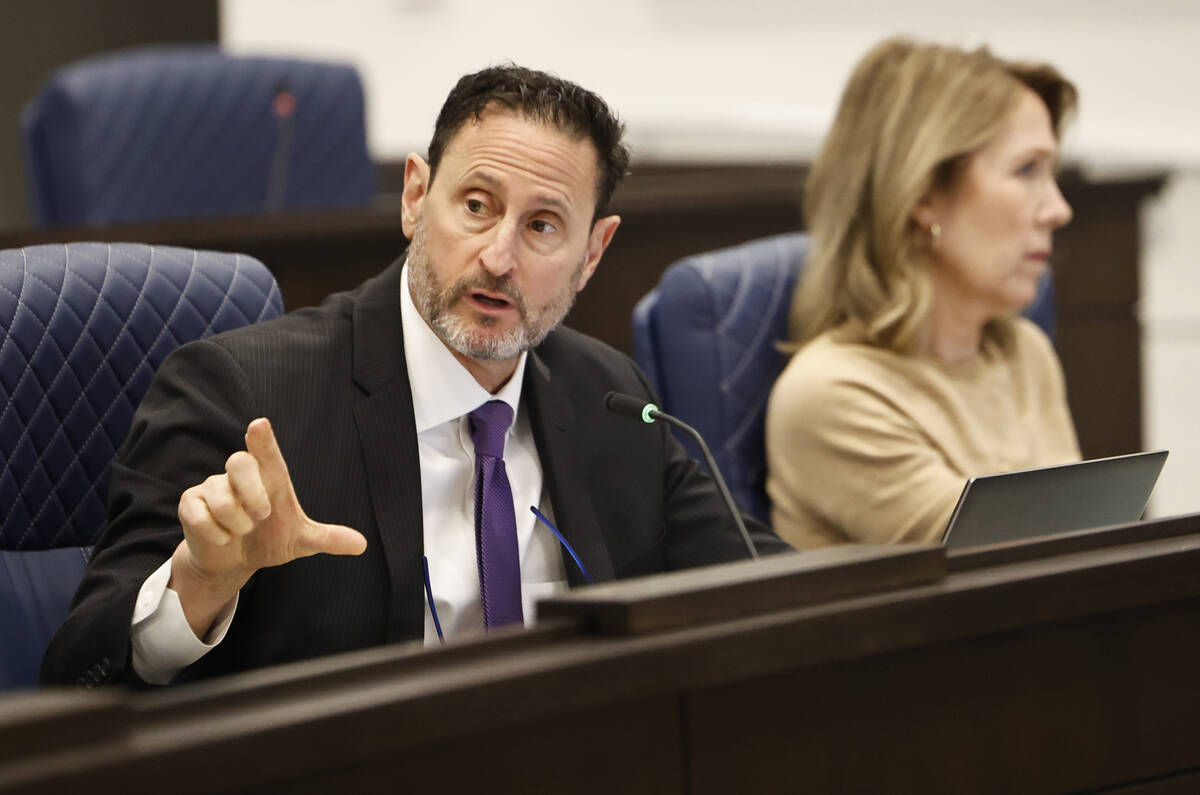
Nevada’s Public Records Task Force was able to reach one conclusion during a public meeting Monday: The group agrees on very little.
Members of the task force, which is made up of government representatives and transparency advocates, have been tasked with recommending improvements to Nevada’s public record laws for the Legislature to review.
An hourslong meeting on Monday occasionally became tense as members questioned actions from the other side and debated what information should be sent to lawmakers.
“I think before we get to that point where we just throw up our hands and say, ‘Well, we’re done, even though we only have one meeting left,’ can we work on the consensus items a little bit more and just say there are areas of agreement?” said Mitch Fox, president of the Nevada Broadcasters Association. “Otherwise, why did we spend all this time?”
After nearly five hours, the task force members ultimately voted for each of the factions to create their own recommendations for the Legislature. At the next hearing, members will vote to determine if the group can reach a consensus on any recommendations, such as creating an ombudsperson to help resolve public records disputes or implementing standardized fees for requests.
“I was very hopeful that we had reached a way to provide a thorough and responsive report to the Legislature that acknowledged the very differing perspectives of both sides but attempted to identify the consensus pieces,” attorney Colleen McCarty, who has represented the Las Vegas Review-Journal and other media organization in legal cases, said after the meeting. “As I leave here now, I’m not sure where we will land on the consensus pieces, if any, which is disappointing.”
The government representatives who attended the meeting in Las Vegas declined to comment. Others joined via videoconference.
Public records can be requested by anyone who wants to examine government documents. When agencies delay releasing records, those seeking access can find themselves in lengthy and costly legal battles.
Government representatives previously have raised issues with large, overly burdensome or “vexatious” requests.
Matthew Christian, assistant general counsel for the Metropolitan Police Department, said he doesn’t think public records laws are onerous, but he believes they are unclear. He said the courts or Legislature can determine if agencies are allowed to charge for public employees to redact records, or if some records should be withheld in their entirety.
Review-Journal Chief Legal Officer Ben Lipman, a task force member, said the law already states that when it’s unclear if a document is a public record, then the government should err on the side of transparency and release the information.
Survey documents raise questions
The transparency advocates also took issue with a survey that asked government agencies to answer questions about their processes fulfilling public records requests. The survey was created and released by the government representatives without input from the other half of the board.
A summary of the survey results was sent to task force members on Friday afternoon, along with a document analyzing the results that appeared intended to represent opinions from the entire task force, the transparency advocates said.
The government representatives agreed that it could be clarified that they distributed the survey and analyzed the responses. But McCarty questioned why the survey was created without input from everyone.
“We have had a process here, and you all have completely disregarded the input on this side of the table,” she said.
Publicly posted survey responses did not explicitly state the names of agencies responding to the questions, although some could be inferred based on the agency’s responses. Metro, which identified itself in one response, said lawmakers should review documents like counterterrorism records and information on juvenile crime victims to determine if those should be automatically withheld.
Metro also said lawmakers should allow agencies to “appropriately manage vexatious requestors.”
One county entity, which was not identified in the survey results, said that using resources to “benefit select individuals” abusing public records laws is a waste of taxpayer money.
“If an individual, special interest group, or member of the media wants information, then they should pay the cost for that information,” the agency said in the survey. “There should be no presumption that these records are ‘their’ records and staff work for ‘them.’”
Leslie Nino Piro, general counsel for the Nevada attorney general’s office, said she did not name the agencies in the survey results because she did not think it would “advance any particular insight into the data.”
McCarty said she would like to know which agencies participated.
“We’re the public records task force, and we’re redacting information from the survey, which doesn’t make a lot of sense to me,” she said.
Contact Katelyn Newberg at knewberg@reviewjournal.com or 702-383-0240.