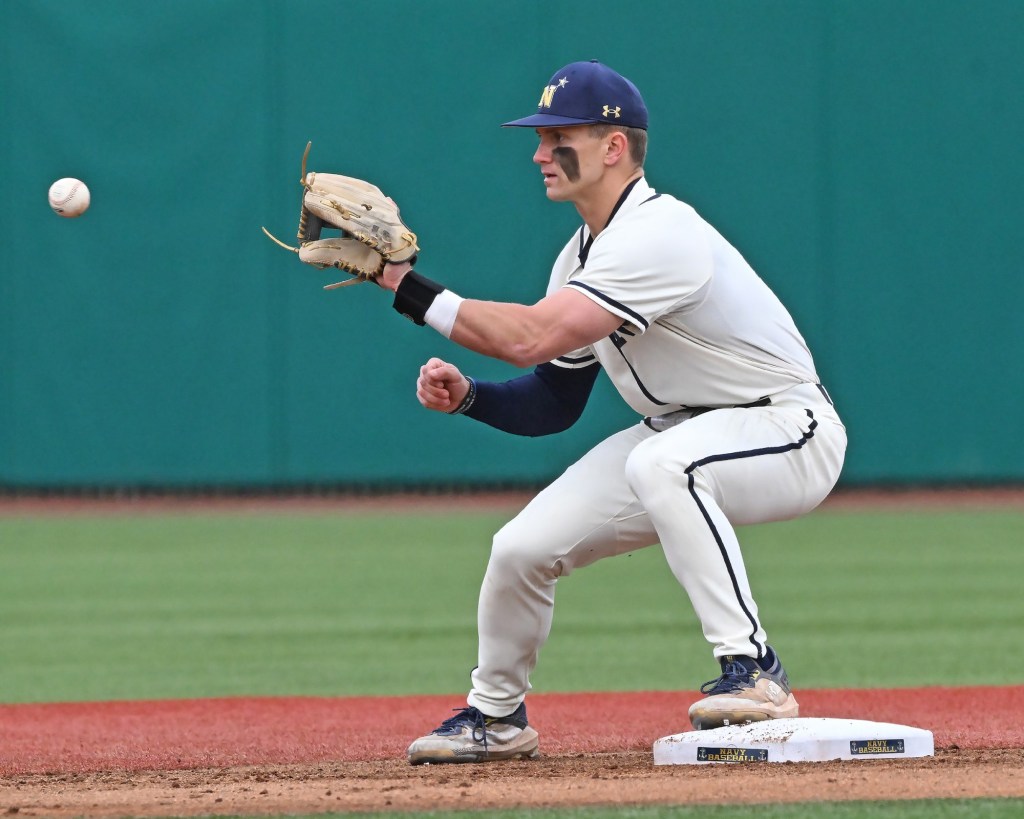
A Naval Academy baseball player’s bid to extend his college career for a fifth season ended Wednesday when a federal judge denied his request.
Brock Murtha, an infielder from Sayville, New York, had asked U.S. District Court Judge Julie R. Rubin for a temporary restraining order to let him play in the current season. Murtha argued that the six games he appeared in at Notre Dame in 2021 should not count toward his four-year NCAA eligibility limit.
“To be blunt, I’m just not seeing it,” Rubin said. “I don’t find that evidence to move the needle at all.” She added that a temporary restraining order is “extraordinary relief” that cannot simply be used to “alter the status quo” to meet a player’s needs.
“I know that it causes you great heartache,” Rubin said. “[But] that is the ruling of the court.”
Murtha played five games as a defensive replacement and had a single at-bat as a pinch hitter at Notre Dame before transferring to the Naval Academy, where he has played in 149 games over three seasons, earning second-team All-Patriot League honors in 2024.
Challenges in the case
The NCAA limits baseball players to four seasons of competition in five years. Murtha argued that denying him the fifth season would cut short his chance to develop leadership skills and better serve the Navy.
Rubin explained that a temporary order would only be the first step, and Murtha would still need a mandatory injunction to win his case — a hurdle she described as “very difficult, if not impossible.” She noted there is “no control in law on the subject,” signaling the legal challenge faced steep odds.
Judges require a clear likelihood of success and evidence of irreparable harm in overriding NCAA eligibility decisions, Rubin said and the NCAA’s rules treat any game participation as using a year of eligibility. She added there is “no control in law on the subject,” signaling that forcing the NCAA to let Murtha play midseason would be unprecedented and unlikely to succeed.
A series of mistakes
Representatives of the Naval Academy Athletic Association initially filed a waiver on Murtha’s behalf seeking an extra year of baseball eligibility during the 2025 spring semester. The NCAA denied the “competition waiver” last March, and Murtha said he was not informed by anyone in Navy athletics that he had a 30-day window to appeal.
Murtha also said the Naval Academy Athletic Association acknowledged making mistakes in filing the initial appeal.
Under NCAA rules, late appeals can be granted if a student-athlete shows extenuating circumstances for missing the deadline. Murtha argued that the lack of notification about the appeal process qualified.
On Jan. 5, Navy submitted a reconsideration request to the NCAA, accompanied by a voluntary institutional letter admitting clerical errors in the original appeal.
The NCAA ultimately refused to reopen the case, sending Murtha a final denial letter on Feb. 10 stating the decision was “final and binding and not subject to review by any other authority.” That led to the federal challenge.
Murtha and council declined comment after the judge’s ruling.
Have a news tip? Contact Chevall Pryce at cpryce@baltsun.com.