The Museum of Science is debuting another high-tech venue for immersive events.
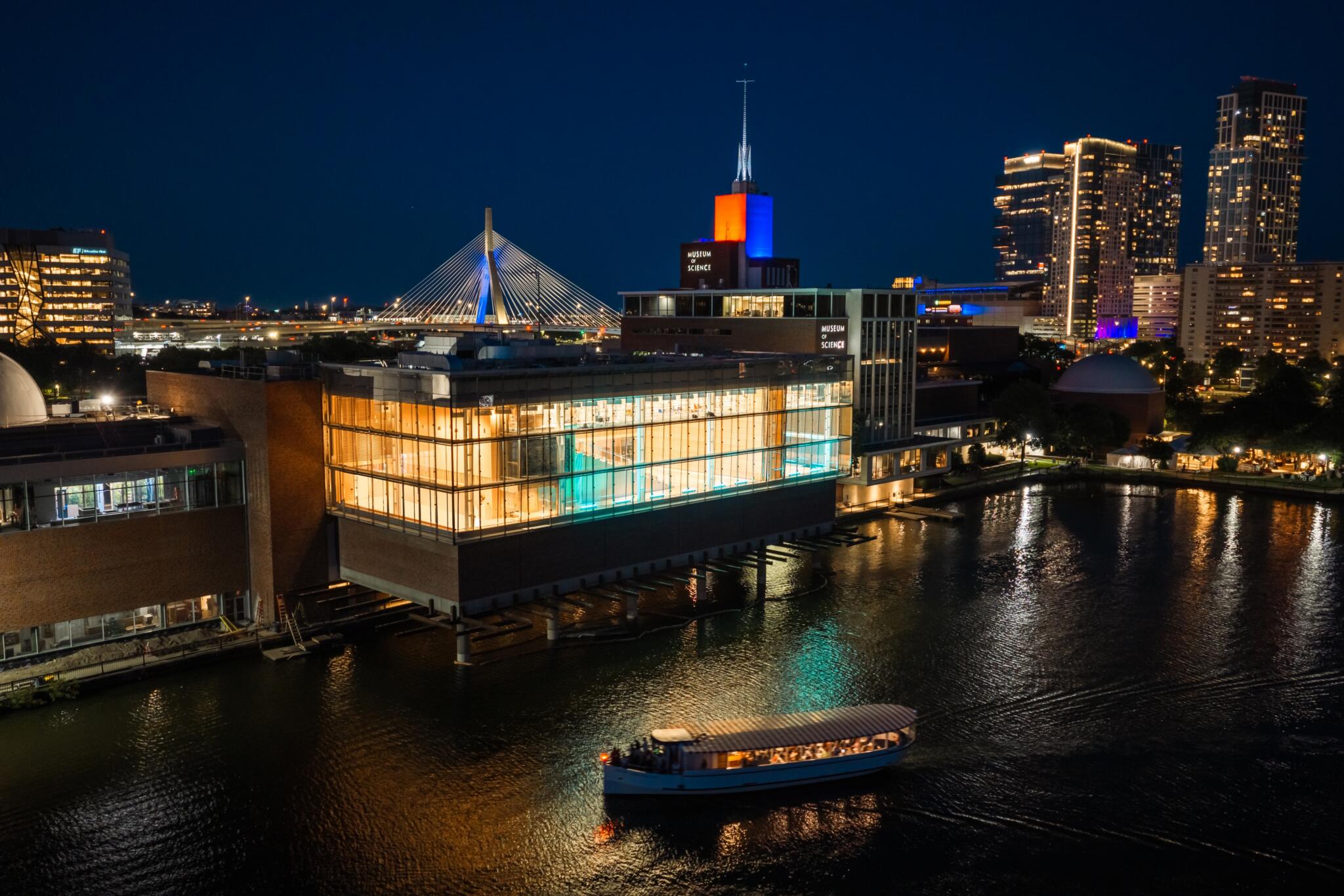
After two years of construction, the William and Charlotte Bloomberg Public Science Common opens this weekend. The 10,000-square-foot wing juts out over the Charles River, a box of glass with views of the skyline. It can transform into an immersive environment with video projections and movable LED walls. The project was supported by a $155 million gift from Bloomberg Philanthropies.
Museum of Science president Tim Ritchie said the new wing would enable the museum to be more flexible and responsive in its programming.
“Science at the pace of exhibits is very slow,” Ritchie said. “Science at the pace of change is lightning fast. And so these tools will enable us to react to the current science and technology in ways we’ve never had before.”
The Museum of Science already boasts three immersive theaters: the Mugar Omni Theater, which mostly shows movies, the Charles Hayden Planetarium, which offers a mixture of educational and entertainment audio-visual experiences, and the 4-D Theater, which is primarily used for daytime programming for kids.
One of the projection screens for Deep Space at the William and Charlotte Bloomberg Public Science Common. (Courtesy Museum of Science)
By contrast, the Public Science Common is built for live and interactive events. The museum plans to expand its performing arts offerings, starting with a sold-out concert on Oct. 16 with the musician Jacob Collier.
“The way the room is designed, I’m pretty sure it will be a breathtaking performing arts place,” Ritchie said, adding that the Jacob Collier show will “really test the ability for it to be a beautiful music hall.”
The crux of the venue’s tech capabilities lies in an immersive video projection system called Deep Space, by Austrian company Ars Electronica. The interface is easily and quickly programmable.
“ It takes a long time to create an IMAX movie or to create a planetarium show,” Ritchie said. But with the new system, “ we’ll be able to take content and turn it into an immersive experience pretty quickly” – in a matter of days as opposed to months.
The museum plans to use the Public Science Common for daily daytime programming, integrated into the ordinary museum experience. On top of that, Ritchie hopes to offer four or five evening programs a week, featuring scientists, musicians and the occasional celebrity. Its October lineup includes events with former NASA engineer Mark Rober, architect of the Zakim Bridge Miguel Rosales and comedian Trevor Noah.
“My hope is that the agenda for the Public Science Common is largely from the world around us,” Ritchie said, “and what’s current in the world.”