ST. PETERSBURG, Fla. — The banners fly in the streets of Milwaukee: “Win Our Way.” The slogan is a point of pride. That the city’s baseball team runs differently. That it plays differently. That there is no mistaking its identity, and no mistaking its success.
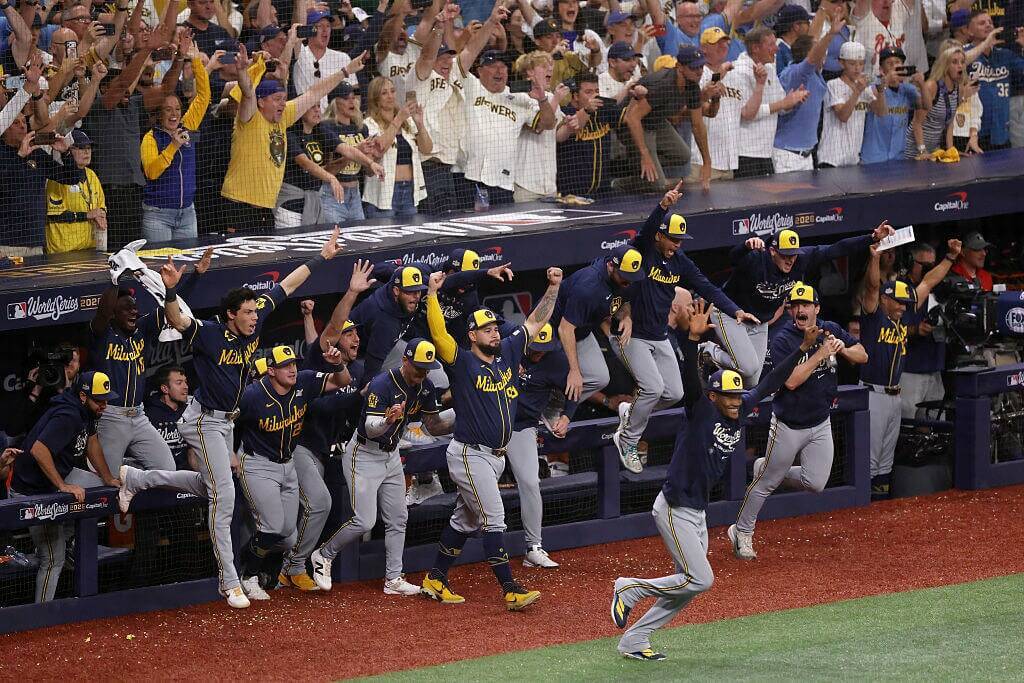
The Brewers’ first World Series title, secured Wednesday night with a 4-1 victory over the Tampa Bay Rays, left so many indelible images. From the fans who took over the Rays’ Tropicana Field to those who filled the watch party at Milwaukee’s American Family Field. From Jacob Misiorowski and Cooper Pratt tearing up in post-game interviews to Christian Yelich dedicating the championship to the team’s late radio broadcaster, Mr. Baseball, Bob Uecker.
But the Brewers’ title, more than anything, is a fitting outcome for a franchise that marches to its own beat, effectively daring the rest of baseball to match its verve and savvy.
The Brewers’ owner, Mark Attanasio, never used playing in the game’s smallest media market as an excuse. The front office, led by president of baseball operations Matt Arnold, built an elite pitching staff and an offense that ran counter to some of the game’s prevailing trends. The manager, Pat Murphy, holds players accountable at a time when many in his position shy away from discipline of any kind.
Murphy’s style works because many of the Brewers’ players are young, and because his veteran leaders, Yelich and Brandon Woodruff, serve as sergeants-at-arms, maintaining his high standards. The manager’s blunt approach might not work with other teams, and in other markets. But that, too, is part of the Brewers’ charm. They win their way. Not anyone else’s.
The Brewers might find it difficult to recreate the magic of their championship run next season, if there is a next season. But what we saw as they went 11-2 in the postseason was the culmination of a team making its eighth playoff appearance in nine years, a team that was hellbent on taking the next step after suffering a humiliating sweep by the Los Angeles Dodgers in last year’s National League Championship Series.
“They just spanked us. They were dominant. They looked at it like, ‘Ah, you guys aren’t in our league,’” Murphy said. “Then we played them again twice this year and the guys were sizing ‘em up, saying, ‘You know what? We’re different. We’re a little bit better. We’re way more committed to each other. We’ve done this movie. And we’re going to get a different ending.’”
Did they ever.
The Brewers went 4-3 against the Dodgers during the regular season. Then, after defeating the San Diego Padres in the Division Series, the most challenging of their three playoff rounds, they swept the Dodgers in the NLCS, reaching the first World Series for the first time in 44 years.
The Rays were the final obstacle. The Brewers’ only loss was in 12 innings. Their pitchers allowed only 12 runs in five games.
For years, the Brewers were defined by those who got away. Leaders such as David Stearns and Craig Counsell. Free agents such as Willy Adames. Fixtures such as Josh Hader, Corbin Burnes, Devin Williams and Freddy Peralta, all of whom the Brewers traded.
Even this season, one of the biggest conversations around the Brewers was about a player they failed to acquire, Tarik Skubal. Yet, even amid criticism, especially for the Hader deal in 2022, they stuck to their roster-building methods. And they kept bringing in talent, through trades, the amateur draft, the international market.
The Hader deal yielded Robert Gasser, who started three road victories in the postseason, including Game 3 of the World Series, when he became the first left-hander to face the minimum number of batters over six innings in the Fall Classic since Sandy Koufax in 1965. The return on Hader, through a second trade four months later, also included catcher William Contreras, the Series MVP.
For Burnes, the Brewers acquired infielder Joey Ortiz and lefty reliever DL Hall. For Williams, they acquired Caleb Durbin, whom they later made the centerpiece of a deal for left-handers Kyle Harrison and Shane Drohan and infielder David Hamilton. Pieces, they kept finding pieces. First baseman Jake Bauers, the NLCS MVP, came in a minor trade. So did the closer who recorded the final out of the Series, Trevor Megill.
Three Brewers — second baseman Brice Turang and outfielders Sal Frelick and Garrett Mitchell — were first-round picks. A number of the team’s other top contributors were not. Misiorowski, the game’s hardest throwing pitcher, National League Cy Young favorite and winner of the Series clincher, came in the second round. Righty Logan Henderson and lefty reliever Aaron Ashby came in the fourth, Pratt the sixth.
Pratt, whose six consecutive hits in Games 4 and 5 set a Series record for a rookie, dropped in the draft because teams feared he would want too big a bonus. The Brewers’ scout in the area, Scott Nichols, had a different idea. He knew Pratt and his family well, and felt Milwaukee could get him for less than what people expected. The Brewers wound up taking Pratt 182nd overall and signing him for $1.35 million. The players drafted around him signed in the $300,000 range.
Internationally, too, the Brewers have pulled off a series of coups. Two of their outfielders, Jackson Chourio and Luis Lara, signed out of Venezuela for $1.8 million and $1.1 million, respectively. Reliever Abner Uribe, way back in 2018, signed out of the Dominican Republic for $85,000. And the club’s recent investments in Dominican talent included two of the game’s top prospects, infielders Jesus Madé and Luis Peña, who signed for $950,000 and $800,000, respectively.
For the Brewers, the Series title might simply mark a special moment in time. It’s never easy for teams to recreate the magic of a championship run. But Bauers is Milwaukee’s only potential free agent of significance. Arnold must decide whether to keep or trade Contreras and Megill, both of whom are under club control for only one more season, the witching hour for Brewers’ veterans. But the rest of the club’s core will be back, and the team’s farm system is among the game’s strongest.
At some point, important pieces will depart. That’s just how the Brewers roll. But few organizations regenerate like Milwaukee’s. And they do it year after year.
In describing the type of offensive player the Brewers covet, Arnold used the phrase, “athletes that hit.”
“It’s our mantra,” he said.
The Brewers are as analytically driven as any team, leading to occasional disagreements between Arnold, a cutting-edge executive, and Murphy, a former college coach. The original goal of analytics was to find market inefficiencies, zig when others zag. But too often in today’s game, teams wind up implementing similar ideas. Most, for example, preach pull-side power.
The Brewers do not oppose that concept, which is a proven success. But they adopted a different approach, trying to counter the extreme velocity and spin hitters face. Their hitters had the lowest opposite-field percentage during the regular season and also the lowest launch angles and lowest chase rates. They’re athletes who hit, putting the ball in play.
Much was made of the Brewers finishing the regular season second in runs but tied for next-to-last in home runs. Many in baseball espouse that a team can’t win in the postseason without hitting homers. The Brewers hit three in the DS, seven in the NLCS and three in the World Series. Some were quite meaningful. But the lasting memory of the Brewers’ offense will be of the eight two-out runs the team scored in the fifth inning of Game 3, the most ever in a World Series inning.
“Their at-bats over the five games were as impressive as I’ve seen all season long,” Rays manager Kevin Cash.
Even fans of opposing teams admire the Brewers’ throwback style, and their ability to work at-bats, run and play defense, and demonstrate actual baseball skills and not just tools. The Rays are similar, and if more clubs follow suit, you know what will happen next. The Brewers and Rays again will zig when others zag, and find some other way to win.
Finding inefficiencies, though, is only part of this. Murphy described his players as “dudes just playing baseball in the backyard.” Their passion was evident, from Bauers’ two lengthy at-bats in the NLCS to Yelich beating out an attempted force to start the eight-run inning to Frelick diving for a ball with a 10-0 lead. Arnold said an executive with another club texted him after Frelick’s play, saying, “That says everything about your team.”
The Brewers, like the Rays, were unusually close-knit, playing for each other, displaying little ego. For the Brewers, much of that came from Yelich, who arrived in a trade with the Miami Marlins in 2018, signed a nine-year, $215 million contract and evolved into a leader who in late September was named captain. But both Frelick and Ashby also credited ownership with helping create a positive culture.
“It’s kind of instilled through this family dynamic that the Brewers ownership brings,” Ashby said. “From the top down, you just want to be really connected. And you want to compete with your best friends every day. You don’t ever want to stop playing for your boys.”
In so many ways, the Brewers seem to be one step ahead. At Murphy’s suggestion, they employ a former major leaguer, Jace Peterson, as a mental skills coach, believing his experience helps him better relate to players. They also promote intense collaboration throughout the organization.
The Brewers’ amateur scouting department will consult with minor-league pitching coordinator Nick Childs and the team’s statistical analysts to determine if pitchers they want in the draft have the ingredients for major-league success. Arnold will do the same with major-league pitching coaches Chris Hook and Jim Henderson before acquiring pitchers in trades.
And then there is Murphy. No team in baseball better reflects the stamp of its manager. Murphy will bench, chastise and tease players, anything to coax better performance out of them. He preaches winning today, not knowing what tomorrow will bring. His attention to detail is such that he was mapping out plans for spring training Wednesday morning. He was displeased by some of what he saw in the Series, and noted what needed to be fixed.
“We didn’t play great,” Murphy said. “This morning, I was in there looking at spring training. What are we going to do in spring training? What are we going to emphasize? Arnold got mad at me. He was like, throw that crap away. I was like, no, I need to think about it. I’ve got good thoughts about 2027.”
No doubt he does, but maybe now, as the celebrations begin, Murphy will turn off his brain for a moment. His team did exactly what he intended, exactly what it was built to do.
“Win Our Way” is not some gimmicky catchphrase. It’s a real thing. It’s the story of the 2026 Milwaukee Brewers.