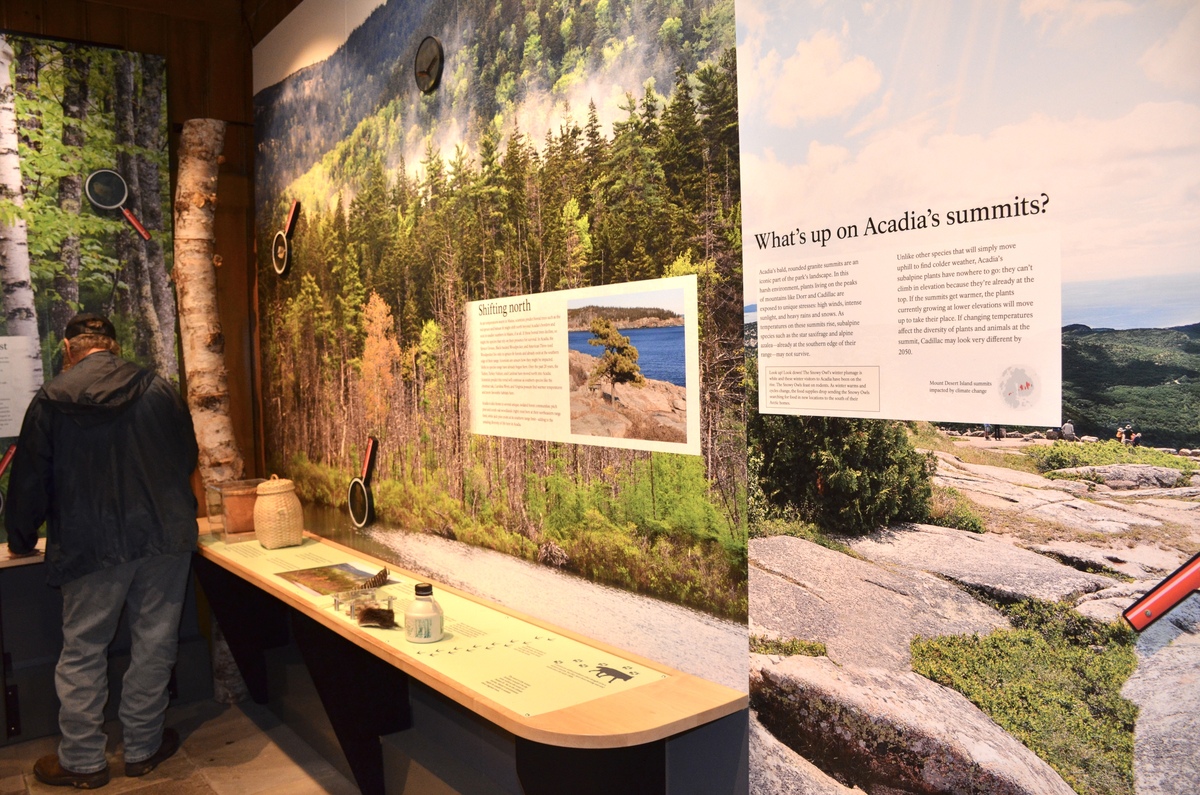
After a federal judge late last week ordered the Trump administration to restore signage that it had removed from national parks, some messages about the impact of climate change were on display in Acadia on Monday.
But some displays that were removed last fall from public view in Acadia have yet to reappear.
A March 2025 order issued by President Donald Trump instructed the National Park Service to pull displays that could “disparage Americans past or living” and distract from the “grandeur of the American landscape.”
The order claimed that American history was being rewritten with “a distorted narrative driven by ideology rather than truth” and that a “revisionist movement” was trying to undermine the country’s achievements by “casting its founding principles and historical milestones in a negative light.”
One visitor to Acadia took issue Monday with Trump’s order and praised the judge’s decision to order the signage to be restored.
“He [Trump] is absolutely wrong, and the judge is absolutely right, we should have all the education of our history, of the indigenous people,” Sieur de Monts visitor and Minnesota resident David Metcalfe said. “Almost everything he [Trump] does is a travesty, but on this specific issue, he is absolutely wrong.”
At Acadia last year, park staffers flagged for removal a host of displays connected to climate change and indigenous history, according to an internal database that was believed to be posted online by a disgruntled park service employee.
A coalition of environmental and historical organizations sued the Trump administration in February over its attempts to “erase history and censor science” at America’s national parks, according to the lawsuit.
U.S. District Judge Angel Kelley issued a preliminary injunction on Friday in the case and ordered the removed displays to be restored by July 3.
Several displays had been removed by November 2025, including a multi-exhibit installation at the Sieur de Monts Nature Center about power plant emissions that produce mercury. That exhibit has not since been restored.
However, several displays at the nature center on Monday discussed the impacts of climate change: one exhibit explored how rising sea levels and harsher storms affect offshore island habitats and another detailed how the warming of the Gulf of Maine will continue to bring severe storms to Acadia.
At least two of the current displays at the nature center — the exhibit about sea levels affecting bird habitats and another on how a warming climate impacts Maine’s boreal trees — were among the content tagged for removal, according to the leaked database.
It was not immediately clear on Monday if the nature center’s displays that mention climate change had been removed and then returned — and whether it had been in response to Friday’s ruling — or if they were new displays.
Todd Martin, a regional official with the National Parks Conservation Association, one of the plaintiffs in the lawsuit, said his group was thrilled with the ruling.
“We have decades of scientific research indicating how climate change is impacting Acadia – more intense rainfall and coastal storms, less snow, longer droughts, and rising sea levels,” Martin said. “These are scientific facts, not political statements.
Few visitors have noticed the changes since the nature center reopened for the season on Sunday. It will remain open until Oct. 17, according to the park service.
Last September, 30 cedar tri-pod signs distributed between the Great Meadow and Cadillac Mountain summit were placed in winter storage about a month before usual. The signs detailed the Cadillac mountain’s importance to the Wabanaki nations and the impacts of climate change on the Great Meadow wetland.
The tri-pod signs were not seen on the summit around midday Monday, nor were they spotted in storage at the park headquarters, where local blog Acadia National Park on My Mind previously reported they had been placed.
“Our national parks are our nation’s storytellers,” Martin said. “When visitors arrive at Acadia, they deserve accurate and uncensored information, including how climate change is impacting Acadia and the deep connection of the Wabanaki tribes to the land.”
Rob Anderson, an Ohio resident who was visiting Cadillac summit on Monday, said he agreed with the judge and thought the park shouldn’t have removed the displays.
The judge’s ruling also ordered the administration to halt any further changes at national parks and landmarks.
“This ruling is from a Biden appointed judge,” an unidentified spokesperson for the Department said in an email to the Bangor Daily News. “The Department is looking at our appeal options.”
Acadia no longer has a dedicated spokesperson, but a request for comment sent Monday morning to a general park communications email did not receive a response.